
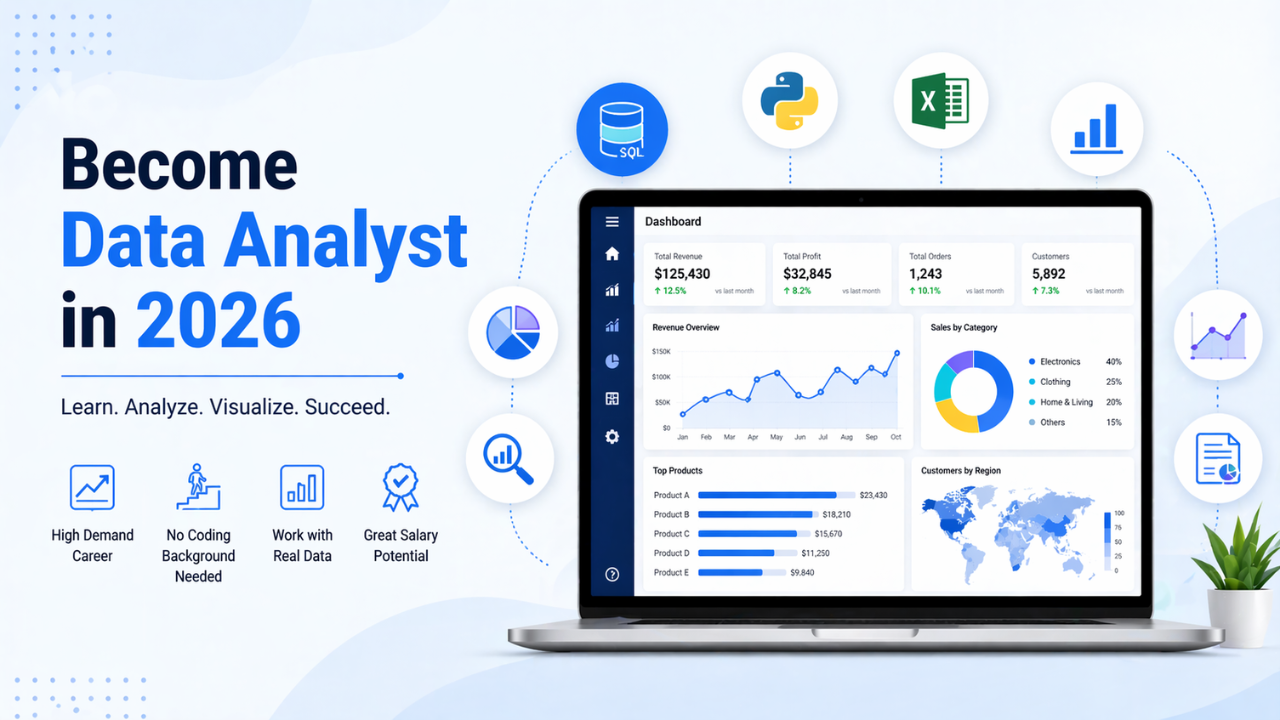
Data Analyst Roadmap for Beginners (2026 Guide for Freshers in India)
1. Why Data Analyst is a Trending Career in 2026
In 2026, data has become one of the most valuable assets for businesses. Every company—whether it’s a startup, e-commerce platform, fintech company, or large enterprise—is collecting massive amounts of data every day. This data includes customer behavior, sales trends, website activity, and business performance metrics. However, raw data alone is useless unless someone can analyze it and extract meaningful insights. This is where Data Analysts play a crucial role.
The demand for data analysts is growing rapidly in India because companies are shifting toward data-driven decision-making. Instead of relying on assumptions, businesses now depend on data to make strategic decisions. For example, companies use data to decide pricing strategies, marketing campaigns, product improvements, and customer targeting.
Another major reason for the popularity of this role is accessibility. Unlike traditional software development roles, data analytics does not require deep programming knowledge at the beginning. Freshers from different backgrounds like B.Tech, B.Com, B.Sc, and even non-technical fields are successfully entering this domain.
Key Reasons Why This Career is Trending:
- High demand across multiple industries
- Relatively easier entry compared to other tech roles
- Strong salary growth potential
- Opportunities for remote and freelance work
If you follow a structured data analyst roadmap for beginners, you can build job-ready skills within a few months and start applying for entry-level roles.
—
2. What Does a Data Analyst Actually Do?
A Data Analyst’s primary responsibility is to convert raw data into meaningful insights that help businesses make better decisions. While the term may sound technical, the actual work involves logical thinking, pattern recognition, and problem-solving.
On a daily basis, data analysts work with different types of data such as sales data, customer data, website traffic data, and operational data. Their job is to clean this data, analyze it, and present it in a simple and understandable format.
Daily Responsibilities Explained
- Data Collection: Gathering data from databases, Excel files, APIs, or internal systems
- Data Cleaning: Removing errors, duplicates, and missing values
- Data Analysis: Finding trends, patterns, and correlations
- Data Visualization: Creating charts, dashboards, and reports
- Communication: Explaining insights to non-technical stakeholders
Real-Life Example:
Suppose a food delivery company notices a decline in orders. A data analyst will analyze order data, delivery time, customer ratings, and pricing. They may discover that delivery delays are causing fewer repeat orders. Based on this insight, the company can improve logistics and regain customers.
This shows that data analysts are not just working with numbers—they are solving real business problems.
—
3. Why Data Analytics is a High-Demand, High-Salary Career in India
India’s digital transformation has created a massive demand for data professionals. With the rise of online platforms, mobile apps, and digital payments, companies are generating huge volumes of data. To make sense of this data, organizations need skilled data analysts.
Industries like e-commerce, banking, healthcare, and IT services are actively hiring data analysts. Even small startups are investing in data analytics to gain a competitive advantage.
Why Demand is Increasing:
- Businesses want data-driven decision-making
- Growth of artificial intelligence and machine learning
- Increased competition among companies
Salary Insights (India 2026):
- Freshers: ₹3L – ₹6L per annum
- 1–3 years experience: ₹6L – ₹10L
- 5+ years experience: ₹12L – ₹25L+
Another important advantage is career growth. A data analyst can transition into roles like Data Scientist, Business Analyst, or Analytics Manager. This makes it a long-term and scalable career option.
This is why searches like data analyst salary India 2026 and how to become data analyst in India are increasing rapidly.
—
4. Skills Required to Become a Data Analyst
To become a successful data analyst, you need a combination of technical and non-technical skills. Many beginners focus only on tools, but companies look for problem-solving ability along with technical knowledge.
Technical Skills
- Excel: Basic formulas, pivot tables, dashboards
- SQL: Writing queries to extract data from databases
- Python: Data analysis using Pandas and NumPy
- Visualization Tools: Power BI or Tableau
Non-Technical Skills
- Analytical Thinking: Ability to understand data patterns
- Communication: Explaining insights clearly
- Problem-Solving: Finding solutions using data
- Attention to Detail: Ensuring accuracy
Important Insight:
Many freshers think coding is everything, but in reality, companies prefer candidates who can interpret data and communicate insights effectively.
—
5. Step-by-Step Roadmap to Become a Data Analyst
If you are starting from scratch, following a structured roadmap is essential. Instead of learning random tools, you should follow a step-by-step approach.
Step 1: Learn Excel
Excel is the foundation of data analysis. Start with basic formulas, then move to pivot tables and dashboards.
Step 2: Learn SQL
SQL is used to extract data from databases. Focus on SELECT, JOIN, GROUP BY, and filtering queries.
Step 3: Learn Python
Python helps in advanced analysis. Learn Pandas for data manipulation.
Step 4: Learn Visualization Tools
Use Power BI or Tableau to create dashboards and present insights visually.
Step 5: Build Projects
Apply your knowledge to real-world datasets like sales data or customer data.
Following this roadmap will help you learn data analytics step by step without confusion.
—
6. Best Tools to Learn
Choosing the right tools is important for beginners. You don’t need to learn everything at once. Focus on tools that are widely used in the industry.
- Excel: Best for beginners and quick analysis
- SQL: Essential for handling large datasets
- Python: Advanced data processing
- Power BI: Easy-to-use visualization tool
- Tableau: Industry-standard dashboard tool
Start with Excel and SQL, then gradually move to Python and visualization tools.
—
7. Best Free and Paid Courses
Learning from structured courses can accelerate your journey. Many platforms offer beginner-friendly and advanced data analytics courses.
- Coursera – Google Data Analytics Certificate
- Udemy – Budget-friendly beginner courses
- upGrad – Career-focused programs
- Scaler – Intensive learning paths
Free resources like YouTube and Kaggle are also helpful for practice.
—
Best Certifications to Boost Your Data Analyst Career
Certifications can strengthen your resume and increase your chances of getting shortlisted.
- Google Data Analytics Certification
- Microsoft Power BI Certification
- IBM Data Analyst Certification
While certifications are not mandatory, they help validate your skills.
—
8. How to Build a Strong Portfolio
A strong portfolio is one of the most important factors for freshers. Since you don’t have work experience, your projects act as proof of your skills.
Project Ideas:
- Sales dashboard analysis
- Netflix dataset insights
- COVID-19 data trends
Use GitHub and a portfolio website to showcase your work professionally.
—
9. Resume Tips for Data Analyst Freshers
Your resume should highlight your skills and projects clearly.
- Write a short summary
- Add technical skills
- Highlight projects
- Include education
Pro Tip: Recruiters focus more on projects than academic marks.
—
10. How to Apply for Data Analyst Jobs
Applying strategically is important. Do not rely only on job portals.
- Apply on job portals
- Use LinkedIn networking
- Send cold emails to recruiters
CTA: Apply for Data Analyst Jobs consistently.
—
11. Interview Preparation
Interviews test both your technical and communication skills.
- Explain your projects clearly
- Practice SQL queries
- Understand basic concepts
Confidence and clarity are key to success.
—
12. Salary Insights for Data Analysts in India (2026)
The data analyst salary India 2026 shows strong growth potential.
- Fresher: ₹3L–₹6L
- Mid-level: ₹8L+
- Senior: ₹15L+
With experience, salaries increase significantly.
—
13. Common Mistakes Beginners Should Avoid
- Trying to learn everything at once
- Ignoring projects
- Not practicing SQL
- Copying resumes
Focus on consistency and practical learning.
—
14. FAQs
Can non-tech students become data analysts?
Yes, with proper skills.
Is coding required?
Basic Python is enough.
How long does it take?
3–6 months.
Is certification necessary?
Optional but helpful.
Which tool should I start with?
Excel.
Can I get a job without experience?
Yes, with strong projects.
—
15. Conclusion + 3–6 Month Action Plan
Becoming a data analyst is achievable if you follow a structured plan.
Month 1–2
- Learn Excel and SQL
Month 3–4
- Learn Python and visualization tools
Month 5–6
- Build projects and apply for jobs
Final CTA: Start learning today and stay consistent.