
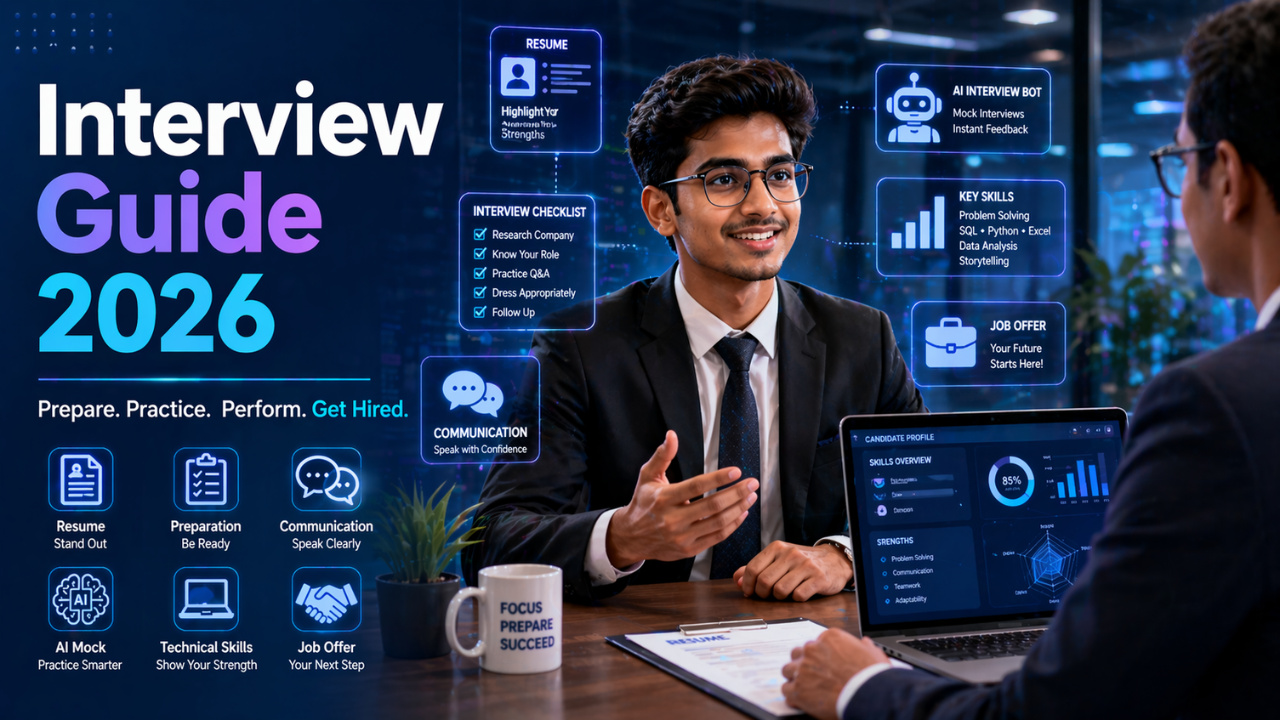
Complete Interview Guide for Freshers in 2026 (Crack Any Job Interview)
1. Why Freshers Fail in Interviews (Reality Check)
Many freshers believe that having a degree or basic knowledge is enough to crack interviews. But in reality, most candidates fail not because they lack skills, but because they are unprepared for how interviews actually work. Interviews are not just about answering questions—they are about communication, clarity, confidence, and problem-solving ability.
One of the biggest mistakes freshers make is relying only on theoretical knowledge. They memorize answers instead of understanding concepts. When interviewers ask follow-up questions, they struggle to explain properly. Another major issue is lack of preparation—many candidates apply to jobs without researching the company or role.
Common Reasons Freshers Fail:
- Lack of clarity while explaining projects
- Poor communication skills
- No real interview practice
- Fear and nervousness
- Not understanding job requirements
For example, a candidate may know SQL but fails to explain how they used it in a project. Recruiters are not looking for textbook answers—they want practical understanding.
If you want to succeed, you must shift your mindset. Focus on preparation, practice, and real-world application. Following proper interview tips for freshers can significantly improve your chances of success.
2. Types of Interviews in 2026 (With 30 Questions & Answers)
In 2026, interviews have evolved beyond traditional face-to-face rounds. Companies now use multiple formats including AI-based interviews, video interviews, and structured assessments. Understanding these formats helps you prepare effectively.
Types of Interviews
- HR Interview: Focus on personality and communication
- Technical Interview: Skill-based questions
- AI-Based Interview: Automated evaluation using tools
- Video Interview: Remote interviews via Zoom/Meet
Common Interview Questions and Answers (Detailed for Freshers)
1. Tell me about yourself
I am a recent graduate with a strong interest in [your field]. During my academic journey, I focused on building practical skills and completed projects related to [mention skills/projects]. I enjoy solving real-world problems and continuously learning new technologies. I am a quick learner and adaptable to new environments. I am now looking for an opportunity where I can apply my skills, gain industry experience, and contribute to the organization’s growth.
2. Why should we hire you?
I believe I am a good fit for this role because I have the required foundational skills and a strong willingness to learn. As a fresher, I bring fresh ideas, energy, and dedication to work. I am quick to adapt to new tools and technologies. I also focus on completing tasks efficiently and learning from feedback. I am confident that I can contribute positively to your team and grow along with the company.
3. What are your strengths?
My key strengths include problem-solving, quick learning, and attention to detail. I can understand new concepts quickly and apply them in practical situations. I am also consistent in my work and ensure that tasks are completed on time. Additionally, I have good communication skills, which help me explain ideas clearly. These strengths help me perform effectively in both individual and team environments.
4. What are your weaknesses?
One of my weaknesses was overthinking before making decisions, which sometimes slowed me down. However, I have been actively working on this by improving my time management and decision-making skills. I now focus on analyzing situations quickly and taking action confidently. I believe recognizing weaknesses and working on them is important for personal growth. I am continuously improving myself in this area.
5. Why do you want to work in this company?
I am impressed by your company’s work culture, innovation, and growth in the industry. I researched your recent projects and found them aligned with my interests and skills. I believe this organization provides a great learning environment for freshers. I am excited about the opportunity to contribute and grow here. Working in your company will help me gain valuable experience and build my career.
6. Explain your project
In my project, I worked on [project name], where the main goal was to solve [problem]. I used technologies like [tools/skills] to build the solution. My role involved designing, implementing, and testing the system. The outcome of the project was [result or impact]. This project helped me understand real-world challenges and improved my technical and problem-solving skills.
7. What are your career goals?
My short-term goal is to gain strong practical experience and improve my technical and professional skills. I want to work in a challenging environment where I can learn and grow. In the long term, I aim to take on more responsibilities and contribute to impactful projects. I also want to continuously upgrade my skills to stay relevant in the industry. My goal is to grow along with the organization.
8. Are you willing to relocate?
Yes, I am open to relocation as I see it as an opportunity to explore new environments and gain experience. I understand that relocating can help me learn and adapt quickly. I am flexible and willing to move based on job requirements. My focus is on gaining experience and contributing to the organization. So relocation is not a problem for me.
9. What motivates you?
I am motivated by learning new things and solving challenging problems. Achieving goals and improving my skills gives me satisfaction. I also feel motivated when I contribute meaningfully to a team or project. Continuous growth and self-improvement drive me forward. I believe staying motivated helps me stay consistent and productive.
10. Describe a challenge you faced
During one of my projects, I faced a challenge related to [problem]. Initially, I was unsure how to solve it, but I researched different approaches and tried multiple solutions. After testing and debugging, I was able to resolve the issue successfully. This experience improved my problem-solving skills and patience. It also taught me the importance of persistence and continuous learning.
11. What do you know about our company?
Your company operates in [industry] and is known for its innovation and strong market presence. I also learned about your recent projects and achievements, which are impressive. Your focus on growth and customer satisfaction stands out. I believe this company provides a great environment for learning and development. That is why I am interested in joining your team.
12. Why did you choose your field?
I chose this field because I have a strong interest in it and enjoy working on related problems. During my studies, I developed a passion for learning and applying these concepts. I also explored projects and practical applications, which increased my interest further. This field offers continuous learning and growth opportunities. That is why I decided to build my career in this domain.
13. How do you handle pressure?
I handle pressure by staying calm and focusing on priorities. I break tasks into smaller parts and manage my time effectively. This helps me stay organized and complete work efficiently. I also try to maintain a positive mindset during stressful situations. This approach allows me to perform well even under pressure.
14. What is your biggest achievement?
One of my biggest achievements was completing [project/goal], which required consistent effort and problem-solving. I faced challenges during the process but stayed focused and completed it successfully. This achievement boosted my confidence and improved my skills. It also taught me the importance of dedication and persistence. I consider it a significant learning experience.
15. Do you prefer working alone or in a team?
I am comfortable working both independently and in a team environment. I can manage tasks on my own and take responsibility when required. At the same time, I enjoy collaborating with others and learning from different perspectives. Teamwork often leads to better results and faster problem-solving. I believe both approaches are important depending on the situation.
16. What are your hobbies?
My hobbies include [hobby], which helps me stay relaxed and focused. I also enjoy activities that improve my creativity and productivity. These hobbies help me maintain a balance between work and personal life. They also improve my concentration and problem-solving ability. Overall, they contribute positively to my personal development.
17. How do you manage your time?
I manage my time by planning tasks based on priority and deadlines. I break larger tasks into smaller steps to stay organized. I also avoid distractions and focus on completing one task at a time. This helps me improve efficiency and productivity. Proper time management allows me to meet deadlines without stress.
18. What is your expected salary?
As a fresher, my main focus is on learning and gaining practical experience. I am open to a salary that is aligned with industry standards and company policies. I believe gaining skills and exposure is more important at this stage. I am confident that my growth will lead to better opportunities in the future. So I am flexible regarding salary.
19. Why were you not placed earlier?
I used that time to improve my skills and work on practical projects. I focused on learning and preparing myself better for job opportunities. This phase helped me gain more clarity and confidence. I now feel more prepared and job-ready. I see it as a learning period rather than a setback.
20. Are you comfortable with deadlines?
Yes, I understand the importance of deadlines in a professional environment. I plan my work effectively to ensure timely completion. I also stay focused and avoid distractions to meet deadlines. Working under deadlines helps me improve my efficiency. I am comfortable managing time and delivering results.
3. Step-by-Step Preparation Strategy Before Interview
Preparation is the most important factor in cracking interviews. Instead of last-minute study, you should follow a structured approach.
- Understand job description clearly
- Prepare answers for common questions
- Revise core concepts
- Practice mock interviews
A good strategy is to prepare 2–3 strong examples for each type of question. For example, prepare one project explanation, one challenge story, and one achievement story.
Consistent preparation helps you crack interview in first attempt.
4. How to Research a Company Properly Before an Interview
Many freshers underestimate the importance of company research, but it plays a crucial role in interview success. Recruiters often ask questions like “What do you know about our company?” not just to test your knowledge, but to evaluate your interest and seriousness about the role. If you give a generic or unclear answer, it shows a lack of preparation.
Proper research helps you align your answers with the company’s goals, understand their expectations, and stand out from other candidates. It also gives you confidence during the interview because you are aware of what the company does and how you can contribute.
Check the Company Website
Start with the official website of the company. Focus on sections like “About Us,” “Services,” “Careers,” and “Mission & Vision.” This helps you understand what the company does, its values, and its target audience. Pay attention to how the company presents itself because this reflects its culture and priorities.
Understand Products and Services
You should clearly know what products or services the company offers. For example, if you are applying to a fintech company, understand whether they provide payment solutions, loans, or digital banking services. This helps you relate your skills to their business needs during the interview.
Learn About Company Culture
Understanding company culture is equally important. Check employee reviews on platforms, career pages, and social media posts. Look for insights about work environment, values, and growth opportunities. This helps you answer questions like “Why do you want to join our company?” more effectively.
Check Recent News and Updates
Always check the latest news about the company, such as new product launches, funding, partnerships, or achievements. Mentioning recent updates during the interview shows that you have done genuine research and are up-to-date with the company’s progress.
Example
If you are applying for a role in a fintech company, you can say: “I understand your company focuses on digital payment solutions and recently expanded into lending services. I am interested in how you are improving financial accessibility.” This kind of answer creates a strong impression.
5. Resume-Based Interview Preparation
Your resume is the most important document in your interview process because it is the first thing recruiters see. Almost every question in the interview will be directly or indirectly based on your resume. Many freshers make the mistake of adding skills or projects they cannot explain properly, which leads to rejection.
To prepare effectively, you must treat your resume as your story. Every line you write should be something you can confidently explain with examples and clarity.
Explain Every Project Clearly
You should be able to explain each project in detail, including the problem you solved, the tools you used, your role, and the outcome. Avoid giving vague explanations. Instead, structure your answer clearly. For example: what was the goal, how did you approach it, and what result did you achieve.
Know Your Skills Deeply
If you mention skills like Python, SQL, or Excel, be prepared for in-depth questions. Recruiters may ask you to explain concepts, write logic, or describe how you used these skills in your projects. It is better to list fewer skills with strong understanding than many skills with weak knowledge.
Prepare for Follow-Up Questions
Interviewers often ask follow-up questions based on your answers. For example, if you say you used Python, they may ask which libraries you used or why you chose a particular approach. You should be ready to explain your decisions and reasoning clearly.
Example
If you mention a “Python project,” don’t just say you built it. Explain: “I developed a project using Python where I used libraries like Pandas for data analysis. I cleaned the dataset, performed analysis, and created insights that helped understand trends.” This level of clarity shows confidence and real knowledge.
Proper resume-based preparation ensures that you can confidently answer questions and handle any discussion during the interview without hesitation.
6. Most Common HR Questions with Answers (Top 10)
HR interview rounds focus on your personality, communication skills, and mindset. Recruiters are not just checking your answers—they are evaluating your attitude, clarity, and how well you fit into the company culture. Preparing these questions properly can significantly increase your chances of selection.
1. Tell me about yourself
I am a recent graduate with a strong interest in [your field]. During my studies, I worked on projects related to [skills], which helped me gain practical experience. I enjoy learning new technologies and improving my skills continuously. I am a quick learner and adaptable to new environments. I am looking for an opportunity where I can contribute and grow professionally.
2. Why should we hire you?
I have the required foundational skills and a strong willingness to learn. As a fresher, I bring fresh ideas, energy, and dedication to work. I am quick to adapt to new tools and processes. I focus on delivering quality work and improving continuously. I am confident that I can contribute positively to your team.
3. What are your strengths?
My strengths include problem-solving, quick learning, and consistency. I can understand concepts quickly and apply them practically. I also focus on completing tasks on time with accuracy. Additionally, I communicate clearly and work well in teams. These strengths help me perform efficiently in different situations.
4. What are your weaknesses?
Earlier, I used to spend too much time perfecting tasks, which affected my speed. However, I have improved by focusing on prioritization and time management. I now balance quality with efficiency. I believe identifying weaknesses and working on them is important. I continuously try to improve myself.
5. Why do you want to join our company?
I am impressed by your company’s innovation and growth in the industry. I researched your products and recent achievements, which align with my interests. I believe this organization provides a strong learning environment. I want to build my career in a company that values growth and development. That is why I am interested in this opportunity.
6. Where do you see yourself in 5 years?
In the next five years, I see myself growing into a skilled professional in my field. I want to take on more responsibilities and contribute to impactful projects. I aim to continuously upgrade my skills and knowledge. I also want to become a reliable member of the team. My goal is to grow along with the organization.
7. Are you a team player?
Yes, I am a strong team player who values collaboration and communication. I enjoy working with others and learning from different perspectives. During my projects, I contributed actively and supported team members. I believe teamwork leads to better results. I am comfortable both leading and supporting when required.
8. How do you handle pressure?
I handle pressure by staying calm and focusing on priorities. I break tasks into smaller steps and manage time effectively. This helps me stay organized and productive. I also maintain a positive mindset in stressful situations. This approach allows me to perform well under pressure.
9. What motivates you?
I am motivated by learning new skills and solving challenging problems. Achieving goals and improving myself gives me satisfaction. I also feel motivated when I contribute to a team’s success. Continuous growth and development drive me forward. I always try to stay focused and consistent.
10. Do you have any questions for us?
Yes, I would like to know more about the team I will be working with and the responsibilities of this role. I am also interested in understanding the growth opportunities and learning programs available. Additionally, I would like to know how performance is evaluated. This helps me understand how I can contribute effectively.
Also:
7. Technical Interview Preparation (Top 10 Questions with Answers)
Technical interviews test your practical knowledge, problem-solving ability, and understanding of concepts. The preparation depends on your role. IT roles focus on coding, SQL, and data structures, while non-IT roles focus on Excel, business concepts, and logical reasoning.
1. What is a database?
A database is a structured collection of data that is stored and managed electronically. It allows users to store, retrieve, and update information efficiently. Databases are used in almost every application today. They help in organizing large amounts of data. Common examples include MySQL and PostgreSQL.
2. What is SQL JOIN?
SQL JOIN is used to combine data from two or more tables based on a related column. It helps in retrieving meaningful information from multiple datasets. Common types include INNER JOIN, LEFT JOIN, and RIGHT JOIN. It is an essential concept in database management. It is widely used in real-world applications.
3. What is Python used for?
Python is a versatile programming language used for data analysis, automation, web development, and machine learning. It is beginner-friendly and widely used in the industry. Libraries like Pandas and NumPy are used for data analysis. Python helps in solving complex problems efficiently. It is one of the most popular languages today.
4. What is data cleaning?
Data cleaning is the process of removing errors, duplicates, and inconsistencies from data. It ensures that the data is accurate and reliable for analysis. This step is important before performing any analysis. Clean data leads to better insights. It is a key responsibility of data analysts.
5. What is Excel used for?
Excel is used for data organization, analysis, and visualization. It allows users to perform calculations, create charts, and build dashboards. It is widely used in business and analytics roles. Features like pivot tables and formulas make it powerful. It is often the first tool beginners learn.
6. What are data structures?
Data structures are ways of organizing and storing data efficiently. Examples include arrays, lists, stacks, and queues. They help in optimizing performance and solving problems. Understanding data structures is important for coding roles. They are widely used in software development.
7. What is API?
An API (Application Programming Interface) allows different software systems to communicate with each other. It enables data exchange between applications. APIs are widely used in web and mobile applications. They simplify integration between systems. It is an important concept in modern development.
8. What is a function in programming?
A function is a block of code designed to perform a specific task. It helps in reusability and better organization of code. Functions make programs more readable and efficient. They can take inputs and return outputs. They are a fundamental concept in programming.
9. What is debugging?
Debugging is the process of identifying and fixing errors in a program. It helps improve the performance and accuracy of code. Developers use debugging tools to find issues. It is an important skill for programmers. It ensures that the program runs correctly.
10. What is data visualization?
Data visualization is the representation of data using charts, graphs, and dashboards. It helps in understanding complex data easily. Tools like Power BI and Tableau are commonly used. Visualization makes insights more clear and actionable. It is an important part of data analysis.
8. Behavioral Interview Questions (STAR Method – Top 10)
Behavioral interviews focus on how you handled situations in the past. The STAR method helps structure your answers effectively:
- Situation: Describe the context
- Task: Explain your responsibility
- Action: What you did
- Result: Outcome achieved
1. Describe a challenging situation
In my project, we faced a delay due to technical issues (Situation). I was responsible for resolving it (Task). I researched solutions and implemented fixes (Action). Finally, we completed the project successfully (Result). This improved my problem-solving skills.
2. Tell me about a time you worked in a team
During a group project, we had to complete tasks under a deadline (Situation). My role was to manage part of the project (Task). I collaborated and communicated with my team (Action). We completed the project successfully (Result).
3. Describe a failure
I once failed to complete a task on time (Situation). It was my responsibility (Task). I analyzed my mistakes and improved planning (Action). Later, I managed tasks more effectively (Result).
4. Tell me about a time you showed leadership
In a project, I took initiative to organize tasks (Situation). I guided the team (Task). I ensured proper coordination (Action). We completed the project efficiently (Result).
5. Describe a time you solved a problem
I faced a technical issue in my project (Situation). I needed to fix it (Task). I researched and applied solutions (Action). The issue was resolved successfully (Result).
6. Tell me about a time you handled pressure
I had multiple deadlines during exams (Situation). I needed to manage time (Task). I planned tasks effectively (Action). I completed everything successfully (Result).
7. Describe a time you learned something new
I learned a new tool for my project (Situation). I needed to apply it (Task). I practiced and implemented it (Action). It improved my project outcome (Result).
8. Tell me about a conflict you handled
There was a disagreement in my team (Situation). I helped resolve it (Task). I communicated and found a solution (Action). The team worked smoothly again (Result).
9. Describe a time you met a deadline
I had a tight project deadline (Situation). I needed to complete it (Task). I managed time effectively (Action). I delivered it on time (Result).
10. Tell me about an achievement
I completed a challenging project (Situation). It required consistent effort (Task). I worked hard and solved problems (Action). It was completed successfully (Result).
9. How to Answer “Tell Me About Yourself” (Best Strategy + Sample Answer)
“Tell me about yourself” is usually the first question in any interview, and it sets the tone for the entire conversation. Many freshers make the mistake of giving long, unfocused answers or simply repeating their resume. However, this question is your opportunity to create a strong first impression and confidently present your story.
The key is to structure your answer in a clear and logical way so that the interviewer understands who you are, what you bring, and what you are looking for.
Introduction
Start with a short introduction about your educational background and your area of interest. Keep it professional and relevant to the job role. Avoid unnecessary personal details. Focus on what defines you as a candidate.
Skills
Next, highlight your key skills that are relevant to the job. Mention both technical and non-technical skills. This helps the interviewer understand your strengths quickly. Always connect your skills to real applications.
Projects / Practical Experience
Since you are a fresher, your projects are your biggest strength. Briefly explain 1–2 important projects and what you learned from them. Focus on your role, tools used, and the outcome. This shows practical knowledge and problem-solving ability.
Career Goals
End your answer by explaining your career goals. Show that you are eager to learn, grow, and contribute to the company. Keep it realistic and aligned with the role you are applying for.
Impressive Sample Answer (Freshers)
I am a recent graduate in Computer Science with a strong interest in data analytics and problem-solving. During my academic journey, I developed skills in Excel, SQL, and Python, and applied them in projects like analyzing sales data and building dashboards. One of my key projects involved using Python and Pandas to clean and analyze datasets, which helped me understand real-world data challenges. I am a quick learner and enjoy continuously improving my skills. I am now looking for an opportunity where I can apply my knowledge, gain industry experience, and contribute effectively to the organization.
Pro Tips to Make Your Answer Stand Out
- Keep your answer within 45–60 seconds
- Do not memorize—practice and speak naturally
- Customize your answer based on the job role
- Maintain confidence and good body language
- Focus on value, not just background
A well-structured answer to this question can immediately create a positive impression and increase your chances of moving forward in the interview process.
10. Common Mistakes Freshers Make in Interviews
Many freshers fail in interviews not because they lack knowledge, but because they make avoidable mistakes. Understanding these mistakes can help you prepare better and improve your chances of success. Interviews are not just about what you know, but how you present yourself.
Memorizing Answers
One of the biggest mistakes is memorizing answers word-to-word. This makes your responses sound robotic and unnatural. Interviewers can easily identify when a candidate is reciting prepared answers without understanding. Instead, focus on understanding the concept and expressing it in your own words. This shows confidence and clarity.
Lack of Practice
Many candidates prepare theoretically but do not practice speaking. This leads to hesitation during the actual interview. Practicing mock interviews helps you improve your confidence, communication, and thinking ability. The more you practice, the more comfortable you become in answering questions naturally.
Poor Communication Skills
Even if you have strong knowledge, poor communication can affect your performance. Speaking too fast, unclear explanations, or lack of structure in answers can confuse the interviewer. Focus on speaking clearly, using simple language, and organizing your thoughts before answering.
Other Common Mistakes
- Not researching the company
- Giving long, irrelevant answers
- Lack of confidence or eye contact
- Not asking questions at the end
Avoiding these mistakes can significantly improve your interview performance and help you stand out among other candidates.
11. How to Use AI Tools for Interview Preparation
In 2026, AI tools have become powerful assistants for interview preparation. Freshers can use these tools to practice, improve answers, and refine their resumes. Using AI smartly can give you an edge over other candidates.
Mock Interviews
AI-powered mock interview platforms simulate real interview scenarios. They ask questions and provide feedback on your answers, confidence, and communication. Practicing with these tools helps reduce fear and improves your performance in actual interviews.
Answer Generation
AI tools can help you generate structured answers for common interview questions. However, you should not copy them directly. Instead, use them as a reference and customize answers based on your experience and skills. This ensures authenticity and relevance.
Resume Improvement
AI can analyze your resume and suggest improvements such as better formatting, keywords, and clarity. This helps make your resume ATS-friendly and increases your chances of getting shortlisted.
Pro Tip
Use AI as a support tool, not a replacement for your thinking. Always review and personalize the output. Combining AI tools with your effort will give the best results.
12. Body Language and Communication Tips
Your body language and communication skills play a major role in interviews. Even if you have the right answers, poor presentation can create a negative impression. Recruiters observe how you speak, sit, and respond.
Maintain Eye Contact
Maintaining eye contact shows confidence and honesty. It helps build a connection with the interviewer. Avoid looking down or away frequently, as it may indicate nervousness.
Speak Clearly
Speak in a calm and clear manner. Avoid speaking too fast or too slowly. Use simple language and structure your answers properly. Clear communication helps the interviewer understand your thoughts easily.
Stay Confident
Confidence does not mean being overconfident. It means believing in your abilities and presenting yourself calmly. Sit straight, maintain good posture, and avoid unnecessary movements.
Additional Tips
- Smile naturally
- Use hand gestures moderately
- Listen carefully before answering
- Avoid interrupting the interviewer
Good communication and body language can significantly improve your overall interview performance.
13. Virtual Interview Tips (Zoom / Google Meet)
Virtual interviews have become very common in 2026. While they may seem easier, they require proper preparation to avoid technical and presentation issues.
Check Internet Connection
Ensure you have a stable internet connection before the interview. Test your audio and video in advance. Keep a backup internet option if possible to avoid interruptions.
Maintain Proper Background
Choose a clean and quiet background. Avoid distractions such as noise or clutter. A simple and professional background creates a good impression.
Dress Professionally
Even though the interview is online, dressing formally is important. It shows professionalism and seriousness about the opportunity.
Additional Tips
- Keep your camera at eye level
- Look into the camera while speaking
- Mute notifications
- Join the meeting 5–10 minutes early
Proper preparation ensures a smooth and professional virtual interview experience.
14. Salary Negotiation Basics for Freshers
Many freshers feel uncomfortable discussing salary, but it is an important part of the hiring process. Negotiation should be done professionally and realistically.
Research Market Salary
Before attending interviews, research the average salary for your role in India. This helps you understand industry standards and set realistic expectations.
Be Flexible
As a fresher, your primary goal should be learning and gaining experience. Be open to reasonable offers that align with your growth opportunities.
Communicate Professionally
When asked about salary expectations, respond politely and confidently. Avoid demanding unrealistic numbers. Instead, show flexibility and interest in the role.
Example Answer
“As a fresher, my priority is to gain experience and learn. I am open to a salary that aligns with company standards and role responsibilities.”
A balanced approach helps you create a positive impression during negotiation.
Top Skills Recruiters Look For in Freshers
Recruiters look for a combination of technical and soft skills in freshers. Even if you lack experience, having the right skills can increase your chances of selection.
Communication Skills
The ability to express ideas clearly is one of the most important skills. Good communication helps in teamwork and problem-solving.
Problem-Solving Ability
Companies prefer candidates who can think logically and solve problems efficiently. This skill is important in both technical and non-technical roles.
Adaptability
The ability to learn and adapt quickly is crucial in a fast-changing work environment. Recruiters value candidates who are open to learning new skills.
Other Important Skills
- Time management
- Teamwork
- Critical thinking
- Positive attitude
Developing these skills will make you more job-ready and improve your interview performance.
Best Courses to Improve Interview Skills
Improving interview skills requires practice and guidance. Several courses and platforms can help freshers prepare effectively.
Communication Courses
These courses help improve speaking skills, confidence, and clarity. They are especially useful for candidates who struggle with communication.
Mock Interview Platforms
These platforms simulate real interviews and provide feedback. Practicing regularly helps you improve your answers and reduce nervousness.
Career Development Programs
These programs focus on resume building, interview preparation, and professional skills. They provide structured learning and guidance.
Pro Tip
Choose courses that include practical exercises and real-world scenarios. Learning by doing is more effective than theoretical learning.
Investing time in improving your interview skills can significantly increase your chances of getting selected.
15. FAQs
How to crack interview easily?
Practice and preparation.
Is coding required?
Depends on role.
How to reduce fear?
Mock interviews.
How many rounds?
Usually 2–4.
What to wear?
Formal dress.
Can freshers get job easily?
Yes with preparation.
16. Conclusion + Action Plan
Week 1–2
- Prepare basics
Week 3–4
- Practice interviews
Week 5+
- Apply jobs