
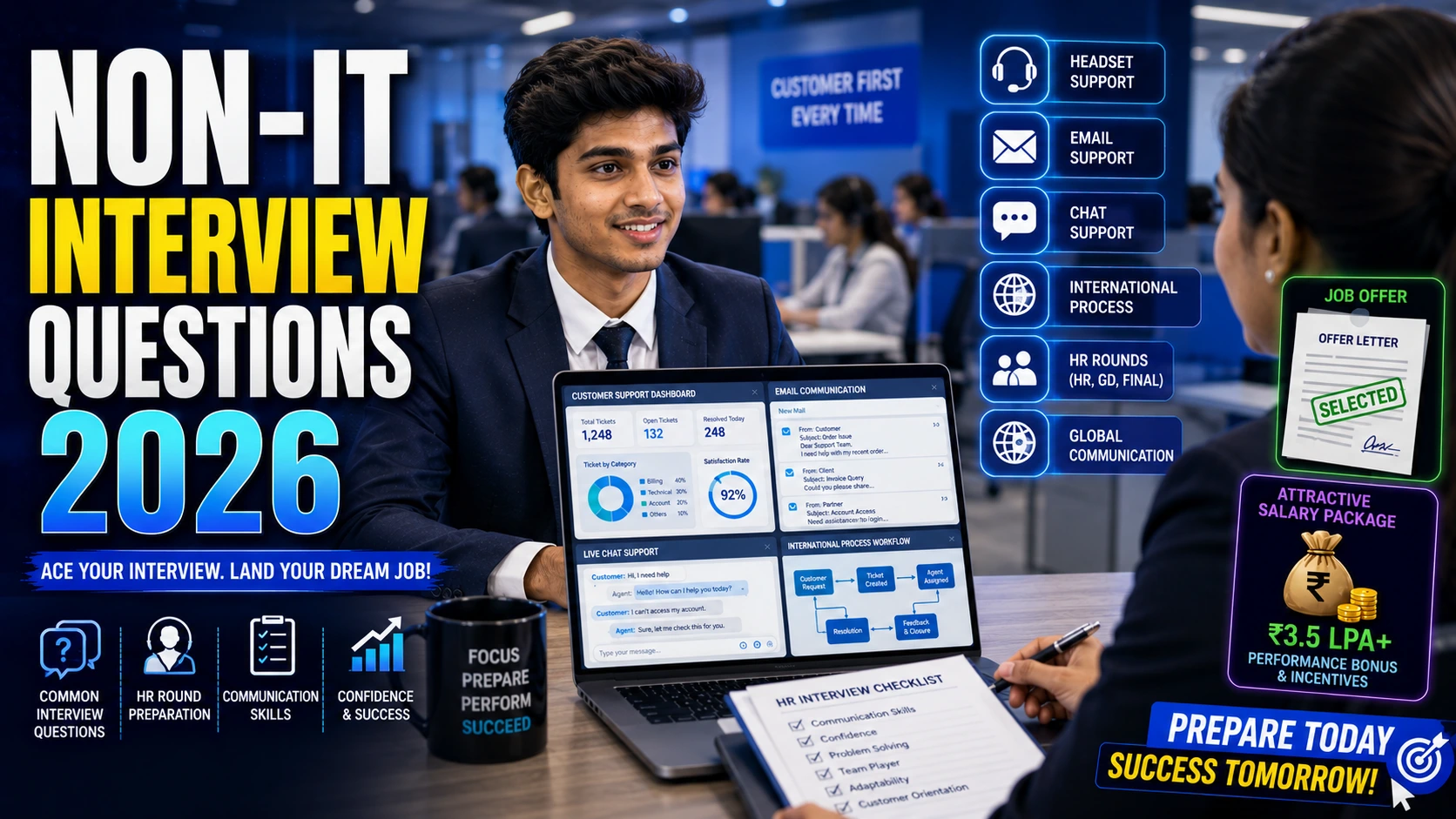
Top Non-IT Interview Questions and Answers for Freshers | Non Voice, International Process, HR Round Complete Guide
Non-IT jobs continue to offer excellent career opportunities for freshers, graduates, and job seekers who want stable employment, communication-based roles, operations exposure, and faster hiring opportunities. Companies across BPO, KPO, banking operations, international process, chat support, back office, email support, customer operations, healthcare process, and shared services regularly hire freshers.
Many candidates assume these interviews are easy and attend without preparation. That is one of the biggest reasons for rejection. Even non-IT interviews evaluate communication, attitude, problem-solving, pressure handling, customer understanding, typing skills, professionalism, and role awareness.
This complete interview guide covers real interview questions and strong sample answers for non-IT roles including non voice process, international non voice, customer support, HR round, chat support, email support, and operations jobs.
Sales Officer Interview Questions and Answers for Freshers
What Are Non-IT Jobs for Freshers?
Non-IT jobs are roles that do not require software development, coding, or technical programming expertise. These roles focus more on communication, customer support, business operations, documentation, coordination, sales support, banking processes, claims handling, and service delivery.
Popular non-IT fresher job roles include:
- Non Voice Process Executive
- International Non Voice Associate
- Chat Support Executive
- Email Support Executive
- Back Office Executive
- Data Entry Associate
- Customer Support Executive
- Banking Operations Associate
- Claims Processing Executive
- Process Associate
- Healthcare BPO Associate
- AR Caller
- Order Management Executive
- Operations Executive
These jobs are excellent entry points for freshers because many companies provide training after selection.
Top OOP Interview Questions and Answers for Freshers
Top Associate Software Engineer Interview Questions and Answers for Freshers
Skills Recruiters Look for in Non-IT Jobs
Even if technical skills are not required, recruiters still assess important professional skills.
- Communication skills
- Typing speed and accuracy
- Email writing skills
- Problem-solving mindset
- Customer handling ability
- Professional behavior
- Time management
- Team collaboration
- Adaptability
- Stress handling
- Attention to detail
- Shift flexibility
International process roles additionally require stronger written English and professional communication.
Non Voice Process Interview Questions and Answers
Non voice process roles involve handling customer requests through chat, email, backend systems, order processing, documentation, ticket resolution, or operations support without direct voice calling.
1. Tell Me About Yourself
Best Interview Answer:
My name is [Your Name], and I recently completed my graduation in [Degree/Stream]. I am a motivated fresher looking to begin my professional career in a structured organization where I can learn and grow. I have strong communication skills, good typing ability, and I am comfortable working with computers, email communication, and process-based tasks. During my academic journey, I developed discipline, teamwork, and problem-solving skills. I am particularly interested in non voice roles because they match my strengths in written communication, attention to detail, and customer handling.
Interview Tip:
Keep this answer confident, clean, and around 60–90 seconds.
2. What Do You Understand About a Non Voice Process Role?
Best Interview Answer:
A non voice process role mainly involves assisting customers or supporting business operations without direct voice calling. Communication usually happens through chat, email, ticketing systems, backend processing, or documentation work. Responsibilities may include resolving customer issues, updating records, processing requests, handling order management, responding professionally through written channels, and maintaining accuracy. This role requires patience, typing skills, written communication, and attention to detail.
Example:
If a customer raises a refund request through chat or email, the executive verifies details, processes the request, updates systems, and sends professional responses.
3. Why Do You Want to Work in a Non Voice Process Job?
Best Interview Answer:
I want to work in a non voice process role because it aligns with my strengths in written communication, problem-solving, and process-oriented work. I enjoy structured tasks that require focus, accuracy, and customer support through digital communication. This role also offers a strong professional foundation where I can learn business operations, communication standards, ticket handling, and process discipline. It is a good opportunity to start my career and build long-term growth.
4. Why Should We Hire You?
Best Interview Answer:
You should hire me because I am a quick learner, disciplined, and genuinely interested in this role. Even though I am a fresher, I bring strong willingness to learn, adaptability, written communication skills, and commitment to quality work. I understand that customer-facing or operations roles require professionalism, patience, and consistency. I am ready to undergo training, follow company processes, and contribute positively to team performance.
5. How Do You Handle Repetitive Work?
Best Interview Answer:
I understand that many process roles involve repetitive tasks, but I see repetition as an opportunity to improve efficiency and accuracy. I stay focused by treating each task carefully rather than mechanically. I also believe consistency is important because even small mistakes in repetitive work can affect customer experience or business operations. Maintaining discipline, concentration, and quality helps me handle repetitive tasks effectively.
Example:
Data verification, order updates, and ticket processing often involve repetition but still require high accuracy.
6. How Good Is Your Typing Speed?
Best Interview Answer:
My typing speed is reasonably good, and I am continuously improving it because I understand typing speed directly impacts productivity in non voice roles. More important than speed, I focus on typing accuracy because incorrect responses or data entry mistakes can create customer issues. I regularly practice typing and written communication to improve both speed and quality.
7. How Would You Respond to an Angry Customer in Chat Support?
Best Interview Answer:
I would remain calm, professional, and empathetic. First, I would carefully understand the customer’s issue instead of reacting emotionally. Then I would acknowledge their frustration respectfully, provide reassurance, investigate the issue, and communicate clear next steps. If escalation is needed, I would handle it professionally without making the customer feel ignored.
Example:
“I understand your concern and apologize for the inconvenience. Let me check this for you and help resolve it as quickly as possible.”
8. How Do You Handle Work Pressure?
Best Interview Answer:
I handle pressure by staying organized, prioritizing tasks, and focusing on solutions instead of stress. In process roles, deadlines, multiple tickets, or customer requests are normal, so maintaining calmness is important. I believe pressure becomes manageable when work is approached systematically and communication remains professional.
9. Are You Comfortable Working in Rotational Shifts?
Best Interview Answer:
Yes, I understand that process-based roles often require rotational shifts to support customers or business operations across different time zones. I am flexible and willing to work according to business requirements. I see adaptability as an important professional quality.
10. How Would You Handle a Situation Where You Do Not Know the Answer?
Best Interview Answer:
If I do not know the answer, I would avoid giving incorrect information. First, I would verify available resources such as process documentation, internal systems, or knowledge bases. If required, I would seek guidance from senior team members and ensure the issue is resolved accurately. Professional honesty is better than guessing.
11. What Is Customer Service?
Best Interview Answer:
Customer service means helping customers effectively by understanding their issues, providing timely assistance, maintaining professionalism, and ensuring a positive experience. Good customer service focuses on problem resolution, empathy, clarity, and trust-building.
12. How Do You Maintain Accuracy in Work?
Best Interview Answer:
I maintain accuracy by staying attentive, double-checking important details, following process guidelines carefully, and avoiding rushed assumptions. Accuracy is critical in backend operations because incorrect entries can affect customers, billing, documentation, or compliance.
13. What If You Make a Mistake at Work?
Best Interview Answer:
If I make a mistake, I would take responsibility, understand the root cause, correct it quickly if possible, and learn from it to avoid repetition. Accountability and continuous improvement are important professional habits.
14. What Is Teamwork for You?
Best Interview Answer:
Teamwork means collaborating respectfully toward shared goals while supporting others, communicating clearly, and contributing reliably. Process-based jobs depend heavily on coordination between teams, so teamwork is essential.
15. Why Do Companies Prefer Written Communication Skills in Non Voice Roles?
Best Interview Answer:
Written communication is critical because customer interactions happen through email, chat, documentation, and ticket systems. Poor writing can create misunderstandings, delays, or unprofessional customer experiences. Clear writing improves efficiency and trust.
Service Desk Interview Questions and Answers for Freshers | HCL, Cognizant, IT Support Roles
16. How Do You Prioritize Multiple Tasks in a Non Voice Process Role?
Best Interview Answer:
I prioritize tasks based on urgency, business impact, deadlines, and process priority guidelines. If multiple requests come at the same time, I first identify which tasks affect customers or operations most critically. I believe smart prioritization improves productivity and prevents delays.
Example:
If one task involves resolving a payment issue affecting a customer order and another is a low-priority documentation update, I would handle the payment issue first.
17. How Do You Stay Focused During Long Working Hours?
Best Interview Answer:
I stay focused by maintaining discipline, organizing my tasks, and keeping a positive work mindset. I understand process roles may require handling repetitive tasks or long shift hours, so consistency and concentration are important. I also believe short mental resets help maintain productivity.
18. Are You Comfortable Working with Targets or Productivity Metrics?
Best Interview Answer:
Yes, I understand that process roles often track productivity through ticket closures, response times, quality scores, or processing accuracy. I am comfortable with performance expectations because metrics help measure efficiency and improvement.
19. What If a Customer Keeps Asking the Same Question Repeatedly?
Best Interview Answer:
I would remain patient and professional. Sometimes customers may be confused, frustrated, or need additional clarification. I would explain clearly in simpler language while ensuring the customer feels supported rather than ignored.
Example:
If a customer repeatedly asks about refund timelines, I would calmly explain the process again with exact expected timelines.
20. What Makes You Suitable for Backend Operations Work?
Best Interview Answer:
I am detail-oriented, disciplined, comfortable with computer-based tasks, and willing to follow process guidelines carefully. Backend operations require consistency, accuracy, documentation handling, and focus, which align with my strengths.
International Non Voice Process Interview Questions and Answers
International non voice roles support customers, business operations, or backend workflows for overseas clients, usually requiring stronger English communication, professional writing, time-zone flexibility, and customer handling maturity.
21. What Is an International Non Voice Process?
Best Interview Answer:
An international non voice process supports customers or operations for overseas markets without direct calling communication. Work typically happens through email, live chat, ticketing systems, order processing, claims handling, or documentation workflows.
Example:
Supporting US customers through chat for e-commerce order issues or helping UK banking customers through email support.
22. Why Do You Want to Work in an International Process?
Best Interview Answer:
I want to work in an international process because it offers global exposure, professional communication development, structured career growth, and opportunities to learn international service standards. It also helps improve my confidence, adaptability, and customer handling skills.
23. Are You Comfortable Working Night Shifts?
Best Interview Answer:
Yes, I understand international processes often align with global customer time zones such as US, UK, or Australia. I am comfortable working night shifts if business requirements demand it and I understand flexibility is important for this role.
24. How Strong Is Your Written English Communication?
Best Interview Answer:
I am confident in my written English communication and continuously improving it. I understand international customer communication requires professionalism, grammar accuracy, clarity, and polite tone. I practice formal email writing and structured communication regularly.
25. How Would You Handle a Difficult International Customer?
Best Interview Answer:
I would remain calm, professional, empathetic, and solution-focused. Cultural differences or urgency may make some customers appear more demanding, but professional handling remains essential.
Example:
I would acknowledge their issue respectfully, avoid defensive communication, investigate quickly, and provide clear next steps.
26. What Is the Difference Between Domestic and International Process?
Best Interview Answer:
Domestic processes support customers within the same country, while international processes support overseas clients. International roles usually require stronger English communication, time-zone flexibility, awareness of global etiquette, and higher service professionalism.
27. How Would You Write a Professional Email to a Customer?
Best Interview Answer:
A professional email should be clear, polite, structured, and solution-oriented.
Basic format:
- Professional greeting
- Acknowledge issue
- Provide explanation or solution
- Mention next steps
- Professional closing
Example:
Hello John,
Thank you for contacting us. I understand your concern regarding your delayed order. I have checked the status, and it is expected to be delivered within 48 hours. Please let us know if you need further assistance.
Regards,
Support Team
28. What If You Do Not Understand a Customer’s Message?
Best Interview Answer:
If the message is unclear, I would avoid assumptions. I would politely request clarification to ensure accurate resolution.
Example:
“Thank you for reaching out. To assist you better, could you please provide more details regarding the issue?”
This prevents incorrect responses and improves customer satisfaction.
29. How Do You Handle Tight Response Time Expectations?
Best Interview Answer:
I stay organized, prioritize urgent tasks, and focus on balancing speed with quality. Fast responses are important, but inaccurate communication creates bigger issues. My goal is efficient and accurate support.
30. Why Is Professional Tone Important in International Customer Support?
Best Interview Answer:
Professional tone creates trust, reduces misunderstandings, and reflects company reputation. International customers expect structured communication, politeness, and clarity. Poor tone can damage customer experience even if the technical solution is correct.
31. What Would You Do If a Customer Uses Aggressive Language in Chat?
Best Interview Answer:
I would stay calm, avoid emotional reactions, and continue professional communication. My focus would remain on understanding the issue and resolving it efficiently while maintaining company communication standards.
32. What Is SLA in Process-Based Roles?
Best Interview Answer:
SLA stands for Service Level Agreement. It defines expected service standards such as response times, issue resolution timelines, and performance expectations. Meeting SLA targets is important for customer satisfaction and business quality metrics.
33. How Would You Manage High Chat Volume?
Best Interview Answer:
I would prioritize efficiently, communicate clearly, stay organized, and avoid panic. Process discipline and structured multitasking help manage high workloads effectively while maintaining service quality.
34. Why Is Grammar Important in International Support?
Best Interview Answer:
Grammar directly impacts professionalism, clarity, and customer trust. Poor grammar can create misunderstandings or appear unprofessional. International communication especially requires strong written language standards.
35. What Is Your Understanding of Customer Experience?
Best Interview Answer:
Customer experience is the overall impression a customer has based on interactions with the company. Fast support, respectful communication, clear resolution, empathy, and professionalism all contribute to positive customer experience.
Top 75 Java Full Stack Interview Questions and Answers for Freshers
Software Development Engineer Interview Guide for Freshers
HR Round Interview Questions and Answers for Freshers (Non-IT Jobs)
The HR round is one of the most important interview stages for non-IT jobs because recruiters assess attitude, professionalism, communication, work ethics, adaptability, confidence, and role fitment.
Even if your technical knowledge is average, strong HR performance can significantly improve your selection chances.
36. Tell Me About Yourself
Best Interview Answer:
My name is [Your Name], and I recently completed my graduation in [Degree/Stream]. I am a motivated fresher looking to begin my professional career in a reputed organization where I can learn, contribute, and grow. I have developed communication, teamwork, discipline, and problem-solving skills during my academic journey. I am particularly interested in customer support and process-based roles because they match my strengths in communication, organization, and professional responsibility. I am eager to learn company processes and build a long-term career.
Interview Tip:
Keep this natural, confident, and under 90 seconds.
37. Why Should We Hire You?
Best Interview Answer:
You should hire me because I am a quick learner, adaptable, disciplined, and genuinely interested in this role. As a fresher, I may not have direct corporate experience, but I bring strong willingness to learn, positive attitude, communication skills, and commitment to delivering quality work. I understand professional environments require accountability, teamwork, and consistency, and I am ready to contribute from day one through training and hard work.
38. Why Do You Want to Join Our Company?
Best Interview Answer:
I want to join your company because it has a strong professional reputation, structured learning opportunities, and a growth-oriented work environment. As a fresher, starting in an organization that values employee development is important for me. I also believe this role aligns with my strengths in communication, process discipline, and customer support. I want to build my career in a company where I can continuously improve professionally.
39. What Are Your Strengths?
Best Interview Answer:
My strengths include adaptability, communication, patience, willingness to learn, teamwork, and attention to detail. I am someone who stays calm under pressure and tries to focus on solutions instead of problems. I also believe consistency and accountability are important professional strengths, especially in customer-facing or operations roles.
Example:
During academics, I successfully managed deadlines, group tasks, and structured work responsibilities.
40. What Are Your Weaknesses?
Best Interview Answer:
One area I am actively improving is overthinking when I want work to be perfect. Earlier, I sometimes spent extra time checking details repeatedly. However, I have learned to balance accuracy with efficiency by prioritizing tasks better and maintaining confidence in structured work processes.
Interview Tip:
Avoid saying weaknesses that directly damage role suitability, such as “I cannot handle pressure.”
41. Where Do You See Yourself in 5 Years?
Best Interview Answer:
In five years, I see myself as a skilled professional with strong domain knowledge, process expertise, and greater responsibilities within the organization. I would like to grow into senior operations, team leadership, quality analysis, or specialized business roles depending on my performance and learning opportunities.
42. Why Did You Choose This Career Path?
Best Interview Answer:
I chose this path because I want to start in a professional environment where I can build communication, operational discipline, customer handling, and business process understanding. Every career starts with foundational experience, and I see this as a practical and meaningful growth opportunity.
43. Are You Comfortable with Rotational Shifts?
Best Interview Answer:
Yes, I understand that many business process and support roles require flexibility based on customer or operational needs. I am comfortable adapting to rotational shifts and understand professional flexibility is part of job responsibility.
44. Are You Comfortable Relocating?
Best Interview Answer:
Yes, if the role requires relocation and it supports my professional growth, I am open to relocating. I understand flexibility is important in early career opportunities.
45. How Do You Handle Pressure?
Best Interview Answer:
I handle pressure by staying organized, focusing on priorities, and maintaining a calm mindset. Pressure is common in customer support and operations roles, especially during deadlines or high workloads. Instead of reacting emotionally, I focus on practical solutions and structured execution.
46. What Motivates You?
Best Interview Answer:
I am motivated by learning, growth opportunities, meaningful work, and achieving professional goals. I also find motivation in solving problems, contributing to team success, and improving my performance continuously.
47. How Do You Handle Feedback?
Best Interview Answer:
I see feedback as an opportunity for improvement rather than criticism. Professional growth depends on learning from mistakes and improving performance. If constructive feedback is given, I would listen carefully, understand expectations, and apply improvements sincerely.
48. Are You a Team Player?
Best Interview Answer:
Yes, I strongly believe teamwork is essential for workplace success. Good teamwork involves communication, cooperation, reliability, and mutual support. I am comfortable contributing independently while also collaborating effectively when team goals require coordination.
49. Why Are You Looking for a Non-IT Role?
Best Interview Answer:
I am choosing this path because it aligns with my strengths in communication, process discipline, customer interaction, and structured work environments. Career success depends on role fitment, and I believe this opportunity matches my capabilities and interests well.
50. How Quickly Can You Learn New Processes?
Best Interview Answer:
I consider myself a quick learner. I adapt by understanding processes carefully, asking relevant questions, practicing consistently, and applying feedback. As a fresher, willingness to learn quickly is one of my strongest professional qualities.
51. What If You Disagree with Your Team Leader?
Best Interview Answer:
If I disagree professionally, I would first understand the reasoning behind the decision rather than reacting emotionally. If appropriate, I would respectfully share my perspective. Ultimately, workplace professionalism requires alignment, collaboration, and maturity.
52. What If You Make a Mistake That Impacts a Customer?
Best Interview Answer:
I would take responsibility, report the issue appropriately, help correct the problem quickly, and learn from the mistake to avoid repetition. Accountability and transparency are important professional values.
Top 50 Full Stack Developer Interview Questions
53. Why Should We Select a Fresher?
Best Interview Answer:
Freshers bring enthusiasm, adaptability, trainability, fresh perspective, and strong motivation to prove themselves. While experienced candidates bring prior exposure, freshers often learn quickly and align strongly with company processes when trained well.
54. What Salary Are You Expecting?
Best Interview Answer:
As a fresher, my priority is the right learning opportunity and career growth. I am open to compensation aligned with company standards for this role and industry norms.
55. Do You Have Any Questions for Us?
Best Interview Answer:
Yes, thank you. I would like to understand the training process for freshers, role expectations in the first few months, team structure, and growth opportunities within this role.
Scenario-Based Non-IT Interview Questions and Answers
Scenario-based questions are extremely common in non-IT interviews because recruiters want to assess how you behave in real workplace situations. These questions test decision-making, customer handling, teamwork, professionalism, patience, and problem-solving skills.
For freshers, interviewers understand that you may not have corporate experience, so academic, internship, or practical reasoning examples are acceptable if explained confidently.
56. What Would You Do If a Customer Is Extremely Angry?
Best Interview Answer:
If a customer is extremely angry, I would remain calm, professional, and empathetic instead of reacting emotionally. Angry customers usually want their issue acknowledged and resolved quickly. I would first listen carefully, acknowledge their frustration respectfully, reassure them that I am there to help, and focus on finding the solution.
Example:
“I understand your frustration, and I sincerely apologize for the inconvenience. Let me check this immediately and help resolve it as quickly as possible.”
This approach helps de-escalate tension and maintain professionalism.
57. What If You Are Handling Multiple Customer Requests at the Same Time?
Best Interview Answer:
I would prioritize tasks based on urgency, business impact, and service timelines. Staying organized and avoiding panic is important. If multiple customers require support simultaneously, I would manage them systematically while maintaining communication quality.
Example:
A payment failure issue affecting a customer transaction would be prioritized over a low-priority account information request.
58. What Would You Do If You Made a Data Entry Mistake?
Best Interview Answer:
If I realize I made a data entry mistake, I would immediately verify the error, inform the appropriate team if necessary, correct it quickly, and analyze why it happened. Accuracy is critical in process roles, so accountability matters.
I believe mistakes should be treated as learning opportunities, not hidden problems.
59. What If Your Team Member Refuses to Cooperate?
Best Interview Answer:
I would first try to understand the reason professionally rather than making assumptions. Sometimes workload pressure or misunderstandings create conflict. I would communicate respectfully, clarify responsibilities, and try to resolve the issue constructively.
If collaboration still fails and work is impacted, I would escalate appropriately through proper channels instead of creating unnecessary conflict.
60. What Would You Do If You Do Not Understand a New Process?
Best Interview Answer:
If I do not fully understand a new process, I would proactively seek clarification through training materials, documentation, knowledge bases, or guidance from seniors. It is better to ask questions early than make repeated mistakes later.
I believe willingness to learn quickly is a strong fresher quality.
61. A Customer Says Your Solution Did Not Work. What Will You Do?
Best Interview Answer:
I would remain calm and avoid defensiveness. First, I would apologize for the inconvenience, understand exactly what happened, review previous actions, and explore alternative solutions or escalation if needed.
Example:
“I’m sorry that the issue still persists. Let me review this again carefully and find the next best resolution for you.”
How Engineering Students Can Prepare for AI-Based Hiring in 2026
62. What If You Are Unable to Meet a Deadline?
Best Interview Answer:
If I foresee a deadline risk, I would communicate early instead of waiting until the last moment. I would explain the situation professionally, prioritize critical tasks, and seek guidance if workload adjustments are needed.
Professional communication helps prevent operational surprises.
63. What Would You Do If a Customer Requests Something Against Company Policy?
Best Interview Answer:
I would remain respectful but follow company policy. Customer satisfaction is important, but compliance and process integrity are equally important.
Example:
If a refund request violates policy conditions, I would explain the policy professionally and explore approved alternatives if available.
64. What If You Feel Work Pressure Is Becoming High?
Best Interview Answer:
I would manage pressure through prioritization, structured task handling, and staying calm. If needed, I would communicate appropriately rather than allowing quality to drop silently.
Pressure is common in professional roles, so maintaining discipline matters.
65. How Would You Handle a Repetitive Customer Complaint?
Best Interview Answer:
I would treat each interaction professionally rather than becoming impatient. Even repeated issues deserve respectful handling because customers expect resolution, not frustration.
I would also check whether a recurring process issue exists that should be escalated for permanent improvement.
Chat Support and Email Support Interview Questions
Chat support and email support roles are among the most common fresher hiring roles in BPO, e-commerce, banking operations, SaaS support, logistics, and customer operations.
66. What Is Chat Support?
Best Interview Answer:
Chat support involves assisting customers through live text-based communication instead of phone calls. Responsibilities include understanding issues, providing solutions, updating systems, maintaining response quality, and ensuring positive customer experience.
Example:
Helping an e-commerce customer track delivery status through live chat.
67. What Is Email Support?
Best Interview Answer:
Email support involves professionally responding to customer or business queries through written email communication. It requires clarity, grammar accuracy, professionalism, documentation discipline, and timely resolution.
68. Difference Between Chat Support and Email Support
Best Interview Answer:
Chat Support:
- Real-time interaction
- Faster response expectations
- Instant customer engagement
Email Support:
- Structured communication
- Less immediate urgency
- More detailed written responses
Both require professionalism and written communication skills.
69. How Do You Handle Multiple Chat Conversations?
Best Interview Answer:
I would stay organized, maintain focus, and manage conversations efficiently without sacrificing accuracy. Multitasking requires structured attention and quick comprehension.
Using templates where appropriate and prioritizing urgent issues helps improve efficiency.
70. Write a Sample Professional Customer Reply
Best Interview Answer:
Hello [Customer Name],
Thank you for contacting us. I understand your concern regarding your order issue. I have checked the details, and your request is currently being processed. We appreciate your patience and will keep you updated on the progress. Please let us know if you need any additional assistance.
Regards,
Support Team
71. Why Is Written Communication Critical in Support Roles?
Best Interview Answer:
Written communication directly impacts customer trust, clarity, professionalism, and operational accuracy. Poor communication can create confusion, delays, or negative customer experience.
72. What If a Customer Message Is Confusing?
Best Interview Answer:
I would politely ask clarifying questions instead of assuming incorrect details.
Example:
“Thank you for reaching out. Could you please provide more details so I can assist you accurately?”
73. How Do You Maintain Professional Tone in Chat?
Best Interview Answer:
I use polite language, structured responses, empathy, clarity, and professional phrasing while avoiding emotional reactions or informal communication.
74. What Is SLA in Chat or Email Support?
Best Interview Answer:
SLA means Service Level Agreement. It defines expected response and resolution timelines for customer interactions. Meeting SLA targets is important for quality metrics and customer satisfaction.
75. How Do You Improve Typing Accuracy?
Best Interview Answer:
I improve typing accuracy through regular practice, structured writing habits, proofreading important responses, and maintaining concentration during high workloads.
Top Data Scientist Interview Questions for Freshers with Answers
Back Office, Data Entry, Banking Operations, Work From Home Non-IT Interview Questions and Answers
This final section covers interview questions commonly asked for back office executive, data entry associate, banking operations, process associate, operations executive, and work-from-home non-IT roles.
These jobs focus on process accuracy, documentation, productivity, customer coordination, compliance, communication, and operational efficiency.
Back Office and Data Entry Interview Questions
76. What Is a Back Office Role?
Best Interview Answer:
A back office role involves handling internal business operations that support customer-facing teams and overall company workflows. Responsibilities may include data processing, document verification, record management, transaction updates, reporting, backend coordination, and maintaining process accuracy.
Example:
In a banking back office role, updating loan application records, verifying documents, and maintaining internal systems are common tasks.
77. What Is Data Entry Work?
Best Interview Answer:
Data entry involves accurately entering, updating, validating, and maintaining information in company systems, spreadsheets, CRM tools, or databases. Accuracy, speed, concentration, and attention to detail are critical because incorrect entries can affect operations or customers.
78. How Do You Ensure Accuracy in Data Entry?
Best Interview Answer:
I ensure accuracy by double-checking entries, following process guidelines carefully, staying focused, and avoiding rushed assumptions. I also verify important fields before final submission because even small errors can create significant operational issues.
Example:
Incorrect customer account numbers or payment details can directly affect transactions.
79. What If You Find Incorrect Data in the System?
Best Interview Answer:
If I identify incorrect data, I would verify the issue carefully, follow company correction procedures, and inform the relevant team if escalation is required. Accuracy and transparency are critical in operational roles.
80. Can You Handle Repetitive Administrative Work?
Best Interview Answer:
Yes, I understand repetitive work is common in operations roles. I stay focused by treating every task seriously and maintaining consistency. Repetition does not reduce the importance of accuracy or discipline.
Banking Operations Interview Questions
81. Why Do You Want to Work in Banking Operations?
Best Interview Answer:
I am interested in banking operations because it offers structured career growth, professional exposure, process-driven work, and opportunities to develop operational discipline and customer handling skills. Banking environments also emphasize accuracy, compliance, and responsibility, which align with my strengths.
82. What Is Banking Operations?
Best Interview Answer:
Banking operations involve backend processing and support functions that ensure smooth banking services. This may include transaction processing, account maintenance, documentation verification, customer request handling, loan support, compliance checks, and operational coordination.
83. Why Is Accuracy Important in Banking Roles?
Best Interview Answer:
Accuracy is critical in banking because errors can affect customer money, transactions, compliance, trust, and regulatory processes. Even small operational mistakes may create major financial consequences.
84. What Is KYC?
Best Interview Answer:
KYC stands for Know Your Customer. It is the process used by financial institutions to verify customer identity and maintain compliance with regulations. KYC helps prevent fraud, identity misuse, and financial crimes.
85. What Is CRM?
Best Interview Answer:
CRM stands for Customer Relationship Management. It refers to systems and processes used to manage customer interactions, records, requests, communication history, and service workflows efficiently.
Work From Home Non-IT Interview Questions
86. Are You Comfortable Working from Home?
Best Interview Answer:
Yes, I am comfortable working from home and understand it requires self-discipline, communication responsibility, productivity management, and accountability. I am prepared to maintain professional work standards even in a remote environment.
87. How Will You Maintain Productivity While Working from Home?
Best Interview Answer:
I would maintain a structured routine, dedicated workspace, organized task management, and consistent communication with the team. Remote work requires self-discipline, and I understand productivity must remain measurable.
88. What If Internet Connectivity Fails During Work?
Best Interview Answer:
I would immediately inform the appropriate team, switch to backup connectivity if available, and minimize disruption as quickly as possible. Professional communication during unexpected issues is important.
89. How Do You Avoid Distractions While Working Remotely?
Best Interview Answer:
I avoid distractions by maintaining a professional workspace, following structured schedules, reducing unnecessary interruptions, and treating remote work with the same seriousness as office work.
90. Why Are Communication Skills Important in Remote Roles?
Best Interview Answer:
Remote roles rely heavily on written communication, status updates, documentation, coordination, and clarity. Poor communication can create delays, misunderstandings, and productivity loss.
Final Interview Preparation Guide for Non-IT Freshers
91. Improve Your Self Introduction
Prepare a confident 60–90 second introduction focused on academics, strengths, communication skills, and role interest.
92. Practice Professional Communication
Focus on clear English communication, professional wording, grammar, and calm response style.
93. Learn Basic Email Writing
Especially important for chat support, email support, and international process roles.
94. Improve Typing Speed and Accuracy
Typing productivity directly affects many process-based jobs.
95. Understand the Role Before Interview
Many rejections happen because candidates cannot explain the job they applied for.
96. Prepare Shift Flexibility Answers
Many non-IT jobs require rotational shifts, weekends, or international timing support.
97. Prepare Scenario-Based Questions
Customer complaints, deadline pressure, teamwork conflict, escalation, and process mistakes are frequently asked.
98. Stay Honest in Interviews
Do not fake experience, technical knowledge, or language skills.
99. Maintain Professional Body Language
Confidence, posture, eye contact, and calm speaking significantly influence HR decisions.
100. Show Learning Attitude
Freshers are often hired for trainability, attitude, communication, and adaptability—not just prior experience.
Common Interview Mistakes to Avoid
- Poor self introduction
- Not understanding the job role
- Weak communication
- Grammar mistakes in written communication roles
- Negative attitude
- No confidence
- Unclear salary expectations
- Dishonest answers
- Poor listening skills
- Lack of professionalism
Final Conclusion
Non-IT jobs provide excellent entry-level career opportunities for freshers across BPO, operations, banking, support, customer service, backend processing, and international business services.
Success in these interviews depends less on advanced technical knowledge and more on communication, professionalism, process awareness, customer handling, adaptability, and confidence.
Prepare these questions thoroughly, practice real interview communication, and attend interviews with confidence.
ATS-Friendly Resume Creation Guide for Freshers Using Overleaf and ChatGPT