
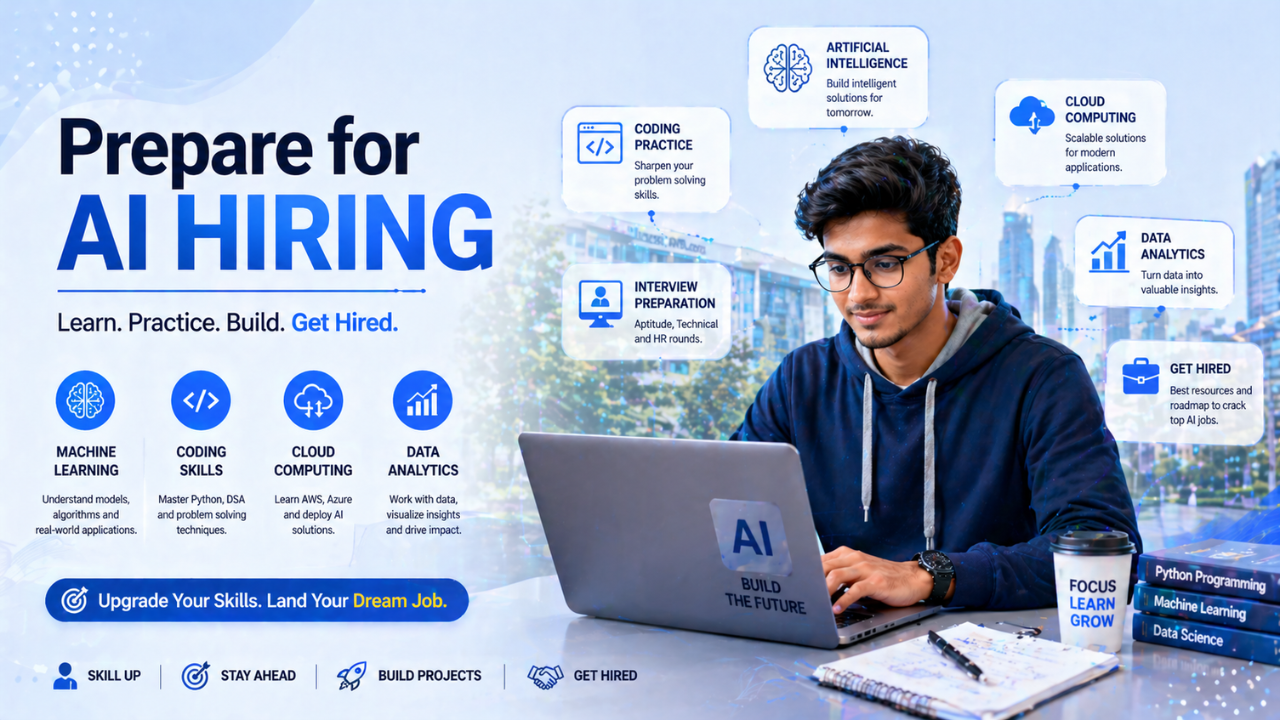
How Engineering Students Can Prepare for AI-Based Hiring
Campus placements and fresher recruitment in India are changing faster than ever. In 2026, many companies are no longer depending only on traditional HR screening and manual interviews. Instead, recruiters are using Artificial Intelligence (AI) to shortlist candidates, scan resumes, analyze video interviews, and even conduct first-round assessments through chatbots and automated systems.
This means engineering students must prepare differently. Good marks alone are no longer enough. Students now need ATS-friendly resumes, optimized LinkedIn profiles, strong communication skills, and the ability to perform well in AI-driven hiring rounds.
Many final-year students still prepare only for aptitude tests and technical interviews, but companies like Accenture, TCS, Infosys, Deloitte, Wipro, Capgemini, Cognizant, and many startups have already integrated AI-based hiring systems into their recruitment process.
If you do not understand how AI hiring works, your resume may get rejected before a recruiter even sees it.
This guide explains how engineering students can prepare for AI-based hiring in 2026 with practical strategies, real-world examples, placement tips, and a clear action plan to improve selection chances.
ATS-Friendly Resume Creation Guide for Freshers Using Overleaf and ChatGPT
1. What is AI-Based Hiring?
AI-based hiring means companies use Artificial Intelligence tools to screen, evaluate, and shortlist candidates before human recruiters start manual interviews. In 2026, most large companies and even startups use AI hiring systems because thousands of students apply for a single role, and manual screening takes too much time.
AI helps companies reduce hiring time, improve accuracy, and shortlist better candidates based on job relevance. Instead of checking every resume manually, AI systems quickly identify the most suitable profiles.
For engineering students, this means your resume, LinkedIn profile, projects, and communication skills are being checked by software first—not by HR.
ATS (Applicant Tracking System)
ATS stands for Applicant Tracking System. It is software that automatically scans resumes and checks whether your profile matches the job role.
It checks:
- Keywords
- Technical skills
- Education details
- Internships and projects
- Resume formatting
- Job relevance
If your resume does not match the job description, ATS may reject it instantly before HR even sees it.
Example:
If a Software Engineer role requires Java, SQL, Problem Solving, and OOP concepts, but your resume only says “good programming skills,” the ATS may reject your profile because the required keywords are missing.
That is why students must create an ATS-friendly resume for freshers using proper headings, clear skills, and job-specific keywords.
AI Resume Screening
Some companies use advanced AI tools that go beyond simple keyword checking. These tools analyze the overall quality of your resume, project relevance, skill consistency, career progression, and profile strength.
AI systems can predict how suitable a candidate is for a role by comparing their resume with previously successful candidates.
Example:
If your resume says “worked on machine learning project” but does not explain the dataset, algorithm, or outcome, AI may consider it weak compared to a student who clearly explains project results and real-world use cases.
This is why detailed and practical project descriptions matter more than generic lines.
Video Interview Analysis
Many companies now conduct one-way video interviews where students record answers instead of speaking directly to an interviewer.
AI systems analyze:
- Communication clarity
- Confidence level
- Facial expressions
- Voice tone
- Eye contact
- Answer structure
- Professional behavior
This is very common in graduate hiring and virtual campus placements.
Example:
A student may have strong technical skills, but if they answer with poor confidence, unclear speech, or nervous body language, the AI interview system may give a lower score.
This is why students must practice speaking answers aloud, not just reading interview questions silently.
Chatbot Interviews
Many companies use AI chatbots for the first round of hiring. These bots ask basic screening questions and record your responses before the technical interview stage.
Common chatbot questions include:
- Tell me about yourself
- Why do you want this role?
- What are your technical skills?
- Are you willing to relocate?
- What projects have you completed?
- Why should we hire you?
Your answers help the company decide whether you move to the next round.
Example:
If a student gives a very generic answer like “I want this job because I need a good career,” it sounds weak. But if they explain how their skills match the role and why they want to grow in that company, the chances improve.
This is why students must prepare for AI interviews differently than traditional interviews. AI systems evaluate clarity, relevance, and confidence very strictly.
2. Why Engineering Students Are Struggling More in 2026 Placements
Many engineering students are facing more placement challenges in 2026 because hiring expectations have changed, but preparation methods have not changed enough.
Students still focus only on marks, aptitude tests, and basic interview preparation, while companies now expect job-ready skills, strong projects, and AI hiring readiness.
This creates a big gap between student preparation and recruiter expectations.
Weak ATS-Friendly Resumes
Many students still use fancy resume templates with tables, colors, graphics, and poor formatting. These designs look attractive visually but often fail in ATS systems.
Example:
If your resume is made using images, text boxes, or columns, ATS may fail to read important information like skills or project details, causing automatic rejection.
This is why simple and keyword-rich resumes work better than decorative resumes.
No Strong Projects or Internships
Recruiters now focus heavily on practical work instead of only academic knowledge. Students without strong projects or internships struggle more because they cannot prove job readiness.
Example:
Writing “Mini Project on Java” is weak. But explaining a full-stack Job Portal Application with authentication, database integration, and deployment shows strong practical skills.
Projects help recruiters trust your technical ability.
Poor LinkedIn Visibility
Many students ignore LinkedIn completely, but recruiters now search candidates directly on LinkedIn before contacting them.
Example:
Two students may have the same degree and CGPA, but the student with a strong LinkedIn profile, project portfolio, and GitHub links gets shortlisted faster than the student with no online presence.
LinkedIn is becoming a second resume for freshers.
Low Practical Skills Despite Good Marks
Many students score well in exams but struggle with real interview questions because they focus only on theory, not practical application.
Example:
A student may know the definition of SQL JOIN but may fail when asked to write a real query during an interview.
Recruiters now prefer students who can solve real problems over students who only remember definitions.
Weak Communication During Video Interviews
AI-based interviews strongly evaluate communication. Many students know the answer but cannot explain it clearly and confidently.
Example:
In a recorded interview, a student may hesitate too much, avoid eye contact, or speak unclear English, which reduces the overall AI score.
Good communication is now a selection factor, not just a soft skill.
No Understanding of AI-Based Hiring Systems
Many students still prepare only for traditional HR rounds and do not understand how AI hiring works.
They do not optimize resumes for ATS, ignore chatbot interviews, and underestimate one-way video interviews.
This creates early rejection before the actual technical round even starts.
Real Example
Two students may have the same B.Tech degree and similar CGPA.
Student A has:
- Strong ATS resume
- GitHub projects
- Optimized LinkedIn profile
- Internship experience
- Good video interview practice
Student B has:
- Generic resume copied from internet
- No project proof
- No LinkedIn profile
- No interview speaking practice
Even with the same academic background, Student A gets shortlisted much faster.
Recruiters now focus on skills + visibility + AI readiness, not just marks.
That is why engineering placement preparation 2026 must be practical, strategic, and aligned with AI hiring systems.
3. How Recruiters Use AI to Shortlist Candidates
In 2026, recruiters use Artificial Intelligence to reduce hiring time and identify the most suitable candidates quickly. Since companies receive thousands of applications for a single fresher role, manually checking every resume is almost impossible.
AI helps recruiters save time by automatically filtering resumes, ranking profiles, and selecting the best candidates for the next round.
This process is now common in campus placements, off-campus hiring, and fresher recruitment across companies like Accenture, TCS, Infosys, Deloitte, Capgemini, Cognizant, and many startups.
Typical AI Hiring Process for Freshers
The AI hiring process for freshers usually follows this flow:
- Application submitted
- ATS scans resume
- AI ranks candidate profile
- Shortlisted candidates receive online assessment
- AI-based video or chatbot interview
- Final HR + technical interview
This means your first few rounds are often handled by software, not by recruiters.
Step 1: Application Submission
When a student applies for a job, the first thing checked is the resume. Before HR opens it, ATS and AI tools scan it automatically.
Example:
If a company posts a Software Engineer role requiring Java, SQL, and Problem Solving, students who clearly mention these skills in their resume are ranked higher than students using vague terms like “good coding knowledge.”
This is why keyword relevance is very important.
Step 2: ATS Resume Scanning
ATS checks resume structure, headings, keywords, education, projects, internships, and job relevance.
If the resume uses tables, images, poor formatting, or missing technical keywords, it may get rejected instantly.
Use Case:
A student applying for Data Analyst roles should clearly mention SQL, Excel, Power BI, Python, and Dashboard Projects. If these are missing, ATS may reject the profile even if the student actually knows them.
Step 3: AI Profile Ranking
After ATS scanning, AI tools rank candidates based on overall suitability for the role.
It checks:
- Relevant technical skills
- Project quality
- Internship experience
- Resume structure
- LinkedIn and GitHub presence
- Communication quality
Example:
Two students may both know Python, but the student who has a GitHub repository with real projects and a clear LinkedIn profile gets ranked higher than the student who only mentions Python in the resume.
Proof matters more than claims.
Step 4: Online Assessment and AI Interview
Shortlisted candidates receive aptitude tests, coding assessments, and AI-driven video or chatbot interviews.
These tools analyze:
- Problem-solving skills
- Logical thinking
- Communication clarity
- Confidence level
- Professional behavior
Example:
If a student gives a strong technical answer but speaks unclearly with low confidence, AI video analysis may still reduce the overall score.
Technical skills and communication both matter equally.
Real Hiring Example
A company hiring 10 Software Engineers may receive more than 10,000 applications.
Recruiters cannot manually review every profile.
AI helps shortlist the top 300 candidates based on:
- Relevant technical skills
- Strong projects
- Internship experience
- ATS-friendly resume quality
- LinkedIn/GitHub visibility
- Communication quality
This is why students must prepare for the AI hiring process from the beginning—not just before interviews.
Top AI Skills Students Must Learn Before Graduation in 2026
4. Common Mistakes Students Make That Cause AI Rejection
Many students get rejected before reaching the interview stage because of simple and avoidable mistakes. Most of these problems happen in resumes, project descriptions, LinkedIn profiles, and AI interview preparation.
Students often think rejection happens only because of low marks, but in reality, AI systems reject many profiles before HR even reviews them.
Using Fancy Resume Templates with Graphics and Tables
Many students use colorful resume templates with images, icons, multiple columns, and text boxes because they look attractive. But ATS systems often fail to read these formats correctly.
Example:
If your technical skills are written inside a table or graphic box, ATS may not detect them, which leads to rejection.
Simple resumes always perform better than fancy resumes in AI hiring.
No Job-Specific Keywords in Resume
Many students apply with the same resume for every job without updating keywords based on the role.
Example:
If the job requires Java, SQL, DBMS, and OOP, but your resume only says “good programming knowledge,” ATS may reject it because exact keywords are missing.
Always customize your resume for each role.
Weak Project Descriptions
Generic project descriptions reduce recruiter trust because they do not show practical understanding.
Weak Example:
Worked on web development project
Strong Example:
Built a MERN stack Job Search Application using React.js, Node.js, Express.js, and MongoDB with authentication, job posting, and search functionality.
Specificity improves both ATS performance and recruiter confidence.
Fake Internships or Copied Project Content
Many students copy projects from the internet or add fake internships without understanding them. During interviews, recruiters quickly identify fake content through simple follow-up questions.
Example:
If you mention Machine Learning project experience but cannot explain the dataset or algorithm used, rejection becomes immediate.
Always include only genuine work you can explain confidently.
No LinkedIn Profile Optimization
Many students ignore LinkedIn completely, but recruiters often check LinkedIn before calling candidates.
Example:
A student with strong projects and a professional LinkedIn headline like “Computer Science Student | MERN Stack Developer | Open to Software Engineer Roles” gets more visibility than a student with no profile updates.
LinkedIn works like your second resume.
Poor Grammar and Spelling Mistakes
Grammar mistakes reduce professionalism and create a negative first impression.
Example:
Writing “I have good knowlege in java and pythan” immediately reduces recruiter trust.
Use tools like Grammarly to avoid such basic mistakes.
No GitHub Portfolio for Technical Roles
For software and technical roles, recruiters want proof of practical work. A GitHub profile helps validate your coding skills and project ownership.
Example:
Two students may both claim MERN Stack skills, but the student with deployed projects and GitHub repositories is more likely to be shortlisted.
Projects should be visible, not just mentioned.
Generic Answers in Video Interviews
AI interviews check clarity, confidence, and answer quality. Generic answers sound weak and reduce scores.
Weak Answer:
I want this job because I want a good future.
Better Answer:
I want this role because it matches my software development skills, and I want to grow in an environment where I can work on real-world projects and improve continuously.
Clear and role-specific answers always perform better.
Final Reality
Most AI rejections happen not because students are incapable, but because they do not prepare strategically.
Strong resume + strong projects + LinkedIn visibility + AI interview readiness = higher selection chances.
That is the real formula for engineering placement preparation in 2026.
5. Step-by-Step Preparation Strategy for AI-Based Hiring
Preparing for AI-based hiring is very different from traditional placement preparation. In 2026, students are not only competing with other candidates but also with AI screening systems that decide who gets shortlisted first.
This means your preparation must be smart, practical, and focused on what recruiters and AI tools actually check. Good marks alone are not enough. Students need strong resumes, visible projects, professional profiles, and confident interview performance.
Below is the most effective step-by-step strategy for engineering students to prepare for AI-based hiring and improve placement success.
Step 1: Build an ATS-Friendly Resume
Your resume is the first round of selection. Before HR reads it, the Applicant Tracking System (ATS) scans it automatically.
If your resume is not ATS-friendly, it may get rejected instantly—even if you have good skills.
An ATS-friendly resume should include:
- Simple formatting
- Clear headings like Skills, Projects, Education, Internships
- Job-specific keywords
- Strong project descriptions
- One-page structure for freshers
- Professional summary
Example:
Instead of writing:
Good knowledge in programming
Write:
Skilled in Java, Python, SQL, OOP, DBMS, and MERN Stack Development
This improves ATS ranking because exact keywords are visible.
Internal Link Suggestion: Read our full guide on ATS Resume for Freshers.
Best Practice: Use Overleaf (LaTeX) for clean and professional ATS-friendly resume creation.
Step 2: Optimize LinkedIn Profile
Many recruiters search candidates directly on LinkedIn before shortlisting them. Your LinkedIn profile should support your resume and create a strong professional impression.
Your LinkedIn should include:
- Professional profile photo
- Strong headline
- Clear About section
- Project details
- Internship experience
- Skills section
- GitHub and portfolio links
- Certifications and achievements
Bad Headline:
Student at XYZ College
Better Headline:
Computer Science Engineering Student | Java | SQL | MERN Stack Developer | Open to Software Engineer Roles
This improves recruiter visibility because LinkedIn search works based on keywords.
LinkedIn is no longer optional—it is your second resume.
Step 3: Build Strong Projects
Recruiters trust projects more than certifications because projects prove practical skills.
Anyone can complete a certificate, but building a real project shows problem-solving ability, technical understanding, and ownership.
Your project should clearly show:
- Problem solved
- Technologies used
- Your role
- Real-world use case
- GitHub repository
- Deployment if possible
Weak Project Example:
Mini project on web development
Strong Project Example:
Built a MERN Stack Job Search Application with authentication, job posting, company dashboard, and search functionality using React.js, Node.js, Express.js, and MongoDB.
Strong projects create stronger interview conversations and improve ATS ranking.
Always upload your projects to GitHub because recruiters trust visible proof.
Step 4: Practice AI Video Interviews
Many companies now use one-way video interviews where students record answers instead of speaking live with HR.
AI systems analyze:
- Confidence
- Communication clarity
- Facial expressions
- Voice tone
- Answer structure
- Professional behavior
This is why silent preparation is not enough. You must practice speaking answers aloud.
Daily Practice Method:
- Choose 10 common interview questions
- Record your answers
- Watch your video
- Improve clarity and confidence
Common Questions:
- Tell me about yourself
- Why should we hire you?
- Explain your final-year project
- Why do you want to join our company?
Speaking practice improves performance much faster than reading interview questions only.
Step 5: Improve Technical + Non-Technical Skills
Many students focus only on coding and ignore communication skills. This is a major mistake.
Recruiters evaluate both technical skills and professional behavior.
Technical Skills Required:
- Programming fundamentals
- Java / Python / C++
- SQL and DBMS
- Data Structures and Algorithms
- Cloud basics
- Git and GitHub
- System fundamentals (OS, CN, OOP)
Non-Technical Skills Required:
- Communication skills
- Problem-solving ability
- Team collaboration
- Adaptability
- Professional attitude
- Time management
Example:
A student with average coding but excellent project explanation and strong communication often performs better than a student with strong coding but poor confidence.
Recruiters hire people who can work in teams, not just solve coding questions.
Step 6: Apply Strategically
Many students make the mistake of applying blindly to hundreds of jobs using the same resume. This reduces selection chances.
Smart students apply strategically.
This means:
- Customize resume for each role
- Match job description keywords
- Research the company before applying
- Apply for relevant roles only
- Connect with recruiters on LinkedIn
- Track applications regularly
Example:
If you are applying for a Data Analyst role, your resume should highlight SQL, Excel, Python, and dashboard projects—not only web development skills.
Role-specific resumes always perform better than generic resumes.
CTA Suggestion: Check Latest Engineering Jobs
CTA Suggestion: Apply for Freshers Hiring Now
Remember: fewer targeted applications are better than hundreds of random applications.
Final Success Formula
The best AI hiring strategy for engineering students is:
ATS Resume + LinkedIn + Strong Projects + Communication + Strategic Applications
Students who prepare in this structured way perform much better in campus placements and off-campus hiring.
AI hiring rewards preparation, clarity, and proof of skills—not just degrees.
6. How to Build an ATS-Friendly Resume for Engineering Students
Your resume is the first round of selection. If ATS rejects it, your interview preparation becomes useless.
An ATS resume for freshers should include:
- Professional Summary
- Technical Skills
- Education
- Projects
- Internships
- Certifications
- Achievements
Use:
- Times New Roman
- Simple headings
- Bullet points
- One-page format
- Role-specific keywords
Avoid:
- Tables
- Graphics
- Photos
- Fancy colors
- Long paragraphs
Best Practice: Use Overleaf (LaTeX) for professional ATS-friendly resume creation.
ATS-Friendly Resume Creation Guide for Freshers Using Overleaf and ChatGPT
7. How to Optimize LinkedIn Profile for Recruiter Visibility
In 2026, LinkedIn is no longer just a social platform for professionals—it has become one of the most powerful tools for job searching and recruiter visibility. Many recruiters search candidates directly on LinkedIn before shortlisting them for interviews.
Even if you apply through job portals like Naukri, Indeed, or company career pages, recruiters often check your LinkedIn profile to verify your background, skills, projects, and professionalism.
If your LinkedIn profile is weak, incomplete, or outdated, it can reduce your chances of getting shortlisted—even if your resume is strong.
This is why engineering students must optimize LinkedIn carefully.
Professional Profile Photo
Your profile photo creates the first impression. Recruiters trust professional profiles more than incomplete or casual-looking profiles.
Use a clear, simple, and professional photo with good lighting and a clean background.
Avoid:
- Group photos
- Casual selfies
- Party pictures
- Blurred images
- No profile photo
Example:
A student with a formal headshot looks more professional than a student using a random social media picture.
LinkedIn should look like your professional identity, not your Instagram profile.
Strong LinkedIn Headline
Your headline is one of the most important parts of your LinkedIn profile because recruiters search candidates using keywords.
Bad Headline:
Student at XYZ College
This gives no useful information and does not help recruiters understand your role or skills.
Better Headline:
Computer Science Engineering Student | MERN Stack Developer | Python | SQL | Open to Software Engineer Roles
This headline improves search visibility because it includes technical keywords recruiters actually search for.
Always include:
- Your domain
- Key technical skills
- Career goal
- Role you are targeting
Clear About Section
The About section should explain who you are, what skills you have, and what opportunities you are looking for.
Do not leave it blank.
Example:
I am a Computer Science Engineering student passionate about software development, problem-solving, and full-stack development. Skilled in Java, Python, SQL, and MERN Stack technologies. I enjoy building practical projects and continuously learning new technologies. Currently looking for Software Engineer opportunities to contribute and grow in a challenging environment.
This helps recruiters quickly understand your profile and career direction.
Projects and Internship Details
Do not just upload a resume and stop there. Add your projects and internships clearly inside LinkedIn.
Recruiters trust practical work more than certificates.
Include:
- Project title
- Technologies used
- Problem solved
- Business use case
- Internship responsibilities
Example:
Instead of writing “Worked on Java Project,” explain:
Built a Job Search Application using MERN Stack with user authentication, company dashboard, and job posting functionality.
Detailed descriptions improve trust and visibility.
Skills Section
Add all relevant technical and professional skills in your Skills section because recruiters often filter profiles using these skills.
Examples:
- Java
- Python
- SQL
- React.js
- Node.js
- DBMS
- Cloud Computing
- Problem Solving
Keep the skills relevant to your target job role. Do not add unnecessary skills just to increase the count.
Recommendations (If Possible)
If you have completed internships, academic projects, or worked closely with faculty mentors, recommendations can improve profile credibility.
A short recommendation from an internship mentor or professor adds trust.
Example:
A recommendation saying “Strong problem-solving skills and excellent ownership during internship projects” creates strong recruiter confidence.
GitHub + Portfolio Links
For technical roles, LinkedIn alone is not enough. Recruiters want proof of practical work.
Add:
- GitHub profile
- Portfolio website
- Live project links
- Hackathon participation links
Example:
If two students both claim MERN Stack knowledge, the student with GitHub repositories and deployed projects gets shortlisted faster.
Projects should be visible, not just mentioned.
Why LinkedIn Optimization Matters
Recruiters often search directly using keywords like:
- Python Fresher Hyderabad
- MERN Stack Developer Fresher
- Java Developer Final Year Student
If your profile is optimized with the right keywords, your chances of appearing in recruiter searches increase significantly.
LinkedIn optimization directly improves job visibility and placement opportunities.
8. Top Skills Recruiters Look For in Engineering Freshers
Recruiters do not hire students only because they have degrees or certificates. They hire students who can contribute quickly in real projects and adapt to professional work environments.
This is why both technical and non-technical skills matter during placements.
Below are the top skills recruiters look for in engineering freshers in 2026.
Problem Solving
Companies want students who can analyze problems and find practical solutions instead of waiting for instructions.
Example:
If a bug appears in production, recruiters prefer candidates who can think logically and solve the issue instead of only explaining theory.
Problem-solving ability is often tested through coding rounds and project discussions.
Programming Fundamentals
Strong basics in Java, Python, C++, OOP, DBMS, Operating Systems, and Data Structures are very important.
Recruiters do not expect freshers to know everything, but they expect strong fundamentals.
Example:
Questions like “What is inheritance?” or “Difference between SQL JOIN and UNION?” are basic but highly important.
SQL and Database Basics
Almost every company works with databases, so SQL is one of the most valuable skills for freshers.
Students should know:
- SELECT queries
- JOINs
- GROUP BY
- Normalization
- Primary and Foreign Keys
Even software engineers are expected to know database basics.
Cloud Basics
Cloud computing is becoming standard across industries. Basic knowledge of AWS, Azure, or Google Cloud improves job readiness.
Example:
Knowing what cloud storage, EC2, or deployment means creates a strong advantage during interviews.
Freshers do not need advanced cloud expertise, but basic awareness is important.
Git and GitHub
Git and GitHub are essential for project collaboration and version control.
Recruiters prefer students who know how real development teams work.
Example:
If you can explain branching, commits, pull requests, and project deployment, it shows strong practical exposure.
Communication Skills
Many students focus only on coding and ignore communication. This is a major mistake because interviews are highly conversational.
You do not need perfect English—you need clarity and confidence.
Recruiters check whether they can trust you in meetings, teams, and client interactions.
Team Collaboration
Most company projects are team-based. Recruiters want students who can work well with others.
Example:
During project discussions, explaining how you handled teamwork and responsibilities creates strong impact.
Being technically strong but difficult to work with is a negative sign.
Adaptability
Technology changes fast. Recruiters prefer students who can learn new tools quickly and adjust to new work environments.
Example:
A fresher who learns new frameworks during internship shows stronger potential than someone who only sticks to classroom knowledge.
Learning Attitude
Freshers are hired more for potential than experience. Companies value students who are curious and willing to learn continuously.
Example:
Students who build side projects, learn outside college syllabus, and improve independently are highly preferred.
Project Ownership
Recruiters want students who truly understand their projects—not students who copied them from the internet.
Example:
If you can clearly explain the problem, technology, challenges, and improvements in your project, it shows ownership and maturity.
This is one of the strongest selection factors for freshers.
Final Reality
Recruiters hire students who can contribute quickly—not students who only collect certificates.
The winning combination is:
Strong Fundamentals + Practical Projects + Communication + Professional Visibility
This is the real formula for engineering placement success in 2026.
9. Best Courses to Improve Placement Readiness
- Python for Everybody – Coursera
- Java Programming – Udemy
- AWS Cloud Practitioner – AWS Skill Builder
- SQL for Data Analysis – Coursera
- MERN Stack Development – Udemy
- Data Structures and Algorithms – GeeksforGeeks
- Interview Preparation – InterviewBit
Complete Interview Guide for Freshers 2026
Choose practical courses with projects, not only theory videos.
10. Best AI Tools Students Should Use
- ChatGPT – Resume writing + interview prep
- Overleaf – ATS-friendly resume creation
- Grammarly – Grammar correction
- LinkedIn – Visibility + recruiter reach
- GitHub – Project proof
- LeetCode – Coding practice
- Pramp – Mock interviews
These tools improve placement readiness significantly when used properly.
11. FAQs
Is CGPA enough for placement in 2026?
No. CGPA helps, but projects, skills, resume quality, and interview performance matter more.
Can AI reject my resume automatically?
Yes. ATS can reject resumes before HR review if keywords or formatting are weak.
Do freshers need LinkedIn?
Yes. Many recruiters search LinkedIn before contacting candidates.
Are certifications enough without projects?
No. Projects prove practical knowledge better than certifications.
How to prepare for AI video interviews?
Practice recording answers daily for common HR and technical questions.
Which companies use AI hiring in India?
Accenture, TCS, Infosys, Wipro, Deloitte, Cognizant, Capgemini, HCL, and many startups use AI-based hiring systems.
12. 30-Day Action Plan
- Week 1: Resume improvement + LinkedIn optimization
- Week 2: Build or improve 2 strong projects
- Week 3: Technical interview + coding preparation
- Week 4: Mock interviews + job applications + recruiter outreach
Consistency matters more than intensity.
Conclusion
AI-based hiring for engineering students is not the future—it is already happening.
Students who understand ATS resumes, LinkedIn optimization, project building, and AI interviews will have a major advantage in 2026 placements.
Preparation must be practical, not theoretical.
Focus on becoming job-ready, not just degree-ready.
The students who adapt fastest to AI hiring systems will get the best opportunities.