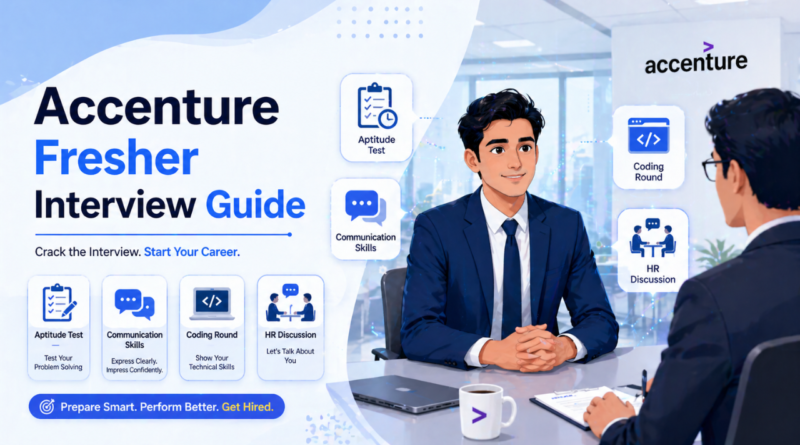
Accenture interview experience for freshers 2026
Accenture Interview Experience for Freshers 2026 – Real Questions, Answers & Complete Hiring Process Guide
Introduction: Why Accenture Interviews Feel Difficult for Freshers
Accenture is one of the top dream companies for freshers in India. Every year, thousands of students apply for roles like Associate Software Engineer, Full Stack Developer, System Associate, and various graduate trainee positions.
But the biggest challenge starts after clearing the assessment rounds — the interview.
Many freshers feel nervous because they do not know what exactly happens inside the Accenture interview. Questions like “Will they ask technical questions?”, “How difficult is the interview?”, and “What if I have no experience?” create anxiety.
The good news is this: most Accenture interviews are not extremely difficult if you prepare the right way.
Based on real candidate experiences, nearly 60–70% of interviews follow a predictable structure focused mainly on self-introduction, project explanation, behavioural questions, and situational questions. Only a smaller percentage includes deeper technical discussions.
This means your success depends less on advanced coding and more on how clearly you explain yourself, your projects, and your problem-solving mindset.
In this complete guide, we will cover:
- Real Accenture interview questions
- Expected answers
- Project explanation strategy
- Technical preparation areas
- Onboarding and document verification process
- Communication tips to improve selection chances
If you prepare these properly, your chances of clearing the interview increase significantly.
Accenture Interview Process Timeline for Freshers
One of the most confusing parts for candidates is the interview schedule itself. Many students panic because they do not receive interview mails immediately after the communication assessment.
This delay is normal.
Accenture handles a huge number of candidates, and interviewer availability is limited. Because of this, interview mails are released gradually over several days instead of all at once.
The general process looks like this:
- Assessment Round
- Communication Assessment
- Interview Mail Release
- HR + Technical Interview
- Document Submission
- Workday Profile Completion
- Background Verification
- Final Onboarding
Important tip: Join your interview at least 20 minutes early. Many candidates miss opportunities because of slot issues or interviewer delays.
If your interview mail has not arrived yet, do not panic. Wait patiently and keep checking your registered email regularly.
Accenture’s hiring process is staggered, and many candidates receive updates even after several days.
How the Accenture Interview Actually Starts
The interview usually begins with the most important question:
“Tell me about yourself.”
This is not a simple introduction. It is your first impression and often decides the tone of the entire interview.
A weak introduction sounds generic:
“My name is Rahul. I completed B.Tech from XYZ College. My hobbies are listening to music and watching movies.”
Complete Interview Guide for Freshers 2026
This does not create impact.
A strong introduction should include:
- Your academic background
- Your strongest technical skills
- Relevant certifications
- Your best project
- Achievements or internships
- Career goals
Sample Answer:
Hello sir/madam, my name is Rahul Sharma and I recently completed my B.Tech in Computer Science from ABC Engineering College with 8.2 CGPA. I have strong interest in software development and problem-solving. I completed certifications in Java, SQL, and Cloud Basics, and I worked on a Full Stack Web Application project for task management using React and Node.js. I enjoy building practical applications and continuously learning new technologies like AI and cloud computing. I am looking for an opportunity where I can contribute and grow professionally.
This creates confidence and professionalism immediately.
Project Questions – The Most Important Part of the Interview
In most Accenture interviews, the project discussion is the deciding factor. Based on real interview experiences from freshers, nearly 80–90% of the interview revolves around your project. This is because recruiters want to check whether you have practical knowledge, problem-solving ability, and real understanding of technology—not just theoretical knowledge.
Many students make one major mistake: they add projects to their resume without understanding them deeply. During the interview, this becomes very obvious. If you cannot explain your own project confidently, the interviewer may assume you copied it from YouTube, GitHub, or a friend.
That is why project preparation is extremely important.
Your project tells the interviewer:
- How you think
- How you solve problems
- Whether you can work independently or in a team
- Whether you understand real-world applications
- Your technical depth and communication skills
Even if your project is simple, explaining it clearly can create a strong positive impression.
Common Project Questions Asked in Accenture Interviews
1. Explain Your Project in Detail
This is usually the first project question.
Do not answer in one line like:
“I made a To-Do List App using React.”
This is too weak.
Instead, explain:
- What problem the project solves
- Why you chose this project
- How the system works
- Technologies used
- Final outcome
Strong Example Answer:
My project is a Task Management Application designed to help users organize daily tasks efficiently. Many students and working professionals struggle to manage deadlines and priorities, so I created this solution to simplify task planning. Users can create tasks, set deadlines, mark tasks as complete, and organize priorities. I used React.js for the frontend, Node.js for backend operations, Express.js for APIs, and MongoDB for storing user data. The goal was to improve daily productivity and provide a simple user-friendly interface.
This answer shows clarity and business thinking.
2. Was It an Individual Project or Team Project?
The interviewer wants to know how you work.
If it was an individual project:
Explain why you chose to do it alone and how you managed everything.
If it was a team project:
Be honest and clearly explain your contribution.
Never say:
“We all did everything.”
This sounds weak.
Instead say:
It was a team project of 4 members. I handled frontend development using React.js and also worked on API integration. Another member handled database design while one focused on backend development.
This shows responsibility and teamwork.
3. What Was Your Role in the Project?
This is one of the most important questions.
The interviewer wants to know your exact contribution.
Be specific:
- Frontend development
- Backend logic
- Database management
- Testing
- Deployment
- UI design
Example:
My primary role was backend development. I created REST APIs, handled authentication, and connected MongoDB with the application. I also tested the APIs using Postman and fixed performance issues.
Specific answers always create trust.
4. What Challenges Did You Face?
This question checks your problem-solving mindset.
Every real project has challenges. If you say:
“There were no challenges”
…it sounds fake.
Good examples of challenges:
- API integration issues
- Database connection problems
- Team coordination problems
- Performance issues
- Deployment errors
- UI responsiveness issues
Example Answer:
One major challenge was managing state updates during task completion because the UI was not refreshing properly. I solved this by improving state management and debugging the React component structure.
This shows technical maturity.
5. What Technologies Did You Use?
Do not just list tools.
Explain why you used them.
Weak Answer:
“I used React, Node.js, and MongoDB.”
Strong Answer:
I used React.js because it allows reusable UI components and faster frontend development. Node.js and Express.js were used for backend API creation, while MongoDB was selected because it handles flexible document-based data efficiently.
This shows understanding, not memorization.
6. What Is the Real-Life Application of Your Project?
This is where many students fail.
The interviewer wants to know whether your project solves a practical problem.
Never explain your project like a college assignment only.
Always connect it to real life.
Example:
If your project is a To-Do List App:
This project helps users organize daily activities, manage deadlines, and improve productivity. It is useful for students preparing for exams, employees managing office work, and teams handling shared responsibilities.
This shows business relevance and practical thinking.
Additional Areas You Must Prepare
Many interviewers go deeper after basic questions.
Be ready for these too:
Frontend + Backend Used
Explain:
- What frontend technology was used
- Why you selected it
- How frontend connects to backend
Database Design
Explain:
- Which database you used
- Why you selected SQL or NoSQL
- Tables or collections structure
- Relationships between data
Advantages and Limitations
Every project has both.
Advantages:
- User-friendly interface
- Time-saving automation
- Easy task tracking
Limitations:
- No mobile app version
- Limited multi-user support
- No advanced notification system
This shows honest analysis.
Future Improvements
This is a high-impact answer.
Example:
In the future, I would like to add AI-based task prioritization, email reminders, and team collaboration features to improve productivity further.
This makes your project sound professional and scalable.
Final Golden Rule
Your project should sound like a solution to a real problem, not just a final-year submission.
Even a simple project can impress if you explain:
- Problem
- Solution
- Logic
- Challenges
- Practical usage
- Future scope
Accenture interviewers care more about clarity and ownership than project complexity.
A small project you understand deeply is far better than a big project you cannot explain.
Final Tip:
Prepare your project explanation at least 10 times aloud before the interview.
Because in most cases:
Your project explanation decides your selection.
Most Asked Behavioural Questions in Accenture Interviews
Behavioural questions are one of the most important parts of the Accenture interview process. Many freshers focus only on technical preparation and ignore this section, but in reality, behavioural questions often decide whether you move forward or not.
These questions are asked to understand your personality, communication style, work ethic, confidence, and professional mindset. The interviewer wants to know how you think, how you handle challenges, and whether you can work well in a professional environment.
These are not coding or technical questions, but they are equally important because companies hire people who can work in teams, solve problems, and communicate clearly.
In most cases, behavioural questions are simple, but your answer must be thoughtful, honest, and confident.
Common behavioural questions include:
- Why do you want to join Accenture?
- What are your strengths and weaknesses?
- Where do you see yourself in 5 years?
- Tell me about a difficult academic subject
- What motivates you?
- Who is your role model?
- How do you handle pressure?
- Tell me about a time when you solved a problem
1. Why Do You Want to Join Accenture?
This is one of the most frequently asked questions and your answer should show that you understand the company and your career goals clearly.
The interviewer wants to know:
- Why you chose Accenture specifically
- Whether you are serious about your career
- Whether your goals align with the company
Top Answer Example:
Accenture is known for innovation, strong learning opportunities, and global exposure. I want to work in an environment where I can improve my technical skills, work on real-world projects, and learn from experienced professionals. Accenture’s strong focus on technology, digital transformation, and employee development makes it the right place for my long-term career growth. I believe joining Accenture will help me build both technical expertise and professional confidence.
This answer sounds professional, clear, and career-focused.
2. What Are Your Strengths and Weaknesses?
This question checks your self-awareness and honesty.
Do not give fake answers like “I have no weaknesses.” That creates a bad impression.
Your strength should be relevant to the job role, and your weakness should show improvement, not a major risk.
Top Answer Example:
One of my biggest strengths is my problem-solving mindset. I enjoy understanding challenges and finding practical solutions, especially in technical projects. I am also a quick learner and adapt easily to new tools and technologies.
As for weakness, I used to hesitate while speaking in public because I wanted everything to be perfect. However, I have been actively improving this by practicing presentations, mock interviews, and daily speaking exercises. This has helped me become much more confident.
This answer shows maturity and growth.
3. Where Do You See Yourself in 5 Years?
The interviewer wants to check your career vision and seriousness.
Do not give unrealistic answers like “I want to be CEO.” Keep it practical and professional.
Top Answer Example:
In the next five years, I see myself growing into a strong software professional with solid technical expertise and real project experience. I want to continuously improve my skills, take on more responsibilities, and contribute to meaningful business solutions. I also want to become someone my team can rely on for both technical support and teamwork.
This answer shows ambition with realism.
4. Tell Me About a Difficult Academic Subject
This question tests how you handle challenges and learning difficulties.
Top Answer Example:
During my academic journey, I found Data Structures challenging in the beginning because it required strong logical thinking and problem-solving skills. Initially, I struggled with concepts like recursion and linked lists. Instead of avoiding it, I started practicing daily, watched tutorials, solved coding problems, and discussed doubts with faculty and friends. Over time, I improved my understanding and even used these concepts in my project work. This experience taught me consistency and patience.
This answer shows effort and a positive mindset.
5. What Motivates You?
This question helps the interviewer understand your mindset and work attitude.
Top Answer Example:
I am motivated by continuous learning and personal growth. I enjoy learning new technologies and improving my skills because it gives me confidence and a sense of progress. Solving problems and completing challenging tasks also motivates me because it helps me feel productive and valuable. I believe growth comes from stepping outside the comfort zone, and that motivates me every day.
This answer sounds genuine and professional.
6. Who Is Your Role Model?
This question checks your values and inspiration.
Choose someone meaningful and explain why.
Top Answer Example:
My role model is Dr. A.P.J. Abdul Kalam because of his dedication, humility, and lifelong commitment to learning. Despite facing many challenges, he remained focused on contributing to the nation and inspiring young people. His discipline, simplicity, and vision motivate me to stay committed to my goals and keep learning throughout my career.
This answer reflects strong values and maturity.
Situational Questions – How to Answer Smartly
Situational questions are very common in Accenture interviews. These questions are designed to test your decision-making ability, problem-solving skills, teamwork, leadership, and professional behaviour.
The interviewer is not looking for a “perfect” answer. They want to see how you think when facing pressure or unexpected challenges.
These questions are based on real workplace situations, and your response should show maturity, calmness, and professionalism.
Common situational questions include:
- What will you do if your teammate is not cooperating?
- How will you handle urgent deadlines?
- What if you fall sick before an important presentation?
- How will you manage conflicts in your team?
- What if your manager gives you a task you do not understand?
- How will you handle multiple tasks at the same time?
How to Answer Situational Questions Properly
The best way to answer situational questions is through storytelling using a simple structure:
- Situation – Explain the problem
- Action – Explain what you did
- Result – Explain the final outcome
This makes your answer strong, logical, and believable.
Example: What Will You Do If Your Teammate Is Not Cooperating?
Top Answer Example:
If a teammate is not cooperating, I would first try to understand the reason by communicating calmly and professionally. Sometimes misunderstandings, personal stress, or workload issues can cause such situations. I would discuss responsibilities clearly and try to solve the issue through teamwork rather than conflict.
If the issue continues and starts affecting the project deadline or team performance, I would respectfully inform the team lead or manager so that the problem can be handled properly. I believe solving problems through communication is always better than creating unnecessary conflict.
This answer shows maturity and professionalism.
Example: How Will You Handle Urgent Deadlines?
Top Answer Example:
If I have an urgent deadline, I would first prioritize tasks based on importance and deadline impact. I would focus on completing the most critical work first while avoiding distractions. If needed, I would communicate with my team for support and keep my manager updated on progress.
I believe staying calm and organized is the best way to handle pressure. Panic only creates more mistakes, while proper planning improves results.
This answer shows responsibility and time management.
Final Preparation Tip
Prepare at least 15–20 situational questions before the interview.
Even if your story is based on college projects, group assignments, or personal experiences, explain it confidently and naturally.
Do not memorize robotic answers. The interviewer should feel that your answer is genuine and practical.
Remember:
Behavioural and situational questions often decide your final selection because they reveal the person behind the resume.
Technical Questions – What You Must Prepare
Technical questions in Accenture interviews are usually based on fundamentals, not advanced coding rounds like product-based companies. The interviewer is not expecting you to solve very complex algorithms. Instead, they want to check whether your basics are clear and whether you can explain concepts confidently.
Many freshers make the mistake of preparing only difficult coding questions and ignoring simple theory-based concepts. In reality, Accenture interviews are often discussion-based, where the interviewer asks basic technical questions and observes how clearly you explain them.
The main purpose of technical questions is to check:
- Your understanding of core computer science subjects
- Your problem-solving mindset
- Your confidence while explaining technical concepts
- Your awareness of current technologies like AI, Cloud, and Generative AI
The most common focus areas include:
- Object-Oriented Programming (OOP)
- SQL and DBMS
- Programming basics
- Cloud Computing
- Artificial Intelligence (AI)
- Machine Learning basics
- Generative AI
The golden rule is simple:
Keep your answers simple, practical, and concept-based.
You do not need textbook definitions. You need clarity.
Object-Oriented Programming (OOP)
OOP is one of the most commonly asked topics because it is the foundation of programming languages like Java, C++, and Python.
The interviewer may ask about concepts like:
- Inheritance
- Polymorphism
- Encapsulation
- Abstraction
- Classes and Objects
Question: What is Inheritance in OOP?
Top Answer:
Inheritance is a feature in Object-Oriented Programming where one class acquires the properties and methods of another class. It helps in code reusability and reduces duplication. For example, if we have a class called Vehicle, classes like Car and Bike can inherit common properties such as speed and color from it. This makes the code more organized and efficient.
Question: Difference Between Abstraction and Encapsulation?
Top Answer:
Abstraction means hiding complex implementation details and showing only the necessary features to the user. For example, when we drive a car, we use the steering and brakes without knowing the internal engine mechanism.
Encapsulation means wrapping data and methods together inside a single unit, like a class, and restricting direct access to protect data. It improves security and control in programming.
In simple words, abstraction focuses on “what to show,” while encapsulation focuses on “how to protect.”
SQL and DBMS
SQL and DBMS are very important because almost every software system works with data.
Interviewers usually ask basic database concepts like:
- Normalization
- Primary Key and Foreign Key
- DELETE vs TRUNCATE vs DROP
- Joins in SQL
- DBMS vs RDBMS
Question: What is Normalization in DBMS?
Top Answer:
Normalization is the process of organizing data in a database to reduce redundancy and improve data integrity. It helps in removing duplicate data and ensures efficient storage. For example, instead of storing repeated customer details in multiple places, normalization separates them into structured tables using relationships.
Question: Difference Between DELETE and TRUNCATE in SQL?
Top Answer:
DELETE is used to remove specific rows from a table using conditions, and it can be rolled back if used inside a transaction. TRUNCATE removes all rows from a table at once without conditions and is faster because it uses fewer system resources.
In simple words, DELETE is selective and slower, while TRUNCATE is faster and removes everything.
Question: What is Primary Key?
Top Answer:
A Primary Key is a column in a table that uniquely identifies each record. It cannot contain duplicate values or null values. For example, Student ID can be a primary key in a student database because every student has a unique ID.
Programming Basics
Even if the interview is not coding-heavy, the interviewer may ask basic programming logic questions.
Examples include:
- Difference between compiler and interpreter
- Difference between array and linked list
- What is recursion?
- Difference between stack and queue
Question: What is Recursion?
Top Answer:
Recursion is a programming technique where a function calls itself to solve smaller parts of the same problem. It is commonly used in problems like factorial calculation, tree traversal, and searching algorithms. A recursive function must have a base condition to stop infinite execution.
Cloud Computing
Cloud computing is one of the most frequently asked modern technology topics in Accenture interviews.
Question: What is Cloud Computing?
Top Answer:
Cloud computing means delivering computing services like storage, servers, databases, networking, and software over the internet instead of using local systems. It helps companies reduce infrastructure costs, improve scalability, and access resources from anywhere.
For example, instead of storing files only on a personal computer, services like Google Drive allow users to store and access data online from any device.
Question: What are the Benefits of Cloud Computing?
Top Answer:
The main benefits of cloud computing are cost savings, scalability, flexibility, and better data backup. Companies can increase or decrease resources based on business needs without investing heavily in physical infrastructure.
Artificial Intelligence (AI) and Machine Learning
Accenture often asks basic AI and ML questions because these technologies are highly relevant in today’s industry.
Question: What is Artificial Intelligence?
Top Answer:
Artificial Intelligence is the ability of machines to perform tasks that normally require human intelligence, such as decision-making, learning, problem-solving, and understanding language. Examples include chatbots, recommendation systems, and voice assistants like Alexa.
Question: Difference Between AI and Machine Learning?
Top Answer:
Artificial Intelligence is the broader concept of making machines smart, while Machine Learning is a subset of AI that allows machines to learn from data without explicit programming.
In simple words, AI is the goal, and Machine Learning is one way to achieve that goal.
Generative AI
Generative AI is one of the hottest interview topics in 2026.
Question: Explain Generative AI in Simple Terms
Top Answer:
Generative AI is a type of Artificial Intelligence that can create new content such as text, images, videos, or code based on the data it has learned from. Tools like ChatGPT and image generation tools are examples of Generative AI.
Unlike traditional AI, which mainly analyzes data, Generative AI can produce new outputs.
Question: Where is Generative AI Used?
Top Answer:
Generative AI is used in content writing, software development, customer support chatbots, image creation, and marketing automation. Many companies use it to improve productivity and save time.
Communication Skills – The Hidden Selection Factor
Many students focus only on technical preparation and completely ignore communication skills. This is one of the biggest mistakes in Accenture interviews.
Accenture interviews are highly conversational. The interviewer is not just testing your knowledge—they are testing whether you can explain your thoughts clearly and confidently.
You do not need perfect English grammar or an advanced accent. What matters most is:
- Clarity of thought
- Confidence while speaking
- Professional communication
- Ability to explain your answers naturally
Even if your technical knowledge is strong, poor communication can reduce your selection chances.
Remember:
If the interviewer understands your thinking clearly, your chances improve significantly.
Best Daily Practice Method
The best way to improve communication is daily speaking practice.
- Choose 10 interview questions every day
- Answer them aloud, not silently
- Record your voice or video
- Listen and identify mistakes
- Improve clarity, speed, and confidence
Speaking practice is far more effective than silent preparation because interviews happen verbally, not on paper.
Example Questions to Practice Daily
Question: Tell Me About Yourself
Practice Goal: Speak clearly for 60–90 seconds without hesitation.
Question: Why Should We Hire You?
Top Answer:
I believe I am a strong fit for this role because I have the right combination of technical knowledge, learning attitude, and problem-solving skills. I may be a fresher, but I am quick to learn, adaptable, and committed to delivering quality work. I have worked on projects that improved my practical understanding, and I am ready to contribute while continuously improving myself.
Question: How Do You Handle Pressure?
Top Answer:
I handle pressure by staying calm and focusing on priorities. I first understand what needs immediate attention and then plan my work step by step. Instead of panicking, I prefer solving problems logically. I believe pressure can be managed better through discipline and proper communication with the team.
Final Communication Tip
Do not try to sound too perfect. Try to sound clear, confident, and genuine.
The interviewer is not looking for an English teacher. They are looking for someone who can communicate professionally in a workplace.
Confidence grows with practice, not with memorization.
Daily speaking practice can improve your interview performance more than reading 100 questions silently.
Accenture Workday Profile & Onboarding Process
After clearing the interview, the next stage is document submission and onboarding.
You will receive Workday portal login details through email.
You must complete:
- Personal details
- Address information
- Education details
- Previous employment details (if any)
Required documents include:
- Graduation certificates
- Experience letters (if applicable)
- PF statements
- Form 16
- ID proof documents
Important rules:
- Files must be clear
- JPEG or PDF only
- Maximum size usually under 6 MB
- No editing or unclear scans
If you face technical issues like “application already exists,” contact HR immediately.
Background verification begins after upload completion.
Final Tips to Crack Accenture Interview
- Prepare strong self-introduction
- Master your project explanation
- Practice 20+ situational questions
- Revise OOP + SQL basics
- Understand AI, Cloud, and Generative AI basics
- Improve speaking confidence daily
- Stay calm during delays in scheduling
The interview is more of a conversation than an exam.
If you communicate clearly and show confidence, your selection chances become much higher.
Conclusion
Accenture interviews are not impossible. In fact, most interviews are predictable if you prepare correctly.
The real secret is not advanced coding — it is project clarity, behavioural preparation, communication skills, and confidence.
Focus on what recruiters actually expect, not what students assume they ask.
If you prepare smartly, practice daily, and stay patient during the hiring process, clearing the Accenture interview becomes much easier.
Your opportunity is closer than you think.