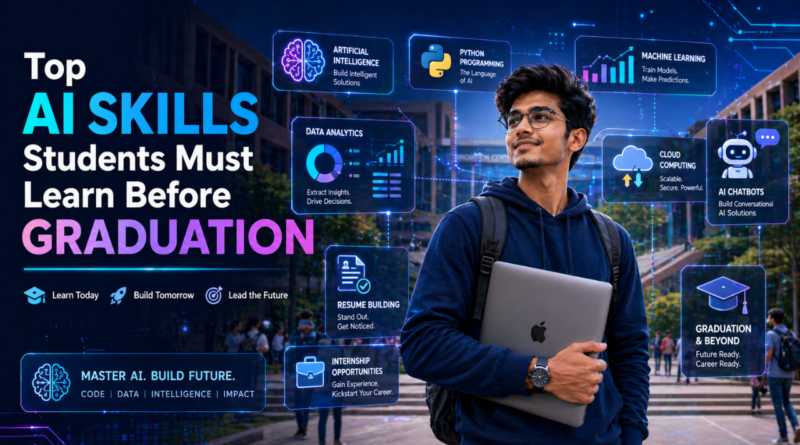
Top AI Skills Every Student and Fresher Must Learn in 2026
Top AI Skills Every Student and Fresher Must Learn in 2026
Introduction
The job market in 2026 is very different from what it was just a few years ago. Companies are no longer hiring candidates solely based on degrees, academic scores, or the reputation of their college. Instead, employers are looking for candidates who can demonstrate practical skills, solve real-world problems, adapt to new technologies, and contribute from day one.
Artificial Intelligence (AI) has become one of the biggest drivers of this transformation. From software development and healthcare to banking, marketing, finance, customer support, and education, AI is changing how businesses operate and how employees perform their daily work.
Whether you are a college student preparing for campus placements or a fresher searching for your first job, learning AI skills before graduation can significantly improve your career opportunities. Recruiters increasingly value candidates who understand modern AI tools, automation, productivity software, and data-driven decision-making.
The good news is that you do not need to become an AI researcher or machine learning expert to benefit from AI. Many of today’s most valuable AI skills focus on using AI effectively to improve productivity, build better projects, communicate professionally, and solve business problems.
In this comprehensive guide, you’ll learn:
- Why AI skills have become essential before graduation
- How AI is changing hiring trends in India and globally
- The difference between using AI tools and becoming an AI Engineer
- The top AI skills every student and fresher should learn
- Best AI learning resources and certifications
- Companies hiring AI-ready freshers
- Salary expectations for AI-related careers
- A practical 90-day roadmap to start your AI journey
Why AI Skills Matter Before Graduation
For many years, earning a degree was considered enough to secure a good job. Today, that is no longer the case. Thousands of graduates enter the job market every year with similar qualifications, making it difficult for recruiters to distinguish one candidate from another.
Artificial Intelligence has accelerated this shift by changing the way businesses hire, operate, and compete. Organizations are adopting AI-powered tools to automate repetitive work, analyze large volumes of data, improve customer experiences, and increase productivity.
This has created a growing demand for candidates who understand AI—not just AI Engineers, but professionals across software development, testing, data analytics, finance, HR, digital marketing, operations, and customer support.
Why Students Should Learn AI Before Graduation
- Gain a competitive advantage during campus placements.
- Improve internship opportunities before graduation.
- Build stronger resumes with practical AI projects.
- Prepare for AI-assisted recruitment processes.
- Increase productivity using modern AI tools.
- Develop future-ready technical and professional skills.
- Stand out from thousands of other fresh graduates.
Real-World Example
Imagine two final-year engineering students applying for the same Software Developer position.
The first student has excellent academic grades but no practical projects or AI knowledge.
The second student has similar grades but has also built AI-assisted projects, optimized their resume using AI tools, prepared for interviews with AI mock interviews, and actively maintains a GitHub portfolio.
Most recruiters will shortlist the second candidate because they demonstrate practical learning, initiative, and industry readiness.
Benefits of Learning AI Early
- Better internship opportunities
- Higher placement success rate
- Improved interview confidence
- Enhanced problem-solving ability
- Higher salary potential
- Long-term career growth
How AI Is Changing Hiring Trends in 2026
Recruitment has evolved dramatically over the past few years. Earlier, recruiters manually reviewed resumes and relied heavily on academic performance. Today, Artificial Intelligence plays a major role throughout the hiring process.
Many organizations use AI-powered Applicant Tracking Systems (ATS) to scan resumes before a recruiter even reads them. AI is also used to shortlist candidates, schedule interviews, analyze assessments, and even evaluate communication skills during video interviews.
Major Hiring Changes in 2026
- AI-powered resume screening
- Skill-based hiring instead of degree-based hiring
- Online coding assessments
- AI-assisted HR interviews
- Portfolio-based candidate evaluation
- Project-focused recruitment
- Remote hiring using AI platforms
Industries Adopting AI Rapidly
- Software Development
- Healthcare
- Banking & Financial Services
- E-commerce
- Manufacturing
- Retail
- Education Technology
- Cybersecurity
- Digital Marketing
- Customer Support
What Recruiters Expect from Freshers
Recruiters are increasingly looking beyond degrees. They want candidates who can demonstrate practical knowledge through projects, GitHub repositories, certifications, internships, and problem-solving abilities.
Understanding AI tools also signals that a candidate is willing to learn continuously and adapt to changing technology—qualities that employers highly value.
Why Degrees Alone Are No Longer Enough
A university degree remains an important foundation, but it is no longer sufficient to guarantee employment.
Thousands of students graduate with similar academic qualifications every year. What differentiates successful candidates is their ability to apply knowledge in practical situations.
Why Recruiters Prioritize Skills
- Skills demonstrate real-world capability.
- Projects show hands-on experience.
- Certifications prove continuous learning.
- Portfolios showcase practical achievements.
- Communication reflects workplace readiness.
Degree vs Skills Comparison
| Degree | Practical Skills |
|---|---|
| Shows academic qualification | Demonstrates job readiness |
| Mostly theoretical knowledge | Hands-on experience |
| Common among candidates | Creates competitive advantage |
| Required for eligibility | Required for selection |
| Static learning | Continuous upskilling |
Employer Perspective
When employers compare two candidates with similar educational backgrounds, they often choose the one who has practical AI knowledge, completed relevant projects, understands modern productivity tools, and can contribute immediately.
AI Tools vs Becoming an AI Engineer
One of the biggest misconceptions among students is that learning AI automatically means becoming an Artificial Intelligence Engineer.
These are two completely different career paths.
Learning AI Tools
This involves using AI-powered applications to improve productivity, communication, creativity, coding, research, documentation, resume building, and everyday work.
Popular AI Tools
- ChatGPT
- GitHub Copilot
- Microsoft Copilot
- Canva AI
- Notion AI
- Grammarly AI
- Google Gemini
- Claude AI
Almost every student can learn these tools regardless of their educational background.
Becoming an AI Engineer
An AI Engineer builds intelligent software systems using programming, mathematics, machine learning algorithms, neural networks, and cloud platforms.
Skills Required
- Python Programming
- Machine Learning
- Deep Learning
- Statistics
- Linear Algebra
- Data Structures
- TensorFlow
- PyTorch
- Cloud Computing
Which Path Should Students Choose?
If your goal is to secure internships, campus placements, or your first job, start by learning AI tools that improve productivity and employability. Once you build confidence and understand the fundamentals, you can gradually move toward advanced topics such as Machine Learning, Deep Learning, and AI Engineering.
This approach helps you gain immediate career benefits while building a strong foundation for future specialization.
Top AI Skills Every Student and Fresher Must Learn in 2026
Now that you understand why AI is transforming the job market and why practical skills matter more than ever, let’s explore the most valuable AI skills that can significantly improve your career opportunities. These skills range from beginner-friendly productivity tools to advanced technical competencies used by leading technology companies.
1. Python Programming – The Foundation of Artificial Intelligence
Python is the most popular programming language for Artificial Intelligence, Machine Learning, Data Science, Automation, and Software Development. If you plan to build a career in AI or any modern technology field, Python should be the first programming language you learn.
Unlike many programming languages, Python has a simple and beginner-friendly syntax, making it an excellent choice for students and fresh graduates with little or no coding experience. It allows developers to write clean, readable code while providing thousands of libraries for solving real-world problems.
Today, companies like Google, Microsoft, Amazon, Netflix, Spotify, Meta, OpenAI, NVIDIA, and IBM use Python extensively in their AI products, cloud platforms, automation systems, and data-driven applications.
Top 100 Python Interview Questions and Answers for Freshers
Why Python Is Important for AI Careers
Artificial Intelligence systems rely heavily on programming to process data, train models, automate tasks, and make intelligent decisions. Python has become the preferred language because of its flexibility, extensive libraries, and large developer community.
Whether you want to become an AI Engineer, Data Scientist, Automation Engineer, Software Developer, or Data Analyst, Python serves as the foundation for many advanced technologies.
Key Benefits of Learning Python
- Simple and beginner-friendly syntax.
- Large collection of AI and Machine Learning libraries.
- Used across multiple industries and domains.
- Supports automation, scripting, web development, and cloud computing.
- Strong demand in both startups and multinational companies.
- Large community with extensive learning resources.
Applications of Python in Artificial Intelligence
Python is not limited to one specific AI domain. It powers a wide range of intelligent applications used every day by millions of people.
| AI Application | How Python Is Used |
|---|---|
| Recommendation Systems | Netflix, Amazon, Spotify recommendations |
| Chatbots | Customer support automation |
| Computer Vision | Image recognition and object detection |
| Natural Language Processing | Language translation and text analysis |
| Data Analysis | Processing large datasets |
| Automation | Reducing repetitive manual tasks |
| Predictive Analytics | Forecasting future trends |
Python Libraries Every Student Should Learn
One of Python’s biggest strengths is its ecosystem of libraries. Instead of writing everything from scratch, developers use these libraries to build powerful AI applications efficiently.
NumPy
NumPy is used for mathematical operations and numerical computing. It provides fast array processing and serves as the backbone of many AI libraries.
Pandas
Pandas helps clean, organize, and analyze structured datasets. Almost every Data Analyst and Data Scientist uses Pandas for handling spreadsheets, CSV files, and business data.
Matplotlib
Matplotlib helps visualize data through charts, graphs, and plots. Data visualization is an important step before building machine learning models.
Scikit-learn
Scikit-learn is one of the most widely used Machine Learning libraries. It contains algorithms for classification, regression, clustering, and model evaluation.
TensorFlow
TensorFlow, developed by Google, is used to build Deep Learning and Neural Network models for advanced AI applications.
PyTorch
PyTorch is another popular Deep Learning framework widely used by researchers and technology companies for AI model development.
Python Skills Freshers Should Master
Instead of memorizing syntax, focus on developing practical programming skills that recruiters commonly test during technical interviews.
- Variables and Data Types
- Operators
- Conditional Statements
- Loops
- Functions
- Lists
- Tuples
- Sets
- Dictionaries
- Object-Oriented Programming (OOP)
- Exception Handling
- File Handling
- Modules and Packages
- Virtual Environments
Real-World Example
Suppose an e-commerce company wants to recommend products to customers.
Python is used to collect customer purchase history, clean the data using Pandas, analyze buying patterns with Machine Learning algorithms, and generate personalized product recommendations.
This is the same principle behind recommendation systems used by Amazon, Flipkart, Netflix, and Spotify.
Mini Projects Students Can Build
Projects demonstrate practical knowledge better than certificates alone.
Beginner Projects
- Student Result Management System
- Calculator Application
- Password Generator
- Number Guessing Game
- To-Do List Application
Intermediate Projects
- Expense Tracker
- Weather Application using API
- Library Management System
- Resume Parser
- Email Automation Tool
AI Projects
- Movie Recommendation System
- Spam Email Detection
- AI Chatbot
- Sentiment Analysis
- Face Recognition System
Common Python Interview Questions
- What makes Python different from Java?
- What are Python decorators?
- Explain list comprehension.
- Difference between List and Tuple.
- Difference between Deep Copy and Shallow Copy.
- What are generators?
- What is PEP 8?
- Explain *args and **kwargs.
- Difference between is and ==.
- What is the Global Interpreter Lock (GIL)?
Preparing these concepts not only helps in Python Developer interviews but also strengthens your understanding for Machine Learning, Data Science, and AI-related technical discussions.
Career Opportunities After Learning Python
| Job Role | Average Fresher Salary (India) |
|---|---|
| Python Developer | ₹4–8 LPA |
| Software Engineer | ₹5–10 LPA |
| Data Analyst | ₹4–7 LPA |
| Machine Learning Engineer | ₹8–15 LPA |
| Data Scientist | ₹8–18 LPA |
| AI Engineer | ₹10–20 LPA |
Best Free Resources to Learn Python
- Official Python Documentation
- Python.org Tutorials
- freeCodeCamp Python Course
- Harvard CS50 Programming Resources
- Kaggle Learn Python
- Google’s Python Class
Key Takeaways
Python is much more than a programming language—it is the gateway to Artificial Intelligence, Machine Learning, Data Science, Automation, and Cloud Computing. By mastering Python fundamentals and building practical projects, students and freshers can significantly improve their technical skills, interview performance, and employability.
Once you have a strong understanding of Python, the next logical step is to explore Machine Learning, where you’ll learn how computers analyze data, identify patterns, and make intelligent predictions.
2. Machine Learning – Teaching Computers to Learn from Data
Machine Learning (ML) is one of the most important branches of Artificial Intelligence. Instead of programming a computer with fixed rules for every situation, Machine Learning enables systems to learn from data, identify patterns, and make predictions automatically.
Today, Machine Learning powers many of the applications we use every day. Whether you’re receiving personalized recommendations on Netflix, detecting spam emails in Gmail, unlocking your phone using face recognition, or getting product suggestions on Amazon, Machine Learning is working behind the scenes.
For students and freshers aiming for careers in AI, Data Science, Software Development, Business Intelligence, or Automation, understanding Machine Learning fundamentals provides a strong competitive advantage during placements and technical interviews.
What Is Machine Learning?
Machine Learning is a field of Artificial Intelligence that enables computers to improve their performance by learning from historical data rather than relying only on manually written instructions.
Traditional software follows predefined rules created by developers. Machine Learning models analyze large datasets, recognize patterns, and continuously improve predictions as more data becomes available.
Traditional Programming vs Machine Learning
| Traditional Programming | Machine Learning |
|---|---|
| Developer writes all rules | Model learns patterns from data |
| Works for predictable tasks | Handles complex patterns |
| Static logic | Continuously improves with data |
| Less flexible | Highly adaptive |
| Best for fixed processes | Best for prediction and automation |
Why Machine Learning Is Important in 2026
Almost every industry is investing heavily in Machine Learning to automate repetitive tasks, improve customer experiences, reduce operational costs, and make better business decisions.
As organizations generate more data than ever before, professionals who understand Machine Learning concepts are becoming increasingly valuable.
Benefits of Learning Machine Learning
- High demand across industries.
- Excellent salary growth.
- Opportunities in India and globally.
- Useful in both technical and business roles.
- Strong foundation for Artificial Intelligence careers.
- Future-proof technical skill.
Where Is Machine Learning Used?
Many people believe Machine Learning is only used by large technology companies. In reality, organizations across every industry use ML to improve decision-making and automate business processes.
| Industry | Machine Learning Applications |
|---|---|
| E-Commerce | Product recommendations, pricing optimization |
| Healthcare | Disease prediction, medical imaging |
| Banking | Fraud detection, credit scoring |
| Insurance | Risk analysis, claim prediction |
| Education | Personalized learning platforms |
| Marketing | Customer segmentation, campaign optimization |
| Cybersecurity | Threat detection |
| Manufacturing | Predictive maintenance |
Types of Machine Learning
Machine Learning is generally divided into three major categories. Freshers should understand these concepts because they are frequently asked in technical interviews.
1. Supervised Learning
Supervised Learning uses labeled data where the correct output is already known. The model learns relationships between inputs and outputs and predicts results for new data.
Examples:
- Email spam detection
- House price prediction
- Student result prediction
- Sales forecasting
2. Unsupervised Learning
Unsupervised Learning works with unlabeled data. The objective is to discover hidden patterns, similarities, or groups without predefined answers.
Examples:
- Customer segmentation
- Market basket analysis
- Recommendation engines
- Behavior analysis
3. Reinforcement Learning
Reinforcement Learning allows an agent to learn by interacting with an environment and receiving rewards or penalties based on its actions.
Examples:
- Self-driving vehicles
- Game-playing AI
- Robot navigation
- Autonomous drones
Important Machine Learning Algorithms Every Fresher Should Know
You do not need to master every algorithm before your first job, but understanding the fundamentals will significantly improve your interview performance.
- Linear Regression
- Logistic Regression
- Decision Tree
- Random Forest
- Naive Bayes
- K-Nearest Neighbors (KNN)
- Support Vector Machine (SVM)
- K-Means Clustering
- Hierarchical Clustering
- Gradient Boosting
Machine Learning Workflow
Most real-world Machine Learning projects follow a structured workflow.
- Understand the business problem.
- Collect relevant data.
- Clean and preprocess the data.
- Perform Exploratory Data Analysis (EDA).
- Select suitable Machine Learning algorithms.
- Train the model.
- Evaluate model performance.
- Improve accuracy through tuning.
- Deploy the model.
- Monitor and continuously improve.
Popular Machine Learning Libraries
- Scikit-learn
- TensorFlow
- PyTorch
- XGBoost
- LightGBM
- Pandas
- NumPy
- Matplotlib
- Seaborn
Real-World Example
Imagine a bank wants to identify fraudulent credit card transactions.
Instead of manually checking millions of transactions every day, the bank trains a Machine Learning model using historical transaction data.
The model learns patterns associated with fraudulent activity and automatically flags suspicious transactions in real time, helping reduce financial losses while protecting customers.
Mini Projects for Students
Beginner Projects
- Student Marks Prediction
- House Price Prediction
- Salary Prediction
- Loan Eligibility Prediction
- Sales Forecasting
Intermediate Projects
- Spam Email Detection
- Movie Recommendation System
- Customer Churn Prediction
- Employee Attrition Prediction
- Credit Card Fraud Detection
Advanced Projects
- Face Recognition System
- Stock Price Prediction
- Medical Disease Prediction
- Predictive Maintenance
- Intelligent Chatbot
Common Machine Learning Interview Questions
- What is Machine Learning?
- Difference between AI, Machine Learning, and Deep Learning?
- Explain supervised and unsupervised learning.
- What is overfitting?
- What is underfitting?
- What is bias and variance?
- Explain feature engineering.
- How do you evaluate a Machine Learning model?
- What is cross-validation?
- Difference between classification and regression?
Recruiters usually expect freshers to understand these concepts conceptually rather than memorize mathematical formulas.
Career Opportunities After Learning Machine Learning
| Job Role | Average Fresher Salary (India) |
|---|---|
| Machine Learning Engineer | ₹7–15 LPA |
| AI Engineer | ₹8–18 LPA |
| Data Scientist | ₹8–20 LPA |
| Data Analyst | ₹4–8 LPA |
| Business Intelligence Analyst | ₹5–9 LPA |
| Research Associate (AI/ML) | ₹6–12 LPA |
Best Free Resources to Learn Machine Learning
- Google Machine Learning Crash Course
- Kaggle Learn Machine Learning
- Coursera (Andrew Ng’s Machine Learning Course)
- freeCodeCamp Machine Learning Tutorials
- Scikit-learn Official Documentation
- TensorFlow Official Tutorials
Common Mistakes Beginners Make
- Learning algorithms without understanding the business problem.
- Ignoring data cleaning and preprocessing.
- Memorizing interview answers instead of understanding concepts.
- Building projects without documenting the workflow.
- Skipping mathematics completely.
- Trying advanced Deep Learning before mastering Machine Learning basics.
Key Takeaways
Machine Learning is no longer limited to research labs or large technology companies. It has become a core skill across software development, finance, healthcare, marketing, cybersecurity, and business analytics. By understanding Machine Learning fundamentals, building practical projects, and learning how models solve real-world problems, students and freshers can prepare themselves for some of the fastest-growing careers in technology.
After learning how machines make predictions, the next essential skill is understanding how to collect, clean, analyze, and interpret data. This brings us to Data Science and Data Analysis, the backbone of every successful AI project.
3. Data Science & Data Analysis – Turning Data into Business Decisions
In today’s digital world, every click, purchase, transaction, website visit, and customer interaction generates valuable data. Organizations collect millions of records every day, but raw data alone has little value unless it can be transformed into meaningful business insights. This is where Data Science and Data Analysis become essential.
Companies across industries rely on data to understand customer behavior, optimize operations, forecast future trends, reduce costs, and make informed decisions. As Artificial Intelligence continues to grow, professionals who understand data are becoming some of the most sought-after employees in the technology industry.
Whether your goal is to become a Data Analyst, Data Scientist, Business Analyst, AI Engineer, or Machine Learning Engineer, learning data analysis is one of the smartest investments you can make during college.
Top Data Scientist Interview Questions for Freshers with Answers
What is Data Science?
Data Science is the process of collecting, cleaning, analyzing, interpreting, and modeling data to solve business problems and support decision-making. It combines programming, statistics, mathematics, business knowledge, and visualization techniques to uncover hidden insights from large datasets.
A Data Scientist not only analyzes historical data but also develops predictive models using Artificial Intelligence and Machine Learning to forecast future outcomes.
What is Data Analysis?
Data Analysis is a subset of Data Science that focuses on examining existing data, identifying trends, generating reports, and helping organizations make better business decisions. Data Analysts usually work with structured datasets, dashboards, spreadsheets, SQL databases, and visualization tools.
Although Data Science and Data Analysis are closely related, Data Science generally involves predictive modeling and Machine Learning, while Data Analysis focuses more on descriptive and diagnostic insights.
Data Analyst vs Data Scientist
| Data Analyst | Data Scientist |
|---|---|
| Analyzes existing data | Builds predictive models |
| Creates reports and dashboards | Develops Machine Learning models |
| Uses SQL, Excel, Power BI | Uses Python, ML, Statistics |
| Answers business questions | Predicts future outcomes |
| Focuses on insights | Focuses on intelligence |
Why Data Skills Are Important in 2026
Organizations no longer make decisions based solely on assumptions or intuition. Instead, they rely on data-driven strategies to improve business performance. Every department—from marketing and finance to healthcare and logistics—uses data to understand what is happening and what should happen next.
This increasing dependence on data has created a huge demand for professionals who can collect, analyze, visualize, and communicate information effectively.
Benefits of Learning Data Analysis
- High demand across multiple industries.
- Excellent career growth opportunities.
- Applicable in technical and non-technical roles.
- Strong foundation for AI and Machine Learning.
- Improves analytical thinking and problem-solving skills.
- Supports better business decision-making.
Where Is Data Science Used?
| Industry | Real-World Applications |
|---|---|
| Banking | Fraud detection, risk analysis, customer segmentation |
| Healthcare | Disease prediction, patient analytics |
| E-Commerce | Recommendation systems, customer behavior analysis |
| Retail | Sales forecasting, inventory optimization |
| Education | Student performance prediction |
| Marketing | Campaign optimization and customer analytics |
| Manufacturing | Quality monitoring and predictive maintenance |
| Sports | Performance analytics |
Essential Skills Every Data Professional Should Learn
Recruiters usually expect freshers to understand the complete data lifecycle instead of focusing on only one technology.
1. Microsoft Excel
Excel remains one of the most widely used tools for analyzing business data. Every student should learn formulas, Pivot Tables, charts, conditional formatting, lookups, and data cleaning techniques.
2. SQL
SQL is used to retrieve, filter, and analyze information stored inside relational databases. Almost every Data Analyst interview includes SQL questions.
3. Python
Python allows analysts to automate repetitive tasks, clean datasets, perform statistical analysis, and build predictive models.
4. Statistics
Basic statistics help professionals understand averages, distributions, correlations, probability, and hypothesis testing.
5. Data Visualization
Visualization tools transform raw numbers into meaningful dashboards and charts that decision-makers can easily understand.
The Data Analysis Process
Every successful data project generally follows a structured workflow.
- Understand the business objective.
- Collect relevant data from different sources.
- Clean duplicate, missing, or incorrect records.
- Transform the data into a usable format.
- Perform Exploratory Data Analysis (EDA).
- Create dashboards and visualizations.
- Generate insights and recommendations.
- Present findings to stakeholders.
Important Tools Used in Data Analysis
| Tool | Purpose |
|---|---|
| Excel | Basic analysis and reporting |
| SQL | Database querying |
| Python | Automation and advanced analytics |
| Pandas | Data cleaning |
| NumPy | Numerical computation |
| Matplotlib | Charts and graphs |
| Power BI | Business dashboards |
| Tableau | Interactive visualization |
Exploratory Data Analysis (EDA)
Before building Machine Learning models, professionals first explore and understand the dataset. This process is called Exploratory Data Analysis (EDA).
EDA helps identify missing values, duplicate records, outliers, relationships between variables, and overall data quality. A well-executed EDA often determines the success of an AI or Machine Learning project.
Typical EDA Activities
- Finding missing values.
- Removing duplicate records.
- Checking data distributions.
- Creating charts and graphs.
- Detecting outliers.
- Finding correlations between variables.
Real-World Example
Imagine an online shopping company wants to understand why customers abandon their shopping carts before completing a purchase.
A Data Analyst collects website analytics, customer demographics, product information, and transaction history. After cleaning the data and performing analysis, they discover that most abandoned carts occur because of unexpected shipping charges.
Based on this insight, the company introduces free shipping above a minimum purchase amount, leading to increased conversions and revenue.
This example demonstrates how data analysis directly influences business decisions and customer experience.
Business Questions Data Analysts Solve
- Which products generate the highest revenue?
- Why are sales declining?
- Which marketing campaign performs best?
- Who are the most valuable customers?
- Which locations produce maximum profit?
- What factors influence customer retention?
- Which products should be recommended together?
- How can operational costs be reduced?
Why Freshers Should Learn Data Analysis
Even if you are not planning to become a Data Scientist, understanding data analysis improves your employability significantly. Modern organizations expect employees to interpret reports, understand dashboards, and make informed decisions using data.
Data literacy is becoming a fundamental workplace skill, similar to communication, problem-solving, and digital proficiency. Students who can analyze information and explain business insights often stand out during interviews and internships.
Hands-On Data Science Projects Every Student Should Build
Recruiters rarely hire candidates based only on certifications. Practical projects demonstrate your ability to solve real-world problems, work with datasets, and communicate business insights. Even two or three well-documented projects on GitHub can significantly improve your chances of getting shortlisted.
Beginner Projects
- Student Performance Analysis
- Sales Dashboard using Excel and Power BI
- IPL Data Analysis
- Netflix Movies Dataset Analysis
- Employee Attendance Dashboard
Intermediate Projects
- Customer Churn Analysis
- E-Commerce Sales Dashboard
- COVID-19 Data Visualization
- HR Employee Attrition Analysis
- Hospital Patient Data Analysis
Advanced Projects
- Fraud Detection System
- Customer Recommendation System
- Predictive Sales Forecasting
- Sentiment Analysis on Product Reviews
- Stock Market Trend Prediction
Real-World Business Scenarios
During interviews, recruiters often evaluate your analytical thinking using business scenarios instead of asking theoretical questions.
Scenario 1: Declining Sales
A retail company notices that sales have dropped by 18% over the last quarter.
A Data Analyst would:
- Collect sales data.
- Compare monthly trends.
- Analyze region-wise performance.
- Identify low-performing products.
- Evaluate marketing campaigns.
- Recommend corrective actions.
Scenario 2: Customer Churn
A telecom company is losing customers every month.
The analyst investigates:
- Customer demographics.
- Subscription history.
- Service complaints.
- Billing issues.
- Contract duration.
- Competitor movement.
The insights help management improve customer retention strategies.
Scenario 3: Website Traffic Drop
An e-commerce website experiences a sudden decline in visitors.
The analyst studies:
- Traffic sources.
- Bounce rate.
- Conversion rate.
- Device usage.
- Page load speed.
- User behavior.
The findings help improve website performance and increase conversions.
Common Data Science Interview Questions
- What is Data Science?
- Difference between Data Science and Data Analytics?
- What is Data Cleaning?
- Explain Exploratory Data Analysis (EDA).
- Why is SQL important for Data Analysts?
- What is data visualization?
- Difference between structured and unstructured data?
- What are missing values?
- How do you handle duplicate records?
- Difference between mean, median, and mode?
- What is correlation?
- Explain normalization.
- Difference between OLTP and OLAP?
- Why do businesses use dashboards?
- Which visualization would you use for sales trends?
Scenario-Based Interview Questions
- A dashboard suddenly shows incorrect sales figures. How would you troubleshoot the issue?
- A client provides incomplete data. What steps would you take before analysis?
- Management asks for customer insights within one day. How would you prioritize your work?
- You discover duplicate customer records in a production database. How would you resolve them?
- Two reports show different revenue numbers. How would you investigate?
Career Opportunities After Learning Data Science
Learning Data Science opens opportunities across multiple industries because every organization generates and relies on data. Even students who do not become Data Scientists can pursue several analytical career paths.
| Job Role | Average Fresher Salary (India) |
|---|---|
| Data Analyst | ₹4–8 LPA |
| Business Analyst | ₹5–9 LPA |
| Data Scientist | ₹8–18 LPA |
| Machine Learning Engineer | ₹8–15 LPA |
| BI Developer | ₹5–10 LPA |
| Reporting Analyst | ₹4–7 LPA |
| Product Analyst | ₹6–12 LPA |
| Marketing Analyst | ₹4–8 LPA |
Essential Tools Every Data Professional Should Master
- Microsoft Excel
- SQL
- Python
- Pandas
- NumPy
- Matplotlib
- Power BI
- Tableau
- Google Looker Studio
- Jupyter Notebook
- Git & GitHub
Recommended Learning Path
- Learn Microsoft Excel.
- Master SQL fundamentals.
- Learn Python programming.
- Practice data cleaning using Pandas.
- Create visualizations using Matplotlib.
- Build dashboards using Power BI.
- Complete at least five portfolio projects.
- Upload projects to GitHub.
- Write project documentation.
- Prepare for interview questions.
Best Free Learning Resources
- Kaggle Learn
- Google Data Analytics Learning Resources
- Microsoft Learn
- Power BI Official Documentation
- Python Official Documentation
- Pandas Documentation
- freeCodeCamp Data Analysis Courses
- YouTube Data Science Tutorials
Recommended Certifications
- Google Data Analytics Professional Certificate
- Microsoft Power BI Data Analyst Associate
- IBM Data Science Professional Certificate
- AWS Data Analytics Certification
- Databricks Fundamentals
Common Mistakes Students Make
- Learning tools without understanding business problems.
- Skipping SQL and focusing only on Python.
- Building projects without documenting results.
- Ignoring data cleaning techniques.
- Creating dashboards without meaningful insights.
- Copying GitHub projects instead of building original work.
- Memorizing interview answers without practicing analysis.
- Not maintaining a portfolio.
How to Stand Out During Interviews
Recruiters are more impressed by candidates who can explain how they solved a real problem than by those who simply list technologies on their resume.
When discussing your projects, explain:
- The business problem.
- Where the data came from.
- How you cleaned the data.
- Which tools you used.
- How you analyzed the data.
- The insights you discovered.
- Your recommendations.
- The business impact.
This storytelling approach demonstrates technical knowledge, communication skills, and analytical thinking—all qualities employers value.
Key Takeaways
Data Science and Data Analysis are no longer niche skills—they have become essential capabilities for professionals across technology, finance, healthcare, marketing, manufacturing, and many other industries. By learning how to collect, clean, analyze, visualize, and interpret data, students develop the ability to solve business problems using evidence rather than assumptions.
Start with Excel and SQL, strengthen your Python programming skills, build practical dashboards and portfolio projects, and continuously improve your analytical thinking. Combined with Machine Learning and Artificial Intelligence, these skills create a powerful foundation for high-paying careers in today’s data-driven economy.
After mastering Data Analysis, the next step is understanding Deep Learning, where computers use neural networks to solve highly complex tasks such as image recognition, speech processing, natural language understanding, and autonomous decision-making.
4. Deep Learning – The Technology Behind Modern Artificial Intelligence
Deep Learning is one of the most advanced branches of Artificial Intelligence and Machine Learning. While traditional Machine Learning algorithms rely on manually engineered features and simpler statistical models, Deep Learning uses Artificial Neural Networks that automatically learn complex patterns from massive amounts of data.
Many of today’s most impressive AI applications—including ChatGPT, Google Translate, autonomous vehicles, facial recognition, medical image diagnosis, voice assistants, and recommendation engines—are powered by Deep Learning models.
Although Deep Learning is an advanced topic, every student interested in Artificial Intelligence should understand its fundamentals. Recruiters often expect freshers to explain where Deep Learning is used, how it differs from Machine Learning, and why it has become the foundation of modern AI systems.
What is Deep Learning?
Deep Learning is a subset of Machine Learning that uses multi-layered Artificial Neural Networks to learn patterns from structured and unstructured data automatically. Instead of requiring developers to manually define every feature, Deep Learning models discover relationships on their own by processing enormous datasets.
The word “Deep” refers to the multiple hidden layers inside the neural network that process information before producing an output.
How Deep Learning Works
A Deep Learning model receives input data, processes it through multiple hidden layers, and generates predictions based on the patterns it has learned.
Basic Workflow
- Collect training data.
- Clean and preprocess the data.
- Design a Neural Network.
- Train the model using historical data.
- Evaluate prediction accuracy.
- Optimize the model.
- Deploy the trained model.
- Continuously retrain using new data.
Machine Learning vs Deep Learning
| Machine Learning | Deep Learning |
|---|---|
| Requires feature engineering | Learns features automatically |
| Works well on smaller datasets | Needs large datasets |
| Less computational power | Requires GPUs or TPUs |
| Simpler algorithms | Neural Networks |
| Faster training | Longer training time |
| Suitable for structured data | Excellent for images, audio, and text |
What Are Artificial Neural Networks?
Artificial Neural Networks (ANNs) are computational models inspired by the human brain. They consist of interconnected nodes called neurons that work together to recognize patterns and solve complex problems.
Each neuron receives input, performs mathematical calculations, and passes information to the next layer until the final prediction is produced.
Main Components
- Input Layer
- Hidden Layers
- Output Layer
- Weights
- Bias
- Activation Functions
Popular Deep Learning Architectures
Artificial Neural Networks (ANN)
ANNs are the basic building blocks of Deep Learning and are widely used for classification, regression, and prediction tasks.
Convolutional Neural Networks (CNN)
CNNs specialize in image processing tasks such as facial recognition, medical image analysis, autonomous driving, and object detection.
Examples:
- Face Unlock
- Self-driving Cars
- X-ray Analysis
- Image Classification
Recurrent Neural Networks (RNN)
RNNs process sequential data where previous information influences future predictions.
Typical applications include:
- Language Translation
- Speech Recognition
- Chatbots
- Text Prediction
Transformers
Modern AI models such as ChatGPT, Gemini, Claude, and Microsoft Copilot use Transformer architecture. Transformers process large amounts of text efficiently and have become the foundation of today’s Generative AI revolution.
Applications of Deep Learning
| Industry | Deep Learning Applications |
|---|---|
| Healthcare | Medical image diagnosis |
| Finance | Fraud detection |
| Retail | Recommendation systems |
| Automotive | Self-driving vehicles |
| Education | Personalized learning platforms |
| Agriculture | Crop disease detection |
| Cybersecurity | Threat detection |
| Entertainment | Content recommendations |
Real-World Examples
Face Recognition
Modern smartphones recognize users by analyzing facial features using Deep Learning models trained on millions of images.
Medical Diagnosis
Hospitals use Deep Learning to detect diseases from X-rays, MRI scans, and CT images with impressive accuracy.
Voice Assistants
Google Assistant, Siri, Alexa, and other voice assistants convert spoken language into text using Deep Learning algorithms.
Language Translation
Services like Google Translate analyze sentence context instead of translating individual words, resulting in much more natural translations.
Popular Deep Learning Frameworks
- TensorFlow
- Keras
- PyTorch
- Caffe
- MXNet
- ONNX
- Hugging Face Transformers
Mini Projects for Students
Beginner Projects
- Handwritten Digit Recognition
- Image Classification
- Flower Recognition
- Dog vs Cat Classifier
- Emotion Detection
Intermediate Projects
- Face Mask Detection
- Vehicle Detection
- Plant Disease Identification
- Brain Tumor Classification
- Speech Emotion Recognition
Advanced Projects
- Autonomous Vehicle Simulation
- Medical Image Diagnosis
- Real-Time Face Recognition Attendance System
- Object Detection Using YOLO
- AI Video Analytics
Common Deep Learning Interview Questions
- What is Deep Learning?
- Difference between Machine Learning and Deep Learning?
- What is an Artificial Neural Network?
- What are hidden layers?
- Explain CNN.
- Explain RNN.
- What is an activation function?
- What is backpropagation?
- What is overfitting?
- What is dropout?
- Why are GPUs important?
- What are Transformers?
Scenario-Based Interview Questions
- Your image classification model achieves only 60% accuracy. How would you improve it?
- Your model performs well during training but poorly on new data. What could be the reason?
- How would you reduce overfitting in a Neural Network?
- Why would you choose CNN over a traditional Neural Network?
- How would you handle an imbalanced dataset?
Career Opportunities
| Job Role | Average Fresher Salary (India) |
|---|---|
| Deep Learning Engineer | ₹10–20 LPA |
| AI Engineer | ₹8–18 LPA |
| Machine Learning Engineer | ₹8–15 LPA |
| Computer Vision Engineer | ₹10–22 LPA |
| NLP Engineer | ₹10–20 LPA |
| Research Engineer | ₹12–25 LPA |
Recommended Learning Resources
- DeepLearning.AI Courses
- TensorFlow Official Tutorials
- PyTorch Official Documentation
- Fast.ai Practical Deep Learning
- Stanford CS231n (Computer Vision)
- Stanford CS224n (Natural Language Processing)
Common Mistakes Beginners Make
- Jumping into Deep Learning without understanding Python and Machine Learning fundamentals.
- Ignoring mathematics and statistics.
- Training complex models on very small datasets.
- Copying GitHub projects without understanding the implementation.
- Not evaluating model performance properly.
- Using Deep Learning where simpler Machine Learning algorithms are sufficient.
Key Takeaways
Deep Learning has become the driving force behind today’s most advanced Artificial Intelligence applications. From autonomous vehicles and medical diagnosis to chatbots, recommendation systems, and voice assistants, neural networks enable computers to solve problems that were once considered impossible.
While Deep Learning may seem complex initially, students who build a strong foundation in Python, Machine Learning, Data Science, and mathematics will find it much easier to learn advanced AI concepts. Understanding the fundamentals is far more important than memorizing algorithms.
Deep Learning has also laid the foundation for the next major evolution in Artificial Intelligence—Generative AI. Modern Large Language Models such as ChatGPT, Gemini, Claude, and Microsoft Copilot are all built using advanced Deep Learning architectures. In the next section, we’ll explore how Generative AI is transforming software development, education, content creation, business productivity, and the future of work.
5. Generative AI – The Future of Work and Intelligent Content Creation
Generative AI has become one of the fastest-growing technologies in recent years, transforming the way people learn, work, write, code, design, and communicate. Unlike traditional Artificial Intelligence systems that focus on prediction and classification, Generative AI can create entirely new content such as text, images, videos, presentations, software code, music, and even 3D models.
Tools like ChatGPT, Google Gemini, Claude, Microsoft Copilot, GitHub Copilot, Midjourney, Adobe Firefly, Canva AI, and many others have changed how businesses operate. Professionals now use Generative AI to improve productivity, automate repetitive tasks, generate ideas, summarize documents, write reports, debug code, analyze data, and support customer service.
For students and fresh graduates, learning how to use Generative AI effectively is no longer optional. Employers increasingly expect candidates to understand AI-assisted workflows while still demonstrating critical thinking, problem-solving abilities, and ethical use of AI.
What Is Generative AI?
Generative AI refers to Artificial Intelligence models capable of creating new content based on patterns learned from massive datasets. Instead of simply recognizing information, these models generate human-like responses, write code, produce images, summarize documents, answer questions, and assist users with complex tasks.
Modern Generative AI systems are powered by Large Language Models (LLMs) trained on billions of words, code repositories, images, and other forms of digital information.
How Generative AI Works
Although the underlying technology is highly sophisticated, the workflow is relatively simple from a user’s perspective.
- The user provides a prompt or question.
- The AI model analyzes the prompt.
- The model predicts the most relevant response based on learned patterns.
- The response is generated almost instantly.
- The user can refine the prompt for better results.
This interaction is commonly known as Prompt Engineering, a valuable skill that enables users to communicate effectively with AI systems.
Generative AI vs Traditional AI
| Traditional AI | Generative AI |
|---|---|
| Analyzes existing information | Creates new content |
| Classification and prediction | Text, images, code, audio, video generation |
| Decision-making | Creative assistance |
| Rule-based automation | Conversational interaction |
| Pattern recognition | Content generation |
Popular Generative AI Tools Every Student Should Know
| Tool | Primary Use |
|---|---|
| ChatGPT | Writing, coding, learning, research |
| Google Gemini | Research and productivity |
| Claude | Long-document analysis |
| Microsoft Copilot | Office productivity and coding assistance |
| GitHub Copilot | AI-powered code completion |
| Canva AI | Graphic design and presentations |
| Adobe Firefly | Image generation and editing |
| Midjourney | AI image creation |
| Notion AI | Documentation and note-taking |
| Perplexity AI | AI-powered search and research |
Why Students Should Learn Generative AI
Generative AI is becoming an everyday workplace tool rather than a niche technology. Learning how to use it responsibly can improve productivity, creativity, and problem-solving across almost every profession.
Benefits
- Create high-quality resumes faster.
- Prepare for interviews efficiently.
- Generate programming code and explanations.
- Summarize lengthy documents.
- Improve communication skills.
- Brainstorm project ideas.
- Create presentations and reports.
- Learn new technical concepts more effectively.
Real-World Applications
| Industry | Generative AI Use Cases |
|---|---|
| Software Development | Code generation and debugging |
| Education | Personalized tutoring |
| Healthcare | Medical documentation |
| Marketing | Content creation |
| Customer Support | AI chatbots |
| Finance | Report generation |
| Legal | Document summarization |
| Human Resources | Job descriptions and resume screening |
Prompt Engineering Fundamentals
Prompt Engineering is the ability to write clear, detailed instructions that help AI systems produce accurate and useful responses. It has become one of the most valuable AI skills for students and professionals.
Characteristics of Good Prompts
- Clearly define the objective.
- Provide sufficient context.
- Specify the expected output.
- Include constraints when necessary.
- Request examples or explanations.
- Refine prompts based on previous responses.
Example Prompt
Weak Prompt:
“Explain Python.”
Better Prompt:
“Explain Python programming for a final-year engineering student with beginner-level coding knowledge. Include real-world examples, career opportunities, and common interview questions.”
Practical AI Use Cases for College Students
- Resume writing assistance.
- Cover letter creation.
- Coding explanations.
- SQL query generation.
- Project documentation.
- Presentation preparation.
- Research summaries.
- Grammar improvement.
- Learning new technologies.
- Mock interview practice.
Mini Projects Using Generative AI
Beginner Projects
- AI Resume Builder
- AI Cover Letter Generator
- Study Notes Generator
- AI Email Writer
- Meeting Notes Summarizer
Intermediate Projects
- Customer Support Chatbot
- AI Coding Assistant
- Document Summarization Tool
- FAQ Generator
- AI Blog Writing Assistant
Advanced Projects
- AI Research Assistant
- Voice-enabled Chatbot
- Multi-document Question Answering System
- Enterprise Knowledge Assistant
- AI Business Analytics Assistant
Generative AI Interview Questions
- What is Generative AI?
- How is Generative AI different from traditional AI?
- What are Large Language Models (LLMs)?
- What is Prompt Engineering?
- How does ChatGPT work?
- What are AI hallucinations?
- How would you improve an AI prompt?
- What are the limitations of Generative AI?
- What ethical concerns exist in AI?
- How can businesses use Generative AI?
Scenario-Based Interview Questions
- Your AI-generated report contains inaccurate information. How would you verify and correct it?
- How would you prevent confidential company information from being exposed while using AI tools?
- Your manager asks you to automate repetitive documentation tasks using Generative AI. How would you approach this?
- How would you evaluate whether AI-generated code is reliable before deploying it?
- When should you avoid using Generative AI?
Ethical Use of Generative AI
AI should be used as a productivity assistant rather than a replacement for critical thinking. Students should verify AI-generated information, respect copyright laws, avoid plagiarism, protect confidential information, and ensure transparency when AI contributes to academic or professional work.
- Always verify factual information.
- Avoid copying AI-generated content without review.
- Protect personal and confidential data.
- Use AI to assist learning, not replace learning.
- Respect academic integrity policies.
Career Opportunities
| Job Role | Average Fresher Salary (India) |
|---|---|
| AI Engineer | ₹8–18 LPA |
| Prompt Engineer | ₹8–20 LPA |
| Generative AI Developer | ₹10–22 LPA |
| LLM Application Developer | ₹10–20 LPA |
| AI Product Specialist | ₹8–15 LPA |
| AI Solutions Consultant | ₹8–18 LPA |
Best Free Learning Resources
- OpenAI Learning Resources
- Google AI Learning Resources
- Microsoft Learn AI
- DeepLearning.AI Short Courses
- Hugging Face Learn
- LangChain Documentation
- Prompt Engineering Guide
Common Mistakes Beginners Make
- Trusting AI-generated information without verification.
- Writing vague prompts.
- Ignoring ethical considerations.
- Depending entirely on AI instead of learning concepts.
- Sharing confidential information with AI tools.
- Using AI-generated code without testing it.
Key Takeaways
Generative AI is rapidly becoming an essential workplace skill rather than a specialized technology reserved for AI engineers. Students who learn how to use AI responsibly can improve productivity, communication, software development, research, and problem-solving while preparing themselves for the future job market.
However, success with Generative AI is not about replacing human intelligence—it’s about enhancing it. The most successful professionals combine technical knowledge, creativity, analytical thinking, ethical judgment, and effective AI usage to deliver better results.
Now that you understand Python, Machine Learning, Data Science, Deep Learning, and Generative AI, you have built a strong foundation in modern Artificial Intelligence. In the next section, we’ll explore Natural Language Processing (NLP), where AI learns to understand, interpret, and generate human language.