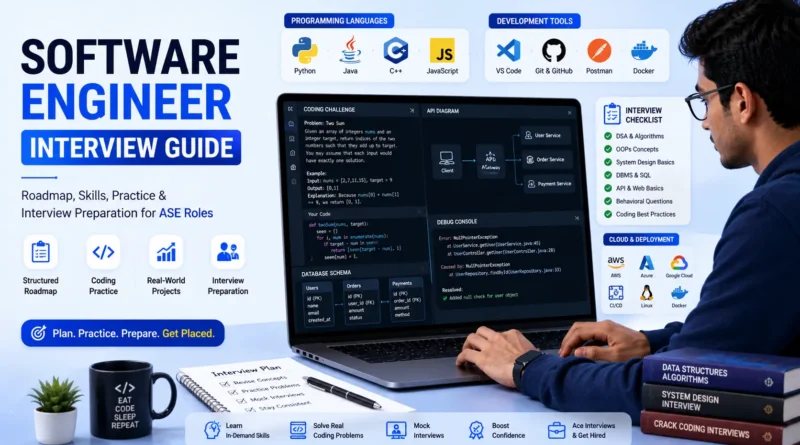
Top Associate Software Engineer Interview Questions and Answers for Freshers
Top Associate Software Engineer Interview Questions and Answers for Freshers (Service & Product Based Companies)
If you are preparing for Associate Software Engineer, Associate System Engineer, Application Developer, or Entry-Level Software Developer roles.
This guide covers the most common Associate Software Engineer interview questions asked across product-based companies, service-based companies, startups, and enterprise organizations.
We analyzed real job descriptions for entry-level software engineering roles, including requirements like Java, Python, C++, JavaScript, SDLC, Agile, DevOps, debugging, testing, problem-solving, enterprise application development, communication skills, and teamwork.
Based on this analysis, recruiters are mainly evaluating:
- Programming fundamentals
- Object-Oriented Programming concepts
- Software Development Life Cycle understanding
- Debugging and problem-solving ability
- Database and backend basics
- Java / Python / JavaScript fundamentals
- Agile and DevOps awareness
- Communication and teamwork
- Project understanding
- Learning mindset
For IBM specifically, enterprise Java, SDLC, DevOps, dependency injection, transaction management, and integration awareness matter.
For product-oriented roles like Empower, debugging, coding standards, collaboration, Agile, and software engineering practices matter heavily.
Also Read:
Software Development Engineer Interview Guide for Freshers
Basic Associate Software Engineer Interview Questions and Answers
This section covers foundational questions commonly asked in fresher interviews.
1. Tell Me About Yourself
Best Answer:
Hello, my name is [Your Name], and I recently completed my Bachelor’s degree in Computer Science / Information Technology. During my academic journey, I developed a strong interest in software development, problem-solving, and application design.
I have worked on academic and personal projects using technologies such as Java, Python, SQL, HTML, CSS, JavaScript, and basic backend development concepts. Through these projects, I learned how software is designed, built, debugged, and improved.
I am particularly interested in entry-level software engineering roles because they allow me to apply technical knowledge in real-world environments while learning from experienced teams.
I believe my problem-solving mindset, adaptability, and willingness to learn make me a strong fit for this role.
Accenture interview experience for freshers 2026
2. What Is Object-Oriented Programming (OOP)?
Best Answer:
Object-Oriented Programming is a programming approach where software is designed around objects instead of just functions or procedures. Objects combine both data and behavior into reusable units.
The four main principles are encapsulation, inheritance, polymorphism, and abstraction.
OOP helps create scalable, reusable, and maintainable software systems, which is why enterprise applications heavily use it.
Example:
In an e-commerce application, Customer, Product, Cart, and Order can all be represented as objects with properties and methods.
This improves organization and modularity in software design.
3. Difference Between Class and Object
Best Answer:
A class is a blueprint or template that defines the structure and behavior of an object, while an object is an actual instance created from that blueprint.
Think of a class as a design plan for a house, and the actual constructed house as the object.
Example:
If “Employee” is a class, then “Rahul, Employee ID 101” is an object created from that class.
This concept is fundamental in Java and enterprise software engineering interviews.
4. What Is Encapsulation?
Best Answer:
Encapsulation means wrapping data and methods into a single class while restricting direct access to internal data. This improves security and prevents unintended modifications.
Example:
In a banking application, account balance should not be directly modified by external code. Instead, methods like deposit() and withdraw() should control access.
Encapsulation is critical in enterprise applications because it improves maintainability and protects business logic.
5. What Is Inheritance?
Best Answer:
Inheritance allows one class to acquire properties and methods from another class. It promotes code reuse and reduces duplication.
Example:
A Manager class can inherit from an Employee class because managers share common employee attributes but also have additional responsibilities.
Inheritance improves extensibility and cleaner software architecture.
6. What Is Polymorphism?
Best Answer:
Polymorphism means the same interface or method can behave differently depending on context.
It improves flexibility and extensibility.
Example:
A payment method can behave differently for UPI, card, or net banking while maintaining the same payment interface.
Java interviews frequently include this question because it reflects understanding of software design flexibility.
7. What Is Abstraction?
Best Answer:
Abstraction means hiding implementation complexity while exposing only essential functionality to users.
Example:
When using an ATM, users interact with simple options like Withdraw or Check Balance without seeing backend transaction processing.
Abstraction reduces complexity and makes systems easier to use and maintain.
8. What Is SDLC?
Best Answer:
SDLC stands for Software Development Life Cycle. It is a structured process used to design, develop, test, deploy, and maintain software applications.
Typical stages include:
- Requirement gathering
- Design
- Development
- Testing
- Deployment
- Maintenance
Understanding SDLC is important because companies expect engineers to work within structured delivery processes.
9. What Is Agile Methodology?
Best Answer:
Agile is a software development methodology focused on iterative development, collaboration, quick feedback, and continuous improvement.
Instead of building everything at once, teams deliver smaller working increments.
Example:
A feature may be developed, tested, and released in short sprint cycles rather than waiting months.
This is widely used in modern product and consulting companies.
10. What Is DevOps?
Best Answer:
DevOps is a set of practices that improves collaboration between development and operations teams to automate software delivery and infrastructure processes.
It helps faster deployment, better reliability, and continuous integration/continuous delivery (CI/CD).
Example:
Code changes automatically tested and deployed through pipelines.
IBM job descriptions specifically mention DevOps exposure.
11. What Is Debugging?
Best Answer:
Debugging is the process of identifying, analyzing, and fixing defects or unexpected behavior in software.
It involves understanding the issue, reproducing it, analyzing logs, inspecting code, and applying corrective fixes.
Example:
If login fails unexpectedly, debugging helps identify whether the issue is in validation logic, API communication, or database authentication.
12. What Is an API?
Best Answer:
API stands for Application Programming Interface. It allows different software systems to communicate with each other using defined request-response mechanisms.
Example:
A frontend application requests product data from a backend API and displays it to users.
Modern enterprise software heavily depends on APIs for integration.
13. Difference Between HTTP and HTTPS
Best Answer:
HTTP transfers data between client and server without encryption, while HTTPS adds SSL/TLS encryption for secure communication.
HTTPS protects login credentials, payment data, and sensitive information.
Enterprise applications always prefer HTTPS for security compliance.
14. What Is Version Control?
Best Answer:
Version control is a system that tracks code changes over time, allowing collaboration, rollback, and safe experimentation.
Git is the most commonly used version control system.
Example:
Multiple developers can work on features without overwriting each other’s code.
15. What Is Git?
Best Answer:
Git is a distributed version control system used to track code changes and support collaborative software development.
Common commands include:
- git init
- git add
- git commit
- git push
- git pull
- git branch
Most engineering teams use Git daily.
Top AI Skills Students Must Learn Before Graduation in 2026
Basic Associate Software Engineer Interview Questions (Continued)
16. What Is a Database and Why Is It Important?
Best Answer:
A database is an organized collection of structured information that applications use to store, retrieve, update, and manage data efficiently. Almost every software system depends on databases for persistence.
For example, an e-commerce application stores customer details, orders, products, and payment records in databases. Without a database, data would be lost whenever the application restarts.
In enterprise software roles like IBM and Empower, understanding databases is important because applications constantly interact with backend systems for business transactions.
17. What Is SQL?
Best Answer:
SQL stands for Structured Query Language. It is used to communicate with relational databases for storing, retrieving, modifying, and managing data.
Common SQL operations include creating tables, inserting records, updating values, deleting data, and querying filtered results.
Example:
SELECT * FROM employees WHERE department=’Engineering’;
Even entry-level software engineering interviews frequently test SQL fundamentals because backend applications depend heavily on data operations.
18. What Is Normalization?
Best Answer:
Normalization is the process of organizing database tables to reduce redundancy and improve data consistency. It helps avoid duplicate information and improves maintainability.
For example, instead of storing customer address details repeatedly in every order row, customer information can be stored in a separate table and referenced through relationships.
This improves storage efficiency and reduces update anomalies in enterprise systems.
19. Difference Between Compilation and Interpretation
Best Answer:
Compilation converts the entire source code into machine code before execution, while interpretation executes code line by line during runtime.
Compiled languages like C/C++ generally offer faster performance because code is pre-translated. Interpreted languages like Python provide faster development flexibility but may have slower runtime execution.
Understanding this helps explain technology trade-offs during engineering interviews.
20. What Is Exception Handling?
Best Answer:
Exception handling is the process of detecting and managing runtime errors gracefully so that applications do not crash unexpectedly.
Example:
If a user enters invalid input or a file is missing, exception handling prevents abrupt application failure and allows controlled recovery.
In Java, this is commonly handled using try-catch-finally blocks.
Enterprise applications depend heavily on proper exception handling for reliability.
Intermediate Associate Software Engineer Interview Questions and Answers
This section focuses on practical engineering concepts frequently asked in product companies and enterprise software interviews.
21. Difference Between Array and ArrayList
Best Answer:
An array has a fixed size once created, while ArrayList is dynamically resizable. Arrays can store primitive types directly, whereas ArrayList stores objects.
For example, if the number of elements is uncertain at runtime, ArrayList is more flexible because it automatically expands as needed.
Arrays may be slightly faster for fixed-size operations, while ArrayList improves usability in real-world application development.
22. Difference Between Method Overloading and Method Overriding
Best Answer:
Method overloading occurs when multiple methods share the same name but different parameter lists in the same class. Method overriding occurs when a child class provides a new implementation of a parent class method.
Example:
calculate(int a, int b) and calculate(double a, double b) demonstrate overloading. Overriding happens when a subclass customizes inherited behavior.
This reflects polymorphism in software design.
23. What Is Dependency Injection?
Best Answer:
Dependency Injection is a design principle where dependencies are provided externally instead of being created directly inside a class.
This improves flexibility, testing, and maintainability.
Example:
Instead of a service class creating its own database connection internally, the connection is injected by a framework like Spring.
IBM specifically mentions dependency injection in its job description, so this is highly relevant.
24. What Is Inversion of Control (IoC)?
Best Answer:
Inversion of Control means shifting control of object creation and lifecycle management from application code to an external framework or container.
Frameworks like Spring manage dependencies, object initialization, and configuration automatically.
This reduces tight coupling and improves scalability in enterprise applications.
25. What Is MVC Architecture?
Best Answer:
MVC stands for Model-View-Controller, a software design pattern that separates application logic into three components.
- Model → data/business logic
- View → UI layer
- Controller → request handling logic
This separation improves maintainability, testing, and cleaner architecture.
Enterprise web applications commonly use MVC patterns.
26. What Is Transaction Management?
Best Answer:
Transaction management ensures that a set of related operations either complete successfully together or fail safely together.
Example:
In banking, money debit and credit operations must both succeed. If one fails, the transaction should roll back.
IBM explicitly mentions transaction management, making this a high-priority interview topic.
27. What Are ACID Properties?
Best Answer:
ACID properties ensure reliable database transactions.
- Atomicity → all or nothing
- Consistency → valid state maintained
- Isolation → transactions don’t interfere improperly
- Durability → committed data persists
These are critical for financial, enterprise, and transactional systems.
28. Difference Between Interface and Abstract Class
Best Answer:
An interface defines a contract of behavior, while an abstract class can provide both abstract and implemented methods.
Interfaces are useful for defining capabilities across unrelated classes, while abstract classes support shared partial implementation.
Java enterprise interviews frequently test this distinction.
29. What Is REST API?
Best Answer:
REST API is an architectural style for communication between systems using standard HTTP methods.
Common operations:
- GET → retrieve data
- POST → create data
- PUT → update data
- DELETE → remove data
Modern frontend-backend integrations rely heavily on REST APIs.
30. What Is JSON?
Best Answer:
JSON stands for JavaScript Object Notation, a lightweight format used for data exchange between systems.
Example:
{
  "name": "Rahul",
  "role": "Engineer"
}
REST APIs commonly send JSON responses.
31. Difference Between Authentication and Authorization
Best Answer:
Authentication verifies identity, while authorization determines access permissions.
Example:
Logging into an application with username/password is authentication. Accessing admin-only settings is authorization.
This distinction is important in secure application design.
32. What Is Multithreading?
Best Answer:
Multithreading allows multiple threads of execution within a program, improving concurrency and responsiveness.
Example:
A web server handling multiple user requests simultaneously uses multithreading.
This improves performance in many enterprise applications.
33. What Is Synchronization?
Best Answer:
Synchronization controls access to shared resources in multithreaded programs to prevent inconsistent data states.
Without synchronization, multiple threads may modify shared data simultaneously, causing race conditions.
34. What Is Batch Processing?
Best Answer:
Batch processing executes large sets of jobs automatically without continuous user interaction.
Example:
Nightly payroll processing or daily banking transaction settlement.
IBM specifically mentions batch processing awareness.
35. What Is Unit Testing?
Best Answer:
Unit testing validates individual software components independently to ensure correctness.
Example:
Testing a discount calculation function without testing the entire application.
This improves reliability and supports TDD practices.
36. What Is Test-Driven Development (TDD)?
Best Answer:
TDD is a development practice where tests are written before implementation code.
Cycle:
- Write failing test
- Write code to pass test
- Refactor code
IBM explicitly references TDD concepts.
37. What Is Code Review?
Best Answer:
Code review is the process where developers inspect each other’s code for quality, correctness, performance, and maintainability.
Empower explicitly mentions code reviews.
Benefits include bug detection, learning, standardization, and better software quality.
38. What Is CI/CD?
Best Answer:
CI/CD stands for Continuous Integration and Continuous Delivery/Deployment.
It automates code building, testing, and release pipelines.
This improves speed, consistency, and deployment confidence.
39. What Is Debugging vs Testing?
Best Answer:
Testing identifies defects, while debugging investigates and fixes them.
Testing asks: “Is something wrong?”
Debugging asks: “Why is it wrong and how do we fix it?”
40. What Is Agile Sprint?
Best Answer:
A sprint is a short time-boxed Agile development cycle where teams complete planned work incrementally.
Typical sprint duration: 1–4 weeks.
It helps teams deliver continuous value and receive rapid feedback.
Advanced Associate Software Engineer Interview Questions and Answers
This section covers deeper engineering concepts often asked in strong fresher interviews at companies like IBM, product companies, enterprise software teams, and high-growth technology organizations. Even for entry-level roles, interviewers may test your conceptual understanding, architecture thinking, debugging maturity, and software engineering fundamentals.
41. What Is a Deadlock?
Best Answer:
A deadlock happens when two or more threads or processes wait indefinitely for resources locked by each other, causing the application to stop progressing.
Example:
Thread A holds Resource 1 and waits for Resource 2, while Thread B holds Resource 2 and waits for Resource 1. Neither can continue.
Deadlocks are critical in enterprise systems because they can freeze application processing and impact users.
Prevention strategies include resource ordering, timeout handling, and minimizing shared locks.
42. What Is a Race Condition?
Best Answer:
A race condition occurs when multiple threads access and modify shared data simultaneously without proper synchronization, causing unpredictable results.
Example:
If two users update the same account balance at the same time without synchronization, incorrect values may be saved.
This issue commonly appears in multi-user enterprise applications and distributed systems.
Synchronization and thread-safe programming help prevent race conditions.
43. What Is Garbage Collection?
Best Answer:
Garbage collection is automatic memory management where unused objects are identified and removed to free system memory.
In Java, developers create objects, but the JVM manages cleanup automatically.
Example:
If an object is no longer referenced anywhere in the program, garbage collection can reclaim its memory.
This reduces memory leaks and improves developer productivity.
44. What Is a Memory Leak?
Best Answer:
A memory leak happens when memory is allocated but not properly released, causing gradual resource exhaustion.
Even in managed environments like Java, leaks can occur if objects remain unnecessarily referenced.
Example:
Keeping unused objects in large collections without cleanup can slowly consume memory.
This affects application performance and reliability.
45. What Is SOLID Principle?
Best Answer:
SOLID is a set of software design principles that improve maintainability and scalability.
- Single Responsibility Principle
- Open/Closed Principle
- Liskov Substitution Principle
- Interface Segregation Principle
- Dependency Inversion Principle
Example:
A payment processing class should only handle payment logic, not reporting or notifications.
These principles improve cleaner software architecture.
46. What Is a Design Pattern?
Best Answer:
Design patterns are proven reusable software design solutions for recurring engineering problems.
They improve maintainability, readability, and architecture consistency.
Common patterns include:
- Singleton
- Factory
- Observer
- MVC
- Strategy
Enterprise engineering interviews often test basic awareness of design patterns.
47. Explain Singleton Design Pattern
Best Answer:
Singleton ensures that only one instance of a class exists throughout the application lifecycle.
Example:
A centralized configuration manager or logger may need only one shared instance.
This pattern helps avoid duplicate resource creation and ensures controlled access.
However, overuse can reduce flexibility and testability.
48. What Is Load Balancing?
Best Answer:
Load balancing distributes incoming traffic across multiple servers to improve performance, availability, and scalability.
Example:
An e-commerce website during festival sales distributes requests across multiple servers instead of overloading one machine.
This prevents downtime and improves user experience.
49. What Is Caching?
Best Answer:
Caching stores frequently accessed data temporarily for faster retrieval instead of repeatedly performing expensive operations.
Example:
Product catalog data can be cached instead of querying the database for every request.
This improves speed, scalability, and reduces backend load.
50. What Is Indexing in Databases?
Best Answer:
Indexing improves query performance by creating optimized lookup structures for faster data retrieval.
Example:
Searching users by email becomes much faster with an index instead of scanning every row.
However, excessive indexing increases storage and slows insert/update operations.
51. Difference Between DELETE, TRUNCATE, and DROP
Best Answer:
DELETE: removes selected rows and can be rolled back.
TRUNCATE: removes all rows quickly and usually resets storage allocation.
DROP: removes the entire table structure permanently.
This is a very common interview question for software engineering roles.
52. What Is Database Join?
Best Answer:
A join combines data from multiple tables based on related columns.
Common joins:
- INNER JOIN
- LEFT JOIN
- RIGHT JOIN
- FULL JOIN
Example:
Joining Employee and Department tables to show employee department names.
53. What Is Microservices Architecture?
Best Answer:
Microservices architecture breaks applications into smaller independently deployable services.
Each service handles a specific business function.
Example:
Authentication, payment, notifications, and order management can run as separate services.
This improves scalability and deployment flexibility.
54. Monolithic vs Microservices
Best Answer:
Monolithic applications package everything into one deployable unit, while microservices split functionality into independent services.
Monoliths are simpler initially. Microservices scale better for large systems.
Interviewers ask this to test architecture understanding.
55. What Is API Rate Limiting?
Best Answer:
API rate limiting restricts how many requests a client can make within a time period.
Example:
A public API may allow only 100 requests per minute to prevent abuse.
This improves security, stability, and fair resource usage.
56. What Is JWT Authentication?
Best Answer:
JWT (JSON Web Token) is a token-based authentication mechanism used in modern web applications.
After successful login, the server issues a token that the client includes in future requests.
This supports stateless authentication and API security.
57. What Is ORM?
Best Answer:
ORM (Object Relational Mapping) allows developers to interact with databases using objects instead of raw SQL queries.
Example:
Frameworks like Hibernate map Java objects to database tables.
This improves productivity and cleaner code organization.
58. What Is Functional Programming?
Best Answer:
Functional programming focuses on pure functions, immutability, and declarative logic instead of changing shared state.
Modern Java includes lambda expressions supporting functional programming styles.
IBM explicitly mentions functional programming awareness.
59. What Is Aspect-Oriented Programming (AOP)?
Best Answer:
AOP separates cross-cutting concerns like logging, security, or transaction handling from core business logic.
Example:
Instead of writing logging code in every service method, AOP applies logging automatically.
IBM specifically mentions AOP concepts.
60. What Is Enterprise System Integration?
Best Answer:
Enterprise system integration connects different software systems so they can exchange data and work together seamlessly.
Example:
An HR system communicating with payroll and attendance systems.
IBM roles strongly emphasize integration and enterprise application development.
Hands-On Practical Associate Software Engineer Interview Questions and Answers
This section is one of the most important for IBM Associate System Engineer, Associate Software Engineer, Application Developer, and entry-level software engineering interviews.
Many interviewers move beyond theory and evaluate how you think practically, debug issues, design solutions, and explain projects.
These questions test real engineering thinking rather than memorized theory.
61. Explain Your Project in Detail
Best Answer:
I developed a Job Search Application using the MERN stack (MongoDB, Express.js, React.js, Node.js) to help users search for jobs, track applications, and manage job-related activities efficiently.
The main problem I wanted to solve was simplifying job search management for freshers who apply across multiple platforms and lose track of applications.
Core features included:
- User registration and authentication
- Job search and filtering
- Application tracking dashboard
- Saved jobs functionality
- Responsive UI design
On the backend, I built REST APIs for user authentication, job retrieval, and application management. MongoDB handled persistent storage.
Challenges included API integration, state management, debugging authentication flow, and ensuring clean frontend-backend communication.
This project helped me understand full-stack architecture, debugging, API design, and practical software engineering workflows.
62. A Bug Appears in Production. How Will You Handle It?
Best Answer:
If a production bug occurs, my first priority is understanding severity and business impact.
I would follow a structured approach:
- Reproduce the issue
- Check logs and error traces
- Identify affected users/features
- Analyze recent code changes
- Implement safe fix
- Test thoroughly before deployment
Example:
If login suddenly fails for users after deployment, I would inspect authentication logs, API responses, token handling, and recent config changes.
Production fixes require calm debugging and controlled deployment.
63. API Returns 500 Internal Server Error. What Will You Do?
Best Answer:
A 500 error indicates a server-side failure.
My troubleshooting approach:
- Check application logs
- Inspect stack traces
- Validate request payload
- Check database connectivity
- Verify backend service dependencies
- Review recent deployments
Example:
If a user creation API fails, causes may include null pointer exceptions, invalid DB connection, schema mismatch, or backend logic errors.
64. Frontend Is Not Displaying Backend Data
Best Answer:
I would debug systematically instead of assuming frontend failure immediately.
Checks include:
- Is API responding successfully?
- Any CORS errors?
- Frontend network request status?
- JSON parsing issues?
- State update problems?
- Authentication token failure?
Example:
Sometimes backend works correctly, but frontend incorrectly maps response fields.
Practical debugging requires verifying each layer.
65. How Would You Design a Login System?
Best Answer:
A secure login system includes:
- User credential input
- Backend validation
- Password hashing
- Authentication logic
- Session or JWT token generation
- Role-based authorization
- Error handling
Example Flow:
User enters email/password → backend validates credentials → password hash comparison → token generated → authenticated access granted.
Security considerations include rate limiting and secure HTTPS communication.
66. Database Query Is Very Slow. How Will You Optimize It?
Best Answer:
Slow query optimization approach:
- Analyze execution plan
- Check indexing
- Reduce unnecessary joins
- Avoid SELECT *
- Optimize filtering conditions
- Review database statistics
Example:
Searching customers by email without indexing forces full table scans, making queries slow.
Index optimization significantly improves performance.
67. How Do You Resolve Git Merge Conflicts?
Best Answer:
Merge conflicts happen when multiple developers modify overlapping code sections.
Resolution steps:
- Pull latest changes
- Review conflict markers
- Understand intended logic
- Merge correct code manually
- Retest functionality
- Commit resolved changes
Good collaboration and communication reduce recurring conflicts.
68. Application Crashes After Deployment. What Will You Check?
Best Answer:
Deployment failures often involve environment or configuration issues.
I would check:
- Server logs
- Environment variables
- Dependency mismatches
- Build artifact correctness
- Database connectivity
- Memory/resource constraints
Example:
An application may work locally but fail in production due to missing environment secrets.
69. Explain a Debugging Issue You Faced
Best Answer:
In a project, login functionality failed despite valid credentials.
I systematically checked:
- Frontend request payload
- API endpoint behavior
- Password hashing logic
- Database user retrieval
I discovered token generation failed due to incorrect secret configuration.
Fixing configuration resolved authentication.
This taught me structured debugging and avoiding assumptions.
70. How Would You Build a REST API?
Best Answer:
REST API development steps:
- Understand business requirements
- Define resources/endpoints
- Design request/response structure
- Implement backend logic
- Connect database
- Add validation/security
- Test endpoints
Example:
Job API endpoints:
- GET /jobs
- POST /jobs
- PUT /jobs/{id}
- DELETE /jobs/{id}
71. How Do You Write Clean Code?
Best Answer:
Clean code principles include:
- Meaningful naming
- Small reusable functions
- Avoid duplication
- Readable logic
- Proper comments when necessary
- Error handling
- Consistent formatting
Maintainability matters more than simply making code “work.”
72. How Would You Test a Feature Before Release?
Best Answer:
Testing includes:
- Functional validation
- Boundary case testing
- Negative scenarios
- Integration testing
- Regression testing
- Performance checks if relevant
Example:
For registration feature, test valid signup, invalid inputs, duplicate users, backend failures, and UI error handling.
73. What If Application Memory Usage Keeps Increasing?
Best Answer:
I would suspect memory leaks or inefficient object lifecycle management.
Investigation includes:
- Memory profiling
- Log monitoring
- Heap dump analysis
- Long-lived object review
- Cache misuse analysis
This is especially important in enterprise Java systems.
74. How Would You Improve Existing Application Performance?
Best Answer:
Performance optimization approach:
- Measure bottlenecks first
- Optimize DB queries
- Improve caching
- Reduce unnecessary API calls
- Improve frontend rendering efficiency
- Optimize backend processing
Engineering optimization should be data-driven, not assumption-driven.
75. How Would You Integrate Two Enterprise Systems?
Best Answer:
Enterprise integration requires understanding business data flow, API contracts, security, and transformation logic.
Steps:
- Define integration objective
- Understand source/destination systems
- Design communication APIs
- Validate authentication/security
- Handle failures/retries
- Monitor integration health
This aligns strongly with IBM’s integration-focused role.
76. What If a Requirement Is Unclear?
Best Answer:
I would avoid assumptions and clarify requirements with stakeholders or senior engineers.
Clarification prevents wasted development effort and incorrect implementation.
Good engineers ask the right questions early.
77. How Do You Handle Code Review Feedback?
Best Answer:
I see code reviews as learning opportunities rather than criticism.
I would understand the reasoning behind feedback, improve code accordingly, and adopt better practices for future development.
Collaborative learning improves engineering maturity.
78. How Would You Troubleshoot a Failed Database Connection?
Best Answer:
Checks include:
- Connection credentials
- Server availability
- Firewall/network access
- Connection pool configuration
- Driver compatibility
- Timeout/log errors
Systematic troubleshooting avoids wasted effort.
79. What If Unit Tests Fail After Code Changes?
Best Answer:
I would inspect failing test cases, understand expected behavior, review recent changes, and determine whether the issue is broken logic or outdated tests.
Fixes should preserve intended functionality while maintaining test reliability.
80. How Would You Contribute as a Fresher in a Real Engineering Team?
Best Answer:
As a fresher, I would focus on learning quickly, understanding coding standards, asking thoughtful questions, contributing to debugging/testing, writing clean code, and collaborating effectively.
I understand that engineering growth comes from disciplined execution, continuous improvement, and strong teamwork.
Scenario-Based Associate Software Engineer Interview Questions and Answers
This is one of the highest-impact interview sections for IBM Associate System Engineer, Associate Software Engineer, Application Developer, Java Developer, and product company fresher roles.
Even if your technical fundamentals are strong, many candidates get rejected in scenario-based rounds because interviewers want to evaluate real engineering thinking, collaboration, ownership, communication, problem-solving maturity, and decision-making.
These questions simulate practical workplace situations you may face as a software engineer.
81. A Production Issue Happens Late at Night. What Will You Do?
Best Answer:
If a production issue occurs, my first priority is understanding business impact instead of panicking. I would gather critical information such as affected users, severity, error symptoms, and recent deployments.
Then I would follow structured incident handling:
- Check logs and monitoring alerts
- Identify root cause indicators
- Attempt safe rollback if needed
- Inform relevant stakeholders
- Coordinate with team members
- Implement validated fix
Example:
If a payment service stops working after deployment, immediate rollback may reduce downtime while root cause investigation continues.
Ownership and calm response matter greatly in engineering roles.
82. Your Teammate Is Not Contributing to a Critical Feature
Best Answer:
I would first avoid assumptions and communicate professionally to understand whether the issue is technical difficulty, unclear expectations, workload pressure, or personal constraints.
If collaboration can solve the issue, I would support and align responsibilities clearly.
If project deadlines are impacted and the issue continues, I would escalate appropriately while staying solution-focused instead of becoming confrontational.
Engineering teamwork depends on communication and professionalism.
83. Manager Gives You a Technology You Have Never Worked With
Best Answer:
As a fresher, learning unfamiliar technologies is expected. I would approach this positively rather than resisting.
My plan:
- Understand project expectations
- Learn core concepts quickly
- Use documentation/tutorials
- Build a small proof-of-concept
- Seek mentorship when necessary
Example:
If assigned Spring Boot without prior experience, I would rapidly learn fundamentals, REST API structure, dependency injection, and deployment basics.
Adaptability is highly valued in IBM and product teams.
84. Deadline Is Tomorrow but Feature Is Incomplete
Best Answer:
I would first assess the exact remaining work and prioritize critical functionality over non-essential enhancements.
Then I would communicate transparently with the team or manager instead of silently struggling.
Possible actions:
- Focus on minimum viable delivery
- Request technical clarification if blocked
- Collaborate for faster resolution
- Avoid risky shortcuts that break quality
Engineering professionalism includes realistic planning and transparent communication.
85. You Introduced a Bug That Broke a Feature
Best Answer:
If my code caused a bug, I would take ownership immediately instead of hiding the issue.
I would:
- Understand impact
- Investigate root cause
- Fix safely
- Test thoroughly
- Communicate transparently
- Learn from the mistake
Strong engineers are accountable and improvement-oriented.
86. Stakeholder Changes Requirements Midway
Best Answer:
Requirement changes are common in Agile environments.
I would first understand what changed, why it changed, and how it affects scope, architecture, timelines, and dependencies.
Then I would work with the team to estimate impact and adjust plans appropriately.
Good engineers adapt while maintaining structured execution.
87. Your Code Review Receives Strong Criticism
Best Answer:
I would remain professional and focus on technical improvement rather than reacting emotionally.
Code reviews exist to improve software quality and team learning.
I would understand feedback reasoning, ask clarifying questions if needed, and improve the implementation.
Growth mindset matters more than ego.
88. Database Server Suddenly Becomes Slow
Best Answer:
I would investigate systematically instead of guessing.
Checks include:
- Query performance
- Recent deployments
- Resource usage
- Index health
- Lock contention
- Connection pool pressure
Example:
A newly deployed inefficient query may overload the database unexpectedly.
89. Multiple Bugs Reported Simultaneously
Best Answer:
I would prioritize based on severity, business impact, affected users, and urgency rather than handling randomly.
Critical production issues affecting many users come first.
Structured triage improves response quality and avoids chaos.
90. A Senior Developer Disagrees With Your Solution
Best Answer:
I would respectfully understand their reasoning rather than defending my approach emotionally.
Experienced engineers often see risks juniors may miss.
If discussion is constructive, comparing trade-offs helps select the best engineering solution.
Collaboration matters more than personal attachment.
91. API Integration Keeps Failing
Best Answer:
I would troubleshoot layer by layer:
- Endpoint correctness
- Authentication tokens
- Request payload
- Response codes
- Timeout/network issues
- Backend logs
Systematic debugging avoids random trial-and-error.
92. QA Reports a Bug You Cannot Reproduce
Best Answer:
I would gather detailed reproduction steps, environment details, logs, test data, screenshots, and version information.
Many bugs are environment-specific or data-dependent.
Good engineers investigate patiently before dismissing reports.
93. You Need to Learn a Framework Quickly for a Project
Best Answer:
I would focus on practical learning rather than trying to master everything immediately.
Approach:
- Understand core architecture
- Build small example project
- Study documentation
- Practice common workflows
- Ask targeted questions
Engineering success depends on learning efficiency.
94. Client Reports Incorrect Data in Application
Best Answer:
I would first verify the issue carefully because data errors can originate from frontend, backend logic, integration systems, or database inconsistencies.
Then I would isolate the affected workflow and identify root cause before applying corrective fixes.
Accuracy is critical in enterprise systems.
95. CI/CD Pipeline Fails Before Deployment
Best Answer:
I would inspect pipeline logs to identify failure stage.
Possible causes:
- Compilation failure
- Dependency issue
- Test failure
- Environment misconfiguration
- Permission issue
Engineering maturity means diagnosing systematically rather than rerunning blindly.
96. Another Team’s API Is Delaying Your Work
Best Answer:
I would communicate proactively instead of waiting passively.
Possible approaches:
- Clarify expected timeline
- Use mock services temporarily
- Coordinate dependency planning
- Escalate professionally if necessary
Cross-team collaboration is essential in enterprise engineering.
97. Your Application Uses Too Much Memory in Production
Best Answer:
I would investigate whether the issue involves memory leaks, inefficient caching, large object retention, excessive logging, or improper lifecycle handling.
Profiling and root-cause analysis would guide optimization instead of assumptions.
98. You Discover Security Vulnerability in Application
Best Answer:
Security issues require urgency and confidentiality.
I would document findings, assess impact, notify relevant stakeholders, and work on remediation responsibly.
Example:
If authentication bypass is discovered, immediate containment and secure fix become top priority.
99. A User Reports “Application Is Slow” but Gives Little Information
Best Answer:
I would ask structured diagnostic questions:
- Which feature is slow?
- When did it start?
- All users or specific users?
- Any recent changes?
- Error messages?
Precise troubleshooting begins with precise information gathering.
100. Why Should We Hire You for This Associate Software Engineer Role?
Best Answer:
I believe I am a strong fit because I combine software engineering fundamentals, problem-solving mindset, adaptability, and strong willingness to learn.
I understand that entry-level engineering roles are not about knowing everything from day one, but about learning quickly, writing maintainable code, collaborating effectively, and taking ownership.
Through my projects and preparation, I have developed practical understanding of software development workflows, debugging, APIs, databases, and engineering discipline.
I am confident I can contribute positively while continuously growing in the team.
Final Interview Preparation Tips for Associate Software Engineer Roles
- Master OOP concepts thoroughly
- Revise Java/Python/JavaScript fundamentals
- Practice SQL and DBMS basics
- Understand SDLC, Agile, DevOps
- Prepare project explanation deeply
- Practice debugging scenarios
- Learn REST API fundamentals
- Understand Git workflows
- Prepare enterprise integration concepts
- Practice behavioral communication
- Study code review mindset
- Be confident, practical, and structured in answers
Also Read:
ATS-Friendly Resume Creation Guide for Freshers Using Overleaf and ChatGPT
Wipro WILP Interview Questions and Answers for Freshers
Final Conclusion
Associate Software Engineer interviews test far more than textbook knowledge. Recruiters want candidates who can think like engineers—solve problems, debug systematically, communicate clearly, collaborate professionally, and adapt quickly.
Strong preparation across basics, intermediate concepts, advanced engineering fundamentals, hands-on debugging, and scenario-based problem solving dramatically improves your selection chances.
Winning Formula:
Programming + Problem Solving + Practical Thinking + Communication + Ownership + Learning Mindset = Software Engineering Job Offer
Also Read this:
IBM Associate System Engineer Interview Questions and Answers for Freshers (Complete Guide)
IBM is one of the most preferred companies for fresh engineering graduates looking to start careers in software development, enterprise technology, cloud computing, application development, and consulting. The IBM Associate System Engineer role is highly competitive because it offers strong learning exposure, enterprise technology experience, and global career growth opportunities.
However, many freshers underestimate IBM’s hiring process. IBM does not only test coding skills. Recruiters evaluate programming fundamentals, problem-solving ability, communication, project knowledge, software engineering concepts, and behavioral readiness.
This complete interview guide covers real IBM Associate System Engineer interview questions, coding round expectations, technical interview preparation, HR questions, scenario-based discussions, and communication round preparation.
IBM Associate System Engineer Hiring Process
Based on recent IBM fresher hiring drives, the selection process usually includes:
- Online Coding Assessment
- English Communication Assessment
- Technical Interview
- Managerial / HR Round
- Document Verification / Final Selection
Some hiring drives may include AI-based communication assessments or offline coding rounds depending on hiring volume.
What IBM Looks For in Freshers
- Programming fundamentals
- Problem-solving skills
- Software Development Life Cycle understanding
- OOPs knowledge
- DBMS and SQL basics
- Project clarity
- Communication skills
- Professional attitude
- Willingness to relocate
- Adaptability
- Analytical thinking
- Team collaboration
IBM Associate System Engineer Interview Questions and Answers (Basic Level)
1. Tell Me About Yourself
Best Interview Answer:
My name is [Your Name], and I recently completed my Bachelor’s degree in Computer Science / Information Technology / related engineering stream. During my academic journey, I developed strong interest in software development, programming, and problem-solving. I have worked on academic projects involving technologies like Java, Python, SQL, web development, or related tools. I consider myself a quick learner, adaptable team player, and someone who enjoys solving technical challenges. I am looking for an opportunity where I can apply my technical knowledge while continuously learning in a global organization like IBM.
2. Why Do You Want to Join IBM?
Best Interview Answer:
IBM is globally recognized for innovation, enterprise technology leadership, consulting excellence, cloud transformation, and AI-driven solutions. As a fresher, joining IBM would provide exposure to large-scale enterprise projects, strong mentorship, and structured professional growth. I also appreciate IBM’s learning culture, technology leadership, and global client environment. I believe this role aligns well with my technical learning goals and long-term software engineering aspirations.
3. What Do You Know About IBM?
Best Interview Answer:
IBM is a global technology and consulting company known for enterprise software, cloud computing, AI solutions, cybersecurity, hybrid cloud transformation, and digital consulting services. IBM works with organizations worldwide across industries including banking, healthcare, telecom, manufacturing, and government sectors. IBM is also known for technologies like Watson AI, enterprise automation, Red Hat integration, and consulting innovation. Its reputation for engineering excellence makes it a strong career destination for freshers.
4. What Is SDLC?
Best Interview Answer:
SDLC stands for Software Development Life Cycle. It is a structured process used to design, develop, test, deploy, and maintain software applications systematically. Common phases include requirement gathering, planning, design, development, testing, deployment, and maintenance. SDLC improves software quality, reduces project risks, and ensures organized development workflows. Different SDLC models are used depending on project needs.
Example:
Developing an online banking application would follow SDLC stages from business requirement analysis to deployment and support.
5. Difference Between Waterfall and Agile Model
Best Interview Answer:
Waterfall is a sequential software development model where each phase is completed before moving to the next. Agile is iterative and incremental, allowing continuous development, feedback, and improvements. Waterfall works better when requirements are fixed, while Agile is suitable when requirements evolve frequently. Agile improves flexibility, collaboration, and faster delivery cycles.
6. What Is Object-Oriented Programming?
Best Interview Answer:
Object-Oriented Programming is a programming approach based on objects and classes that combine data and behavior. OOP improves code modularity, maintainability, reusability, and scalability. Core concepts include encapsulation, inheritance, polymorphism, and abstraction. Most enterprise applications use OOP principles because they improve structured software design.
Example:
A banking system may represent Customer, Account, Transaction, and Loan as separate classes.
7. What Is Encapsulation?
Best Interview Answer:
Encapsulation means binding data and methods into a single unit, usually a class, while restricting direct access to internal implementation details. It improves security, modularity, and controlled access using getters and setters.
Example:
In a BankAccount class, account balance may be private and accessed only through deposit or withdrawal methods.
8. What Is Inheritance?
Best Interview Answer:
Inheritance allows one class to acquire properties and methods of another class, improving code reuse and maintainability. The parent class provides common functionality, while child classes extend or customize behavior.
Example:
Employee can be a parent class, while Developer and Manager inherit common employee attributes.
9. What Is Polymorphism?
Best Interview Answer:
Polymorphism allows the same interface or method name to behave differently depending on implementation. It improves flexibility and reusable design. Common types include method overloading and method overriding.
Example:
A payment method may process credit card, UPI, or net banking differently using the same interface.
10. What Is Abstraction?
Best Interview Answer:
Abstraction hides implementation complexity while exposing only essential functionality. It helps reduce system complexity and improves maintainability.
Example:
A user can drive a car without understanding engine internals.
Wipro WILP Interview Questions and Answers for Freshers
11. What Is DBMS?
Best Interview Answer:
DBMS stands for Database Management System. It is software used to create, manage, retrieve, update, and organize data efficiently. DBMS improves data consistency, security, integrity, and accessibility for applications.
Examples:
MySQL, PostgreSQL, Oracle Database.
12. Difference Between DBMS and RDBMS
Best Interview Answer:
DBMS stores data generally without strict relational structures, while RDBMS organizes data into related tables using keys and relationships. RDBMS supports normalization, SQL querying, and stronger consistency models.
13. What Is a Primary Key?
Best Interview Answer:
A primary key uniquely identifies each record in a database table. It cannot contain duplicate or null values.
Example:
Student_ID uniquely identifies each student in a student database.
14. What Is a Foreign Key?
Best Interview Answer:
A foreign key is a column that establishes a relationship between two tables by referencing another table’s primary key.
Example:
Department_ID in Employee table may reference Department table.
15. What Is Normalization?
Best Interview Answer:
Normalization is the process of organizing database tables to reduce redundancy and improve data integrity. It helps eliminate duplication and maintain structured relationships.
16. What Is SQL?
Best Interview Answer:
SQL stands for Structured Query Language. It is used to manage relational databases through operations like querying, inserting, updating, deleting, joining, and schema management.
17. Difference Between DELETE, TRUNCATE, and DROP
Best Interview Answer:
DELETE removes selected records and can be rolled back. TRUNCATE removes all rows faster with minimal logging. DROP removes the entire table structure permanently.
18. What Is a Stack?
Best Interview Answer:
A stack is a linear data structure following LIFO (Last In First Out) principle.
Example:
Undo operations in text editors.
19. What Is a Queue?
Best Interview Answer:
A queue follows FIFO (First In First Out) principle.
Example:
Task scheduling or printer job management.
20. What Is Recursion?
Best Interview Answer:
Recursion is a programming technique where a function calls itself to solve smaller versions of a problem until a base condition is reached.
Example:
Factorial calculation or Fibonacci sequence generation.
IBM Associate System Engineer Interview Questions and Answers (Intermediate Technical + Programming Questions)
This section covers intermediate-level IBM interview questions that are frequently asked in technical rounds. IBM recruiters often focus on programming fundamentals, logical thinking, database concepts, software engineering understanding, and practical coding knowledge.
21. Why Is Java Platform Independent?
Best Interview Answer:
Java is platform independent because Java code is compiled into bytecode, which runs on the Java Virtual Machine (JVM) rather than directly on the operating system. Since JVM exists for different operating systems like Windows, Linux, and macOS, the same Java program can run anywhere without changing source code. This is commonly described as “Write Once, Run Anywhere.”
Example:
A Java banking application compiled on Windows can run on Linux if JVM is installed.
22. Difference Between C++ and Java
Best Interview Answer:
C++ supports both procedural and object-oriented programming, while Java is primarily object-oriented. Java offers automatic memory management through garbage collection, while C++ requires manual memory management. Java is platform independent because of JVM, whereas C++ programs are platform dependent after compilation. Java also does not support direct multiple inheritance through classes, unlike C++.
23. What Is Exception Handling?
Best Interview Answer:
Exception handling is a mechanism used to manage runtime errors gracefully without crashing the program. It improves application reliability by separating normal logic from error-handling logic. Common blocks include try, catch, finally, throw, and throws.
Example:
If a user enters invalid numeric input, exception handling prevents abrupt program termination.
24. What Is Method Overloading?
Best Interview Answer:
Method overloading means defining multiple methods with the same name but different parameter lists within the same class. It improves readability and code flexibility by allowing similar operations with different inputs.
Example:
A calculateSalary() method may accept monthly salary, annual salary, or salary with bonus parameters.
25. What Is Method Overriding?
Best Interview Answer:
Method overriding occurs when a child class provides its own implementation of a parent class method with the same signature. It enables runtime polymorphism and customized behavior.
Example:
A Payment class may define processPayment(), while UPIPayment overrides it differently.
26. What Is a Constructor?
Best Interview Answer:
A constructor is a special method automatically called when an object is created. Its purpose is to initialize object attributes and set up default values. Constructors improve cleaner object initialization.
27. Difference Between Array and Linked List
Best Interview Answer:
An array stores elements in contiguous memory locations, providing faster direct access through indexing. Linked lists store elements as connected nodes with pointers, allowing dynamic memory allocation but slower random access. Arrays are efficient when size is fixed, while linked lists are useful when size changes frequently.
28. What Is a HashMap?
Best Interview Answer:
HashMap is a data structure that stores key-value pairs for fast retrieval using hashing techniques. It improves search efficiency significantly compared to linear traversal.
Example:
Storing employee ID as key and employee details as value.
29. What Is Time Complexity?
Best Interview Answer:
Time complexity measures how the execution time of an algorithm grows as input size increases. It helps evaluate algorithm efficiency. Common complexities include O(1), O(log n), O(n), O(n²), and O(2ⁿ).
Example:
Linear search has O(n), while binary search has O(log n).
30. What Is Space Complexity?
Best Interview Answer:
Space complexity measures how much additional memory an algorithm requires as input size grows. Efficient algorithms aim to balance time and space usage.
31. What Is Bubble Sort?
Best Interview Answer:
Bubble sort repeatedly compares adjacent elements and swaps them if they are in the wrong order until the list becomes sorted. It is simple but inefficient for large datasets because its time complexity is O(n²).
32. What Is Selection Sort?
Best Interview Answer:
Selection sort repeatedly selects the minimum element from the unsorted portion and places it in the correct position. Its time complexity is also O(n²).
33. What Is Insertion Sort?
Best Interview Answer:
Insertion sort builds the sorted list gradually by inserting each element into its proper position. It performs well for small or nearly sorted datasets.
34. Difference Between Interface and Abstract Class
Best Interview Answer:
An interface defines behavior contracts without implementation details (traditionally), while an abstract class can include both abstract and implemented methods. Interfaces support multiple inheritance-like behavior, while abstract classes support shared base functionality.
35. What Is Dependency Injection?
Best Interview Answer:
Dependency Injection is a design principle where dependencies are provided externally rather than created internally. It improves modularity, testability, and maintainability.
Example:
Spring Framework uses dependency injection extensively.
36. What Is SQL JOIN?
Best Interview Answer:
SQL JOIN combines data from multiple tables based on relationships between columns.
Types:
- INNER JOIN
- LEFT JOIN
- RIGHT JOIN
- FULL JOIN
Example:
Combining Employee and Department tables using Department_ID.
37. What Is Agile?
Best Interview Answer:
Agile is an iterative software development methodology focused on flexibility, collaboration, continuous feedback, and incremental delivery. It improves adaptability in changing project requirements.
38. What Is Version Control?
Best Interview Answer:
Version control helps track changes in source code over time, enabling collaboration, rollback, branching, and safer development workflows.
Example:
Git is widely used for version control.
39. What Is REST API?
Best Interview Answer:
REST API is an architectural style for communication between systems using HTTP methods like GET, POST, PUT, and DELETE. It allows applications to exchange data efficiently.
Example:
A frontend application calling backend APIs to fetch user profile data.
40. Difference Between GET and POST
Best Interview Answer:
GET retrieves data from the server and is generally used for read operations. POST sends data to the server for creation or processing. GET parameters appear in URLs, while POST data is sent in request bodies.
IBM Associate System Engineer Interview Questions and Answers (Advanced Technical + Coding Questions)
This section focuses on advanced technical and coding questions that IBM interviewers may ask during technical rounds. These questions test logical thinking, software engineering fundamentals, coding knowledge, debugging ability, and problem-solving skills.
41. Explain JVM, JRE, and JDK
Best Interview Answer:
JVM stands for Java Virtual Machine. It is responsible for executing Java bytecode and making Java platform independent. JRE stands for Java Runtime Environment, which includes JVM and libraries needed to run Java applications. JDK stands for Java Development Kit, which contains JRE plus development tools like compiler and debugger required to build Java applications.
Simple understanding:
- JVM = Runs Java code
- JRE = Runs Java applications
- JDK = Develops Java applications
42. What Is Multithreading?
Best Interview Answer:
Multithreading allows multiple threads to execute concurrently within a program, improving performance and resource utilization. It is useful for handling parallel tasks like background processing, file downloads, or server request handling. In enterprise systems, multithreading improves responsiveness and throughput.
Example:
A web server handling multiple client requests simultaneously.
43. What Is Synchronization?
Best Interview Answer:
Synchronization controls access to shared resources when multiple threads operate simultaneously. Without synchronization, race conditions may occur, causing inconsistent or incorrect results. It ensures thread-safe operations in concurrent environments.
Example:
Two threads updating the same bank account balance.
44. Difference Between Process and Thread
Best Interview Answer:
A process is an independent program execution unit with its own memory space, while a thread is a lightweight execution unit within a process sharing the same memory. Threads are faster and more efficient for parallel execution, while processes provide stronger isolation.
45. What Is Garbage Collection?
Best Interview Answer:
Garbage collection is Java’s automatic memory management mechanism that removes unused objects from memory. It helps prevent memory leaks and reduces manual memory handling complexity. This improves application reliability and developer productivity.
46. What Is a Deadlock?
Best Interview Answer:
Deadlock occurs when two or more processes or threads wait indefinitely for resources held by each other, causing system blockage.
Example:
Thread A waits for Resource 1 held by Thread B, while Thread B waits for Resource 2 held by Thread A.
47. What Is Recursion with Real Coding Use Case?
Best Interview Answer:
Recursion solves problems by breaking them into smaller versions of the same problem. It is useful in tree traversal, factorial calculations, graph algorithms, directory traversal, and divide-and-conquer approaches.
Example:
Finding factorial of 5:
5 × 4 × 3 × 2 × 1
The function keeps calling itself until the base case is reached.
48. Write Logic for Palindrome Number
Best Interview Answer:
A palindrome reads the same forward and backward. The logic involves reversing the original number and comparing it with the original value.
Example:
121 → Reverse = 121 → Palindrome
Logic:
- Store original number
- Extract digits using modulus
- Reverse the number
- Compare with original
49. Write Logic for Fibonacci Series
Best Interview Answer:
Fibonacci series generates numbers where each number equals the sum of the previous two numbers.
Example:
0, 1, 1, 2, 3, 5, 8, 13…
Logic:
- Initialize first two numbers
- Loop required number of times
- Calculate next = first + second
- Update values
50. Write Logic for Prime Number Check
Best Interview Answer:
A prime number has exactly two divisors: 1 and itself. The logic checks divisibility from 2 up to square root of the number.
Example:
7 is prime because only divisible by 1 and 7.
51. Reverse a String Without Built-In Functions
Best Interview Answer:
This tests loop understanding and string manipulation logic. A common approach is iterating from the last character to the first and building a new string.
Example:
“IBM” → “MBI”
52. Difference Between == and equals()
Best Interview Answer:
In Java, == compares object references or primitive values, while equals() compares actual object content depending on implementation.
Example:
Two String objects may have same content but different references.
53. What Is Method Overriding in Real Projects?
Best Interview Answer:
Method overriding allows child classes to customize inherited behavior. In real enterprise applications, this supports extensible architecture and role-specific implementations.
Example:
A Notification class defines sendAlert(), while EmailNotification and SMSNotification override behavior differently.
54. What Is Database Indexing?
Best Interview Answer:
Indexing improves database query performance by allowing faster data lookup instead of scanning the entire table. However, excessive indexing increases write overhead.
Example:
Searching employee records by Employee_ID becomes much faster with indexing.
55. What Is ACID in DBMS?
Best Interview Answer:
ACID properties ensure reliable database transactions:
- Atomicity → all or nothing
- Consistency → valid state maintenance
- Isolation → transactions independent
- Durability → committed changes persist
Example:
Bank money transfer should either complete fully or not happen at all.
56. What Is API?
Best Interview Answer:
API (Application Programming Interface) allows communication between software systems. APIs expose functionality so applications can exchange data or trigger operations.
Example:
A weather app fetching weather data from an external service.
57. What Is Debugging?
Best Interview Answer:
Debugging is the process of identifying, analyzing, and fixing software defects. It involves tracing logic errors, syntax issues, runtime failures, and unexpected outputs.
58. What Is Unit Testing?
Best Interview Answer:
Unit testing validates individual software components independently to ensure correctness before integration.
Example:
Testing a login validation method separately.
59. What Is CI/CD?
Best Interview Answer:
CI/CD stands for Continuous Integration and Continuous Deployment/Delivery. It automates building, testing, and deploying applications, improving release speed and reliability.
60. Explain Agile Sprint
Best Interview Answer:
A sprint is a fixed-duration Agile iteration where a team completes a defined set of work items. Typical sprint durations are 1–4 weeks. Sprints improve faster delivery and iterative development.
IBM Associate System Engineer Interview Questions and Answers (Coding + Project-Based + Resume-Based Questions)
This round is extremely important because IBM interviewers often ask questions directly from your resume, academic projects, internships, coding knowledge, and practical problem-solving ability.
Many freshers get rejected here not because they lack knowledge, but because they cannot explain their own projects clearly.
Coding Questions Frequently Asked in IBM Interviews
61. Write Logic to Reverse a Number
Best Interview Answer:
To reverse a number, we repeatedly extract the last digit using modulus operator (%), append it to a new reversed number, and remove the last digit using division. This continues until the original number becomes zero.
Example:
Input: 1234
Output: 4321
Logic:
- Take last digit using n % 10
- Add digit to reversed variable
- Remove last digit using n / 10
- Repeat until number becomes zero
62. Write Logic to Find Largest Number in an Array
Best Interview Answer:
This tests array traversal and comparison logic. We initialize the first element as maximum, then compare each remaining element and update the maximum whenever a larger value appears.
Example:
Array: [12, 45, 8, 90, 23]
Largest = 90
63. Write Logic to Count Frequency of Characters in a String
Best Interview Answer:
This is commonly solved using HashMap where each character becomes a key and its count becomes the value. Frequency counting is useful in text analysis, duplicate detection, and data processing.
Example:
“IBM”
- I = 1
- B = 1
- M = 1
64. What Is Binary Search?
Best Interview Answer:
Binary search efficiently finds an element in a sorted array by repeatedly dividing the search range into halves. It significantly improves performance compared to linear search.
Time Complexity: O(log n)
Example:
Searching 45 in sorted array [10, 20, 30, 45, 60]
65. Difference Between Linear Search and Binary Search
Best Interview Answer:
Linear search checks elements one by one and works on both sorted and unsorted data. Binary search requires sorted data but performs much faster for large datasets by dividing search space repeatedly.
Project-Based IBM Interview Questions
66. Explain Your Project
Best Interview Answer Structure:
This is one of the most important IBM interview questions. Interviewers expect clarity, confidence, ownership, and practical understanding.
Ideal Answer Structure:
- Project problem statement
- Solution built
- Technologies used
- Your contribution
- Challenges faced
- Outcome / impact
Example:
I developed a Job Portal application using MERN stack. The purpose was to simplify job search and application tracking for users. Features included user registration, authentication, job posting, filtering, and application management. I worked mainly on frontend UI development and backend API integration. One challenge was maintaining secure authentication and proper database integration. This project improved my practical understanding of full-stack development and real-world application architecture.
67. Why Did You Choose This Project?
Best Interview Answer:
I chose this project because it solves a practical real-world problem while allowing me to apply my technical skills meaningfully. I wanted a project that involved problem-solving, architecture thinking, database integration, and practical software development experience.
68. What Was Your Exact Contribution in the Project?
Best Interview Answer:
Interviewers specifically ask this to detect fake projects. Be honest and specific.
Example:
I was responsible for frontend component development, API integration, user authentication flow, debugging, and testing major workflows. I also contributed to database schema discussions.
69. What Challenges Did You Face in the Project?
Best Interview Answer:
Challenges show practical maturity.
Example:
One challenge was integrating frontend and backend authentication securely. Another was debugging API response mismatches and database schema issues. I resolved these through systematic debugging, documentation review, and collaborative problem-solving.
70. Why Did You Choose MongoDB Instead of SQL?
Best Interview Answer:
MongoDB provides schema flexibility, easier JSON-like document storage, and fast development for dynamic applications. SQL databases provide stronger relational consistency. My choice depended on project requirements, data flexibility, and rapid development convenience.
71. Why React Instead of Traditional Frontend Development?
Best Interview Answer:
React improves reusable component architecture, state management, faster UI development, and maintainability. It is especially useful for interactive frontend applications requiring dynamic updates.
72. If You Had More Time, What Would You Improve in Your Project?
Best Interview Answer:
I would improve scalability, security, performance optimization, test coverage, better error handling, enhanced user experience, deployment automation, and analytics integration. This shows product-thinking maturity.
73. Was This Individual or Team Project?
Best Interview Answer:
If team project, explain team structure honestly.
Example:
This was a team project involving 4 members. My primary responsibilities included frontend implementation, API integration, and debugging collaboration.
74. What Technologies Did You Use and Why?
Best Interview Answer:
Interviewers want reasoning, not tool memorization.
Example:
- React → reusable frontend UI
- Node.js → backend server logic
- Express → API routing simplicity
- MongoDB → flexible data storage
75. How Would You Explain Your Project to a Non-Technical Person?
Best Interview Answer:
This tests communication clarity.
Example:
My project is like an online employment platform where job seekers can create profiles, search jobs, and apply digitally, while recruiters can post openings and manage applications.
Resume-Based Interview Questions
76. Why Did You Mention Java/Python/C++ in Resume?
Best Interview Answer:
Only mention technologies you can defend.
I mentioned Java because I have worked on object-oriented programming concepts, problem-solving exercises, and practical coding projects using Java fundamentals.
77. Which Technology Are You Most Comfortable With?
Best Interview Answer:
Choose honestly and be prepared for deep questions.
Example:
I am currently most comfortable with Java because of my academic projects, OOP implementation experience, and problem-solving familiarity.
78. Explain Internship Experience
Best Interview Answer:
Focus on real contribution, learning, tools used, and impact.
79. Why Did You Include This Skill in Resume?
Best Interview Answer:
Interviewers verify authenticity. Only list skills you genuinely understand.
80. Which Subject Are You Strongest In?
Best Interview Answer:
Choose a subject you can confidently defend technically.
Good examples:
- OOPs
- DBMS
- SQL
- Java
- DSA basics
IBM Associate System Engineer Interview Questions and Answers (HR + Scenario-Based + Communication Round Questions)
This final section covers HR interview questions, scenario-based problem-solving questions, behavioral discussions, and IBM communication round preparation.
IBM strongly evaluates not only technical knowledge but also communication clarity, professionalism, adaptability, and workplace decision-making.
IBM HR Interview Questions and Answers
81. Why Should IBM Hire You?
Best Interview Answer:
IBM should hire me because I bring strong technical fundamentals, problem-solving mindset, adaptability, and willingness to learn in fast-paced enterprise environments. As a fresher, I may not have large-scale industry experience yet, but I bring discipline, curiosity, structured thinking, and commitment to continuous improvement. I also understand IBM values collaboration, communication, and innovation, which align with my working style. I am prepared to contribute while learning from experienced teams.
82. What Are Your Strengths?
Best Interview Answer:
My strengths include problem-solving, adaptability, analytical thinking, teamwork, and continuous learning. I remain calm while solving technical problems and enjoy understanding system logic rather than memorizing solutions. I also learn quickly from feedback and work well in collaborative environments. During projects, these strengths helped me debug issues systematically and communicate effectively with team members.
83. What Are Your Weaknesses?
Best Interview Answer:
One weakness I have been actively improving is spending extra time validating my work because I naturally focus strongly on correctness. Earlier, this sometimes slowed my speed slightly. However, I am learning to balance quality with efficiency through better prioritization and confidence in structured decision-making. I believe professional growth comes from identifying weaknesses honestly and working consistently to improve them.
84. Where Do You See Yourself in 5 Years?
Best Interview Answer:
In five years, I see myself as a technically strong software engineer handling meaningful project responsibilities, contributing to enterprise solutions, mentoring junior colleagues, and continuously upgrading my expertise in areas like cloud, enterprise application development, or AI-driven technologies depending on project exposure. My focus is on long-term growth through strong technical foundations.
85. Are You Willing to Relocate Anywhere in India?
Best Interview Answer:
Yes, I understand IBM operates across multiple locations and client delivery centers. I am comfortable relocating based on business requirements because I see adaptability as part of professional growth. Exposure to different teams and work environments also contributes positively to learning.
86. Can You Work Under Pressure?
Best Interview Answer:
Yes, I believe pressure is part of professional life, especially in technology delivery environments with deadlines and client expectations. My approach is to stay organized, break tasks into manageable priorities, communicate proactively, and remain solution-focused instead of reacting emotionally. Pressure often improves focus when handled constructively.
87. Why Did You Choose Engineering / Computer Science?
Best Interview Answer:
I chose engineering because I enjoy logical problem-solving, technology, and understanding how systems work. Computer science particularly interested me because software enables scalable real-world solutions across industries. My academic journey strengthened this interest through programming, projects, and practical problem-solving.
88. What Motivates You Professionally?
Best Interview Answer:
I am motivated by solving meaningful problems, continuous learning, measurable improvement, and opportunities to contribute to impactful technology solutions. Working in challenging environments where I can learn from experienced professionals is highly motivating for me.
89. Why IBM Instead of Other Companies?
Best Interview Answer:
IBM stands out because of its enterprise technology leadership, consulting expertise, innovation culture, hybrid cloud transformation work, and strong learning ecosystem. As a fresher, I value structured professional growth, mentorship, and exposure to global-scale engineering environments, which IBM provides.
90. Do You Have Any Questions for Us?
Best Smart Questions:
- What does success look like for freshers in this role during the first six months?
- What technologies do new hires commonly work with?
- How does IBM support continuous technical learning for freshers?
Scenario-Based IBM Interview Questions
91. If Your Team Member Disagrees with Your Solution, What Will You Do?
Best Interview Answer:
I would first understand their reasoning objectively rather than defending my approach emotionally. Technical disagreements often improve solutions when discussed constructively. I would compare alternatives using logic, project requirements, and maintain open communication. Collaboration matters more than ego in engineering teams.
92. What If Your Code Breaks Before Production Deployment?
Best Interview Answer:
I would remain calm, identify root cause quickly, isolate the defect, validate the fix systematically, and communicate with relevant stakeholders if deadlines are impacted. Panic worsens technical issues, while structured debugging improves resolution speed.
93. Suppose Your Manager Asks You to Learn a New Technology Quickly
Best Interview Answer:
I would treat it as a learning opportunity. In technology roles, adaptability is essential. I would prioritize fundamentals, use documentation, practice small implementations, seek guidance where needed, and become productive as quickly as possible.
94. If You Receive Two Similar Job Offers, How Will You Decide?
Best Interview Answer:
I would evaluate learning opportunities, technical growth potential, organizational culture, role alignment, mentorship, and long-term career value rather than focusing only on immediate compensation.
95. What If You Miss a Deadline?
Best Interview Answer:
If a deadline risk becomes visible, I would communicate proactively rather than hiding the issue. I would re-evaluate priorities, seek support if needed, and work toward recovery while maintaining transparency and accountability.
96. If Requirements Change Mid-Project, What Will You Do?
Best Interview Answer:
Requirement changes are common in software development, especially Agile environments. I would understand the updated business needs, assess technical impact, adapt implementation plans, and communicate clearly with the team.
97. If a Client Rejects Your Solution?
Best Interview Answer:
I would understand the rejection reason professionally, gather feedback, identify expectation gaps, and refine the solution accordingly. Client feedback helps improve solution alignment and delivery quality.
98. How Would You Handle Working with a Difficult Team Member?
Best Interview Answer:
I would maintain professionalism, communicate clearly, understand the underlying issue, and focus on shared goals rather than personal conflict. If collaboration breakdown impacts delivery, I would escalate appropriately.
99. What If You Do Not Know the Answer in Interview?
Best Interview Answer:
I would remain honest instead of guessing incorrectly. I would explain my understanding, reasoning approach, or how I would find the solution. Interviewers often value structured thinking and honesty more than memorized answers.
100. What If Your Project Fails?
Best Interview Answer:
Failure is a learning opportunity. I would analyze technical causes, planning gaps, communication issues, or execution mistakes, then apply those lessons to future work. Engineering growth depends on reflection and improvement.
IBM Communication Round Questions
101. Introduce Yourself in Professional English
Practice concise, structured introduction with confidence.
102. Sentence Correction Questions
Grammar accuracy is tested.
103. Synonyms and Antonyms
Vocabulary assessment is common.
104. Reading Comprehension
Understanding written communication under time pressure.
105. Short Written Communication Tasks
AI or communication evaluation may assess professional written clarity.
Final IBM Interview Preparation Guide
- Master OOPs fundamentals
- Revise DBMS + SQL basics thoroughly
- Practice coding logic questions
- Prepare strong project explanation
- Know your resume deeply
- Practice English communication
- Prepare HR scenario questions
- Stay honest in technical discussions
- Be relocation-ready
- Demonstrate learning attitude
Conclusion
IBM Associate System Engineer interviews test a balanced combination of technical knowledge, communication skills, project ownership, and professional maturity. Freshers who prepare fundamentals thoroughly, explain projects clearly, and handle HR scenarios confidently significantly improve their selection chances.