
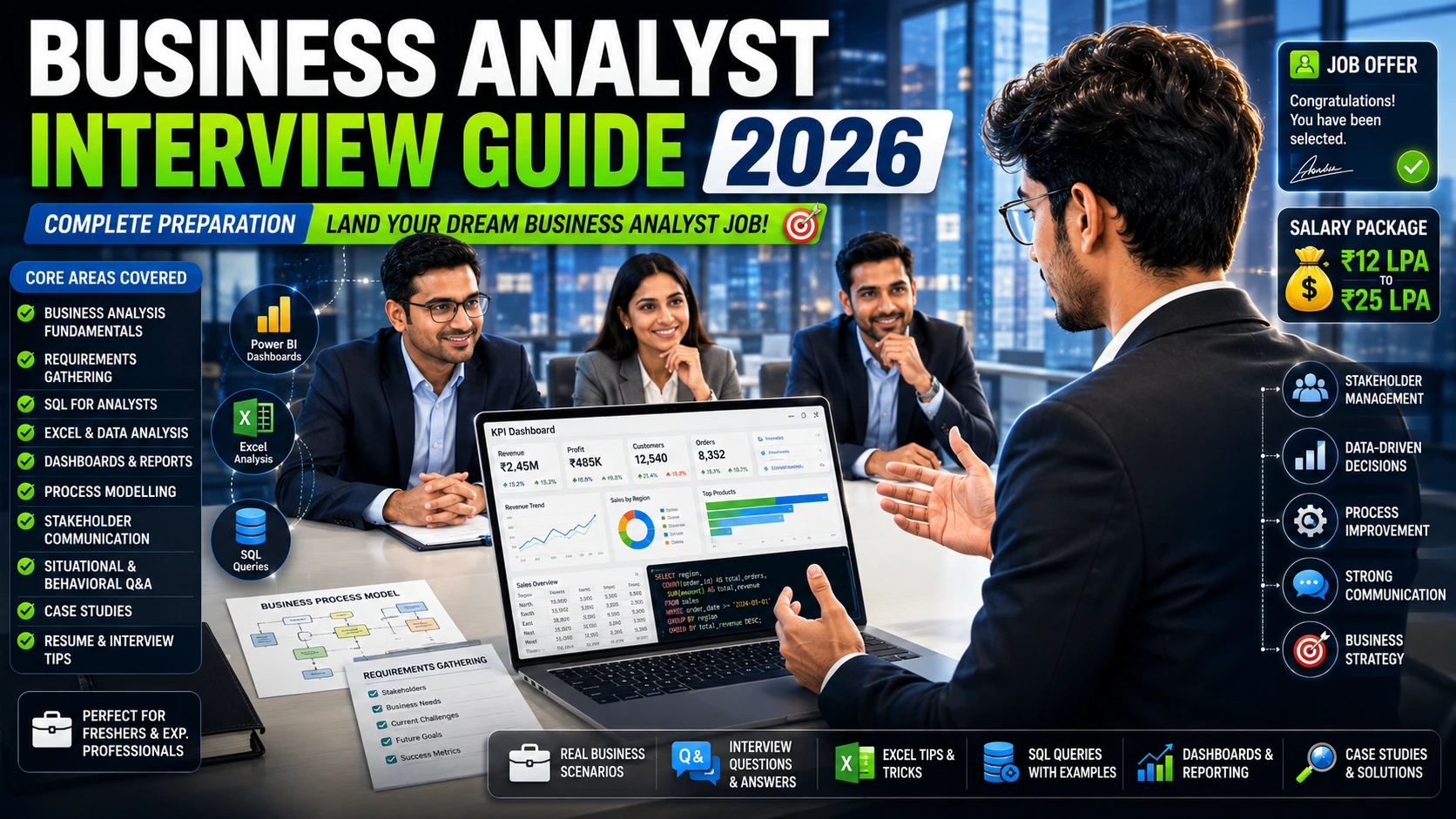
Business Analyst Interview Preparation Guide for Fresh Graduates
Business Analyst (BA) is one of the most sought-after career options for fresh graduates from engineering, commerce, management, mathematics, statistics, economics, and computer science backgrounds. Business Analysts bridge the gap between business stakeholders and technical teams by gathering requirements, analyzing business problems, and helping organizations implement effective solutions.
This complete Business Analyst Interview Preparation Guide will help fresh graduates understand the role, required skills, tools, concepts, interview strategies, and preparation roadmap needed to crack Business Analyst interviews in companies like Deloitte, Accenture, Cognizant, Capgemini, TCS, Infosys, Wipro, IBM, EY, KPMG, PwC, Amazon, and many startups.
Section 1: What Does a Business Analyst Do?
A Business Analyst acts as a bridge between business teams and technical teams. Their primary responsibility is understanding business problems, gathering requirements, documenting needs, and ensuring that solutions align with organizational objectives.
Typical Responsibilities:
- Gather business requirements from stakeholders
- Analyze existing business processes
- Identify gaps and improvement opportunities
- Create requirement documents
- Prepare reports and dashboards
- Work with developers and testers
- Support project implementation
- Monitor project outcomes and improvements
Example:
A bank wants to reduce loan approval time. The Business Analyst studies the current process, identifies delays, documents requirements, and works with developers to build a faster digital approval system.
Section 2: Skills Recruiters Expect from Freshers
1. Communication Skills
Business Analysts communicate with stakeholders, clients, managers, developers, testers, and business users. Strong communication helps gather accurate requirements and avoid misunderstandings.
Example:
Explaining a client’s requirement clearly to the development team.
2. Problem-Solving Skills
Organizations hire Business Analysts to solve business problems. Recruiters evaluate how candidates analyze issues and propose practical solutions.
Example:
Reducing customer complaints by improving support workflows.
3. Analytical Thinking
Analytical thinking helps Business Analysts identify trends, patterns, bottlenecks, and opportunities from data and business processes.
Example:
Analyzing sales data to determine why revenue decreased in a specific region.
4. Stakeholder Management
Stakeholders often have different expectations. Business Analysts must manage relationships, expectations, and communication among all parties.
Example:
Balancing business priorities and technical constraints during project discussions.
5. Documentation Skills
Business Analysts prepare requirement documents, process flows, meeting notes, and project documentation.
Example:
Creating a Business Requirements Document (BRD) for a new application.
Section 3: Business Analyst Tools You Should Know
Microsoft Excel
Excel remains one of the most important tools for Business Analysts. It helps analyze data, create reports, perform calculations, and visualize information.
Important Topics:
- VLOOKUP
- XLOOKUP
- Pivot Tables
- Conditional Formatting
- Charts and Dashboards
SQL
SQL helps Business Analysts retrieve and analyze data from databases.
Top 100 SQL Interview Questions and Answers for Freshers
Topics to Learn:
- SELECT
- WHERE
- GROUP BY
- JOINS
- Subqueries
- Aggregate Functions
Power BI
Power BI is used for creating interactive dashboards and business reports.
Tableau
Tableau helps visualize complex datasets and communicate insights effectively.
JIRA
JIRA is widely used for Agile project management, sprint tracking, issue management, and requirement tracking.
Microsoft Visio
Visio is commonly used to create process flow diagrams, business workflows, and system architecture diagrams.
Section 4: Business Analysis Concepts – Detailed Guide
Business Analysts are expected to have a strong understanding of software development processes, project management methodologies, requirement documentation, and business analysis frameworks. Recruiters frequently ask questions from these concepts during interviews because they represent the foundation of a Business Analyst’s day-to-day responsibilities.
What is Business Analysis?
Business Analysis is the process of identifying business needs, analyzing challenges, gathering requirements, and recommending solutions that deliver value to an organization. A Business Analyst acts as a bridge between business stakeholders and technical teams to ensure business goals are successfully translated into functional solutions.
Example:
If an online shopping company receives customer complaints about delayed order tracking updates, a Business Analyst would analyze the issue, gather stakeholder requirements, document improvements, and work with development teams to implement a better tracking system.
Software Development Life Cycle (SDLC)
SDLC is a structured process used to design, develop, test, deploy, and maintain software applications. Business Analysts are heavily involved during the early phases of SDLC, particularly requirement gathering and analysis.
Stages of SDLC
1. Requirement Gathering
Business Analysts interact with stakeholders, clients, managers, and end users to understand business needs and project objectives.
Example:
A bank wants customers to apply for loans online. Requirements may include user registration, loan application forms, document uploads, and status tracking.
2. Requirement Analysis
The collected requirements are analyzed for feasibility, risks, business value, cost implications, and technical constraints.
3. System Design
Architects and developers create system designs, database structures, workflows, and UI wireframes based on approved requirements.
4. Development
Developers write application code according to documented requirements.
5. Testing
QA teams validate whether the developed solution meets business requirements and acceptance criteria.
6. Deployment
The application is released to production and made available to end users.
7. Maintenance
Bug fixes, updates, performance improvements, and future enhancements are implemented after deployment.
Agile Methodology
Agile is an iterative software development methodology that emphasizes collaboration, flexibility, customer feedback, and continuous improvement.
Instead of waiting several months to deliver a complete product, Agile delivers smaller functional releases in short development cycles called sprints.
Agile Principles:
- Customer collaboration over contract negotiation
- Responding to change over following a fixed plan
- Frequent software delivery
- Continuous stakeholder feedback
- Cross-functional team collaboration
Example:
Instead of building a complete mobile banking application in one year, Agile teams may release login functionality in Sprint 1, account details in Sprint 2, fund transfers in Sprint 3, and bill payments in Sprint 4.
Scrum Framework
Scrum is one of the most widely used Agile frameworks for managing software development projects.
Product Owner
Represents business stakeholders and prioritizes requirements based on business value.
Scrum Master
Facilitates Scrum ceremonies and removes obstacles affecting the team.
Development Team
Developers, testers, designers, and analysts who build the product.
Sprint
A fixed time-boxed period (typically 2 weeks) during which a specific set of features is developed.
Daily Stand-Up
A 15-minute meeting where team members discuss:
- What was completed yesterday
- What will be done today
- Any blockers or challenges
Sprint Review
Completed features are demonstrated to stakeholders for feedback.
Sprint Retrospective
The team discusses lessons learned and identifies process improvements.
Waterfall Model
The Waterfall model follows a sequential approach where each project phase must be completed before the next phase begins.
Changes are difficult and expensive once development has started.
Best Suitable For:
- Government projects
- Construction projects
- Projects with fixed requirements
Agile vs Waterfall
| Agile | Waterfall |
|---|---|
| Flexible requirements | Fixed requirements |
| Continuous feedback | Feedback at end |
| Iterative development | Sequential development |
| Fast delivery | Slower delivery |
| Changes accepted easily | Changes are expensive |
Business Requirements Document (BRD)
A BRD is a high-level document that explains the business problem, objectives, scope, and expected outcomes of a project.
Contents of BRD:
- Business objectives
- Project scope
- Stakeholders
- Business requirements
- Success criteria
Example:
A loan approval process currently takes seven days. The business objective is to reduce approval time to one day through automation.
Functional Requirements Document (FRD)
An FRD provides detailed system functionality and technical requirements needed for implementation.
Example:
Requirement: Customers should track loan application status.
FRD Details:
- Status values: Submitted, Under Review, Approved, Rejected
- Email notifications on status changes
- Status history tracking
User Stories
User Stories capture requirements from the end-user perspective.
Format:
As a [User]
I want [Feature]
So that [Benefit]
Example:
As a customer, I want to reset my password so that I can regain access to my account.
Acceptance Criteria
Acceptance Criteria define the conditions that must be satisfied before a feature is considered complete.
Example:
User Story: Password Reset
- User receives reset email
- Link expires after 15 minutes
- Password must contain at least 8 characters
- Confirmation message displayed successfully
Use Case
A Use Case describes how a user interacts with a system to achieve a goal.
Example:
Use Case: ATM Cash Withdrawal
- Insert card
- Enter PIN
- Select withdrawal amount
- Receive cash
- Print receipt
Gap Analysis
Gap Analysis compares the current state of a business process with the desired future state.
Example:
Current State:
Manual attendance management using spreadsheets.
Future State:
Automated biometric attendance tracking system.
The identified gap includes technology implementation, employee training, and process redesign.
SWOT Analysis
SWOT Analysis helps organizations evaluate internal and external factors affecting business performance.
- S – Strengths
- W – Weaknesses
- O – Opportunities
- T – Threats
Example:
| Strengths | Weaknesses |
|---|---|
| Strong brand reputation | Limited product range |
| Opportunities | Threats |
| Growing online market | Increasing competition |
MoSCoW Prioritization Technique
MoSCoW is used to prioritize project requirements.
- Must Have – Critical requirements
- Should Have – Important but not mandatory
- Could Have – Nice-to-have features
- Won’t Have – Out of scope
Example:
Mobile Banking App:
- Must Have: Login and Account Dashboard
- Should Have: Fund Transfer
- Could Have: Dark Mode
- Won’t Have: Cryptocurrency Trading
Root Cause Analysis (RCA)
Root Cause Analysis helps identify the underlying cause of a problem rather than treating symptoms.
Example:
Problem: Customer complaints increased.
Root Cause: Delivery delays due to warehouse inventory mismatch.
Solution: Improve inventory tracking and forecasting.
RACI Matrix
RACI Matrix defines project responsibilities.
- R – Responsible
- A – Accountable
- C – Consulted
- I – Informed
This helps avoid confusion regarding ownership and accountability.
Section 5: How to Answer Common Business Analyst Interview Questions
Tell Me About Yourself
Focus on education, skills, projects, internships, and career goals.
Why Do You Want to Become a Business Analyst?
Discuss your interest in solving business problems, analyzing data, improving processes, and working with both business and technical teams.
What Is the Role of a Business Analyst?
A Business Analyst gathers requirements, analyzes business processes, communicates stakeholder needs, and helps deliver effective business solutions.
Difference Between BRD and FRD?
BRD focuses on business needs, while FRD provides detailed functional requirements for implementation.
Section 6: Case Study Questions and Sample Answers
Case Study 1: Declining Sales
Scenario:
An e-commerce company reports declining sales over three months.
Approach:
- Analyze sales data
- Review customer feedback
- Check marketing campaign performance
- Identify affected product categories
- Recommend corrective actions
Case Study 2: High Customer Complaints
Scenario:
A telecom company receives increasing customer complaints.
Approach:
- Analyze complaint categories
- Identify root causes
- Review support workflows
- Recommend process improvements
Section 7: Business Analyst Resume Tips
- Keep resume concise (1 page for freshers)
- Highlight analytical projects
- Mention SQL, Excel, Power BI, Tableau skills
- Include internships and certifications
- Use measurable achievements where possible
- Customize resume for each job application
Recommended Sections:
- Summary
- Education
- Skills
- Projects
- Internships
- Certifications
ATS-Friendly Resume Creation Guide for Freshers Using Overleaf and ChatGPT
Section 8: Interview Day Strategy
- Research the company
- Review your resume thoroughly
- Prepare project explanations
- Practice self-introduction
- Arrive early or join virtual interviews early
- Maintain positive body language
- Listen carefully before answering
- Ask thoughtful questions at the end
Section 9: Common Mistakes Freshers Make
- Not understanding the BA role properly
- Ignoring communication skills
- Weak knowledge of Agile and Scrum
- Poor SQL fundamentals
- Giving generic answers
- Unable to explain projects clearly
- Lack of business thinking
- Not preparing case study questions
Section 10: 30-Day Business Analyst Interview Preparation Plan
| Days | Focus Area |
|---|---|
| Day 1-5 | BA role, SDLC, Agile, Scrum concepts |
| Day 6-10 | Excel and SQL fundamentals |
| Day 11-15 | Power BI and Tableau basics |
| Day 16-20 | BRD, FRD, User Stories, Documentation |
| Day 21-25 | Case studies and scenario questions |
| Day 26-28 | Mock interviews and resume review |
| Day 29-30 | Final revision and confidence building |
Section 11: Frequently Asked Questions (FAQs)
Can a fresher become a Business Analyst?
Yes. Many companies hire fresh graduates for Business Analyst, Associate Business Analyst, Junior Business Analyst, and Analyst roles.
Do Business Analysts need coding skills?
Coding is not mandatory, but knowledge of SQL, Excel, and data analysis tools is highly beneficial.
Is SQL important for Business Analysts?
Yes. SQL is one of the most frequently required skills because analysts often work with databases and reports.
Which certifications help Business Analyst freshers?
- ECBA (Entry Certificate in Business Analysis)
- Google Data Analytics
- Microsoft Power BI Certification
- Agile and Scrum Certifications
Which companies hire fresher Business Analysts?
Deloitte, Accenture, Cognizant, Capgemini, TCS, Infosys, Wipro, IBM, EY, KPMG, PwC, Amazon, and many startups regularly hire Business Analyst freshers.
Final Thoughts
Business Analysis is an excellent career path for fresh graduates who enjoy problem-solving, communication, data analysis, and process improvement. By mastering business concepts, analytical tools, documentation techniques, and interview skills, you can significantly improve your chances of securing a Business Analyst role in top organizations.